Paperless line startup
In a mass-market bakery, the line leader starts every shift with a printed Production Order and a hand-filled oven startup log. Both documents determine whether the batch will meet spec, yet they sit in a plant folder until someone collects them. With iLEAN Connect, two phone photos are enough for the batch to exist in the central system at zero latency.
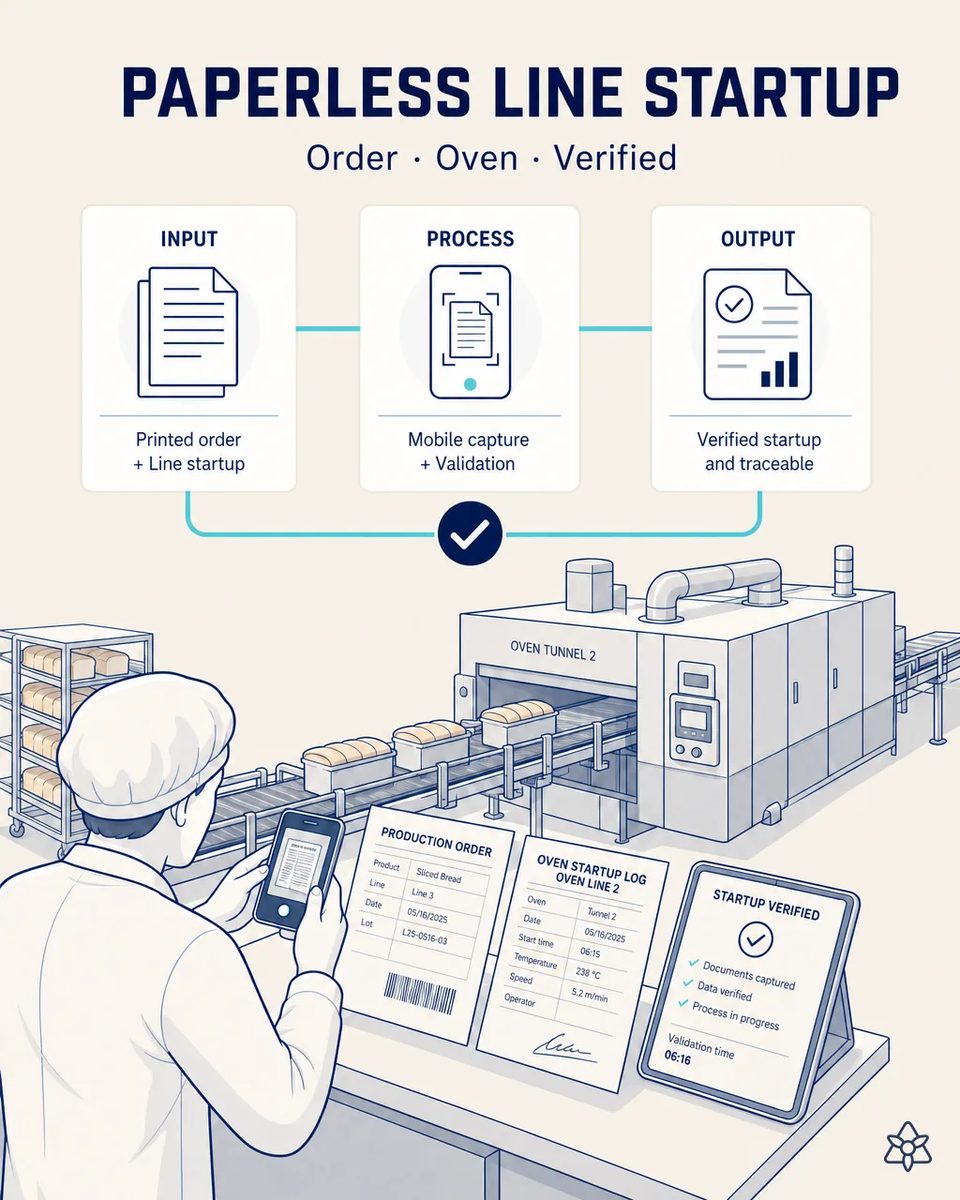
The two sheets that decide the batch sit in a folder until lunch.
The Production Order prints each morning from the ERP, and any last-minute adjustment gets scribbled on by hand. The oven startup log is handwritten by habit. Both can sit undigitized for four to eight hours — if there's an oven deviation mid-morning, nobody correlates it with the startup until the next day, and root-cause analysis arrives too late to prevent it recurring in the next batch.
- The Production Order prints from the ERP every morning, but the real batch is defined by what gets scribbled on it: a target weight nudged up, a recipe swapped, a belt speed changed because the mixer ran late.
- The oven startup log is handwritten by habit: the temperature of each tunnel oven zone, belt speed, the time the first pans went in and the line leader's initials.
- Both sit undigitized for four to eight hours. If the tunnel oven drifts mid-morning, nobody ties it to how it was started until the next day, when the folder finally reaches the office.
- By then the next batch has already been baked with the same settings, and the root-cause analysis arrives one batch too late to prevent the repeat.
Connect in photo-of-paper mode — the line leader keeps the clipboard and adds a photo.
Connect's photo-of-paper mode. The line leader photographs the order and the startup log with their phone. A grounded language model extracts format, target weight, recipe, initial zone temperature and belt speed, storing it in iLEAN's central memory with nobody transcribing anything. Zero habit change for the line leader.
Nothing on the line changes: the same order, the same log, the same pen. What changes is that the batch exists in central memory from the first minute, with the handwritten adjustments included, which is exactly where the real story of the shift is written, and where the oven deviation of mid-morning finds its explanation. That is usually why it is the first case a bakery approves.
Startup on the clipboard versus startup in central memory
| Aspect | Today, on paper | With iLEAN Connect |
|---|---|---|
| When the batch is queryable | 4-8 h later, when someone collects the folder | Zero latency, from the two photos |
| Target weight changed by hand | Lives only on the printed sheet | Extracted and tied to the batch |
| Initial oven zone temperatures | Handwritten, never charted | Stored per batch and per oven |
| Oven drift at mid-morning | Correlated the next day, if ever | Visible in the same shift |
| Belt speed and recipe at startup | Inferred from memory | Recorded exactly as started |
| The line leader's routine | — | Unchanged: two photos |
Impact estimate — to be validated with your bakery's numbers.
The block below is an estimate to be validated against your plant's actual data. We put it forward so the committee has an order of magnitude; we refine it during the assessment.
- Estimated payback 4-9 months, depending on how many line startups you run per day.
- Transcription time recovered for the line leader, who today copies the same figures into the system at the end of the shift or never does.
- From four to eight hours of latency down to zero: an oven deviation becomes visible in the same shift instead of the next morning.
- Root-cause work on a bad batch starts from the real startup settings, not from what someone remembers about them.
Estimated payback of 4 to 9 months depending on daily startup volume, plus recovered transcription time for the line leader. Estimate to validate against real plant data.
And the fair question from the production manager
“What if it misreads a zone temperature the line leader wrote by hand?” — reading fields from a document with a known structure is an anchored task, where the best models drop below 1.5% error [1]. On top of that, every temperature and speed is checked against the physical range of that oven, and the summary reaches the line tablet for a person to confirm before anything is stored as final.
[1] OpenAI paper "Why Language Models Hallucinate", 2025 — on the reliability of AI in anchored tasks.
What people ask about digitizing the bread line startup
Does the line leader have to learn an app?
No. They take two photos with the phone they already carry, one of the Production Order and one of the oven log. Everything else happens in iLEAN's central memory, with no forms to complete on screen.
Which fields come out of the oven startup log?
Format, target weight, recipe, initial temperature of each oven zone and belt speed, plus the time and initials. Those are the values that explain a batch later, when the lab or a customer asks why it came out the way it did.
What happens to the handwritten changes on the printed order?
They are the most valuable part, because they record what was actually run. They are extracted as one more field and a low-confidence value is flagged for a person to confirm.
Is it useful on lines with several startups a day?
That is where it pays fastest: every changeover from pan loaves to buns is a new startup, and each one stops waiting for the folder to be collected at the end of the shift.
Do we need to connect the ERP from day one?
No. The case runs against iLEAN's central memory from the first photo, and the push to the ERP is added once the value has been shown on the floor.
More cases from this series
- Coder without typingiLEAN stitches the date/batch coder to the ERP via API: a batch change is a tap in the ERP, not typing…
- Supplier alert in secondsiLEAN reads the flour supplier's email at zero latency, cross-references active ERP orders, and suggests…
- Voice that keeps walkingThe shift leader dictates issues while walking the floor with a headset; iLEAN structures them and…
- Lab Excel, into the ERPiLEAN Connect absorbs the lab's quality Excel and pushes it to the ERP after verification, with up to…
- Camera reads vintage panelAn external camera reads a 15-20-year-old proofing-chamber panel and digitizes its curve without…
- Delivery note photo to ERPPhotograph the delivery note and pallet labels; iLEAN extracts batch and expiry and verifies to ERP in…
Tell us how many hours your bread line startup takes to reach the system today.
We work on your plant's real data, not ours. Assessment with no commitment.
Request estimated ROI within 48h ‹ See all cases of industrial bakery See food industry