Coder without typing
The coder that prints expiry date and batch on every bag has an API, but it's isolated from the ERP: every batch change gets typed by hand on its panel, risking an error that ends in a product recall. With iLEAN, the coder is bidirectionally stitched to the ERP.
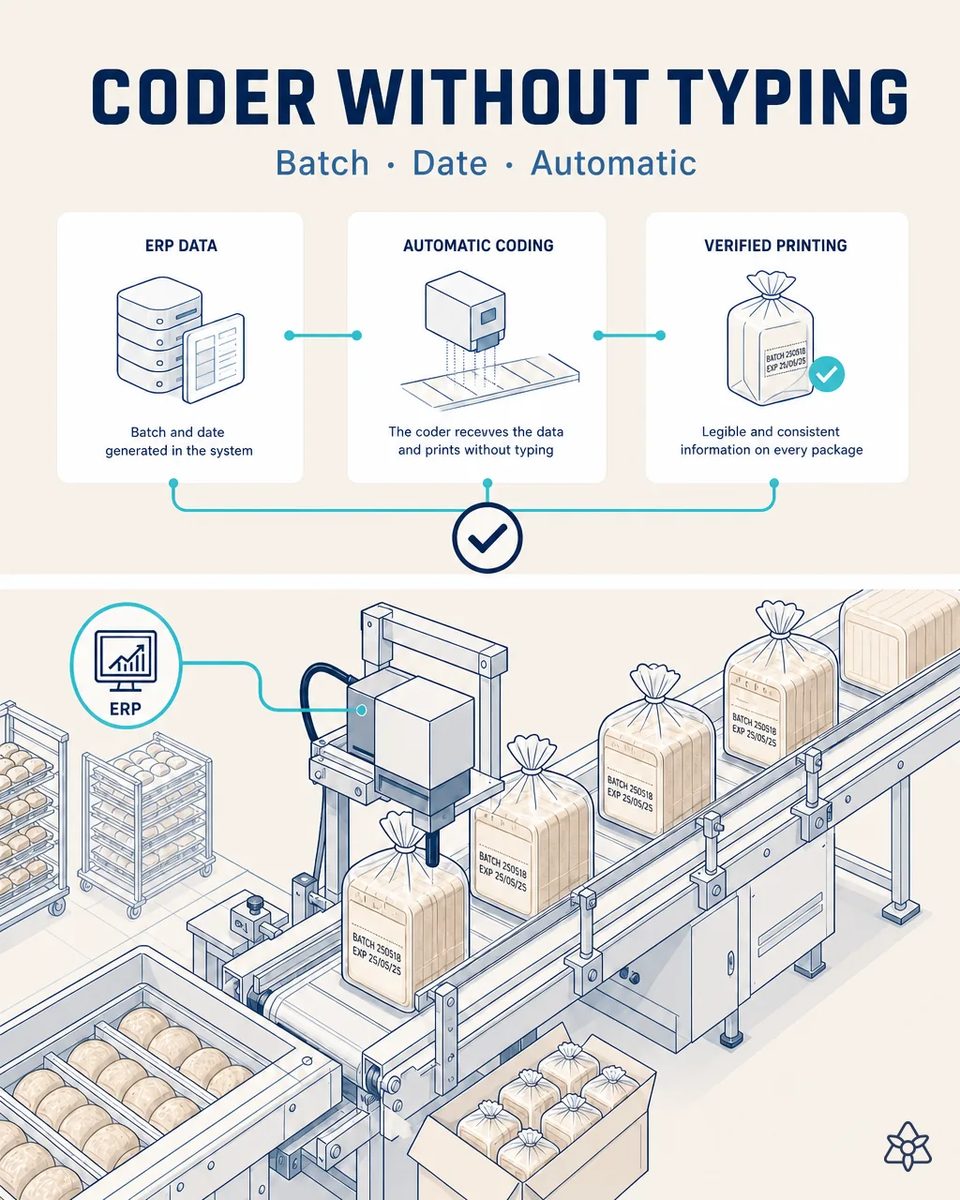
The last machine before the customer is still fed by hand.
The coder is the last physical step before the customer. One mistyped digit means part of the run ships with the wrong date or batch. Manual typing remains the standard method because integrating it properly "takes time" maintenance doesn't always have.
- The coder prints expiry date and batch on every bag of pan loaves and buns, right after the slicer and the bagger. It has an API, but it is isolated from the ERP and nobody has had time to connect it.
- Every batch change is typed by hand on its keypad, with the same data already sitting in the Production Order a few meters away. The same information is entered twice, and the second time under pressure.
- On short-shelf-life bread, one wrong digit means part of the run ships with the wrong date or batch — and that ends in a withdrawal from the shelf or a recall.
- Manual typing stays the standard because a proper integration takes time that maintenance rarely has, and the coder project keeps slipping down a list topped by urgent repairs.
Connect stitches ERP and coder through their APIs — neither one is replaced.
Connect stitches two modern systems together via API. When the ERP marks a Production Order as started, it automatically publishes date, batch and format to the coder — no manual typing in between.
The date printed on the bag stops depending on a keypad. When the ERP marks the Production Order as started, date, batch and format travel on their own, and what the coder confirms it printed comes back to the system. Marking becomes evidence instead of an assumption.
The keypad coder versus the coder stitched to the ERP
| Aspect | Today | With iLEAN Connect |
|---|---|---|
| Expiry date on the bag | Typed on the coder keypad | Published by the ERP |
| Batch change between runs | Re-entered by an operator | A tap when the order starts |
| Wrong date reaching the shelf | A periodic risk | Zero errors of human origin |
| Shelf-life rule per format | In the operator's head | Applied from the item master |
| What the coder actually printed | Assumed | Confirmed back to the system |
| Coder and ERP at the bakery | — | Both kept as they are |
Impact estimate — to be validated with your bakery's numbers.
The block below is an estimate to be validated against your plant's actual data. We put it forward so the committee has an order of magnitude; we refine it during the assessment.
- Estimated payback 3-6 months, one of the fastest in the matrix.
- A drastic cut in recall risk from a wrong date or batch, which on short-shelf-life bread is the most expensive labeling failure: product already spread across hundreds of stores and routes.
- Typing errors of human origin in coding go from periodic to zero, and with them the night calls to pull product from the shelf.
- And maintenance does not have to wait for an integration project slot: this stitching asks for no shutdown window and is set up between production runs.
Estimated payback of 3 to 6 months, drastic reduction in recall risk from wrong date/batch. Estimate to validate.
And the fair question from the production manager
“What if the date the ERP sends is wrong?” — then it is wrong in one place and visible, instead of being retyped by hand on each machine. Building the date from the start time and the format's shelf life is an anchored task, where the best models drop below 1.5% error [1], and the coder returns what it printed so any mismatch with the order raises an alert before the cases are palletized.
[1] OpenAI paper "Why Language Models Hallucinate", 2025 — on the reliability of AI in anchored tasks.
What people ask about connecting the expiry coder
Is a new coder or a new ERP part of the project?
Neither. Connect uses the API the coder already has and the start signal the ERP already gives when a Production Order begins. Both machines stay exactly as they are.
Where does the best-before date come from?
From the item master: the format's shelf life applied to the production date of the order. Nobody calculates it at the machine any more, and a change to the rule is made once, in one place, for every line.
What happens if the coder misprints or skips?
What comes back is the coder's own confirmation of what it printed. If it does not match what was sent, the line is alerted instead of the error going unnoticed until a store calls.
Does it handle several baggers on the same line?
Yes. Each coder receives the data of the order running on its own bagger, so pan loaves and buns can run side by side without crossed dates, even when their shelf lives differ.
Is this the same as a full MES project?
No. It stitches two systems that already exist through their interfaces, without asking for a new platform or a long shutdown. It fits between production runs, and the same pattern can later reach the bagger or the case labeler.
More cases from this series
- Supplier alert in secondsiLEAN reads the flour supplier's email at zero latency, cross-references active ERP orders, and suggests…
- Voice that keeps walkingThe shift leader dictates issues while walking the floor with a headset; iLEAN structures them and…
- Lab Excel, into the ERPiLEAN Connect absorbs the lab's quality Excel and pushes it to the ERP after verification, with up to…
- Camera reads vintage panelAn external camera reads a 15-20-year-old proofing-chamber panel and digitizes its curve without…
- Paperless line startupHow Connect digitizes the Production Order and oven startup log with two phone photos, at zero latency,…
- Delivery note photo to ERPPhotograph the delivery note and pallet labels; iLEAN extracts batch and expiry and verifies to ERP in…
Tell us how many times a shift someone types a date on your coder.
We work on your plant's real data, not ours. Assessment with no commitment.
Request estimated ROI within 48h ‹ See all cases of industrial bakery See food industry