Supplier alert in seconds
At 9:15am an email arrives from the flour supplier warning of a 48-hour delay. It lands in an inbox nobody watches live and gets read only once a Production Order is already scheduled with that raw material. With iLEAN Connect on silent copy of the mailbox, the alert is read, cross-referenced with the ERP, and turned into a concrete action in seconds.
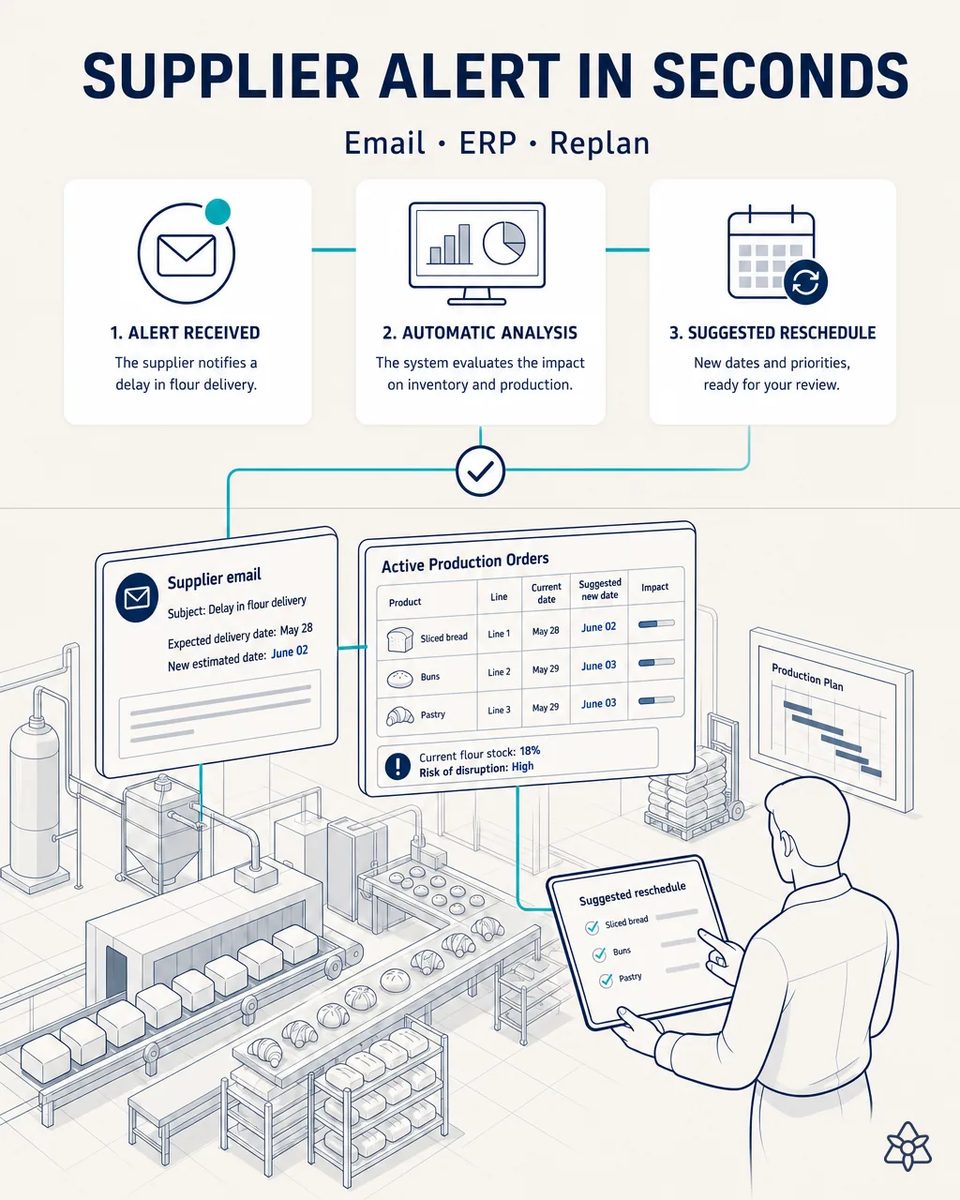
The flour delay is read after the mixer has already been scheduled for it.
Critical supplier alerts land by email or WhatsApp with specific people who can't watch their inbox in real time. By the time they're read, planning decisions are already in motion and break — and the line ends up stopped waiting for a decision.
- At 9:15am an email from the flour mill warns of a 48-hour delay. It lands in a buyer's inbox that nobody reads live, or in a WhatsApp chat on someone's personal phone.
- It gets read two or three hours later, when a Production Order using that flour is already released and the mixer is booked for it.
- By then the plan breaks in motion: the line waits for a decision, the bun run gets pushed, and the pan bread order for the morning route is short. Nobody did anything wrong; the channel simply was never designed to reach the schedule.
- On a short-shelf-life product, a batch that slips one day is not delayed stock that can be shipped later: it is a gap on the retail shelf that a competitor's bread takes over.
Connect in chaotic-sources mode — the purchasing mailbox on 24/7 silent copy.
Connect's chaotic-sources mode — a mailbox on 24/7 silent copy. A language model extracts intent (supply delay), entities (supplier, material, dates) and cross-references active Production Orders in the ERP, returning the concrete action to the right role.
Reading the alert sooner is only half the value. The other half is knowing, in the same second, which Production Orders depend on that flour and which line can absorb the change, so the planner receives a decision to approve instead of a problem to research. The right role gets it, not whichever inbox it happened to land in.
Today's flour alert versus the alert crossed with the schedule
| Aspect | Today, in the inbox | With iLEAN Connect |
|---|---|---|
| Lag before anyone acts | 2-3 hours of human delay | Seconds |
| Orders using that flour | Searched by hand in the ERP | Listed automatically |
| Rescheduling basis | What was read hours ago | Real-time stock and orders |
| Line waiting for a decision | A stopped mixer | A sequence change made in time |
| Alerts by WhatsApp | Stay on one person's phone | Captured on a business number |
| Final call on the reschedule | Whoever opened the email | The planner — iLEAN proposes |
Impact estimate — to be validated with your bakery's numbers.
The block below is an estimate to be validated against your plant's actual data. We put it forward so the committee has an order of magnitude; we refine it during the assessment.
- Estimated payback 3-7 months, depending on how often supply alerts arrive.
- The return comes from unplanned stoppages avoided when a supply change is caught before the mixer is loaded, not after, and from overtime that is no longer spent recovering a broken sequence.
- From two or three hours of human lag to seconds, so the reschedule is built on current stock and orders.
- Fewer short route orders on short-shelf-life product, which is where a late reschedule actually costs money: bread that is not baked today cannot be sold tomorrow.
Estimated payback of 3 to 7 months depending on alert frequency, from avoided unplanned stoppages due to supply misinformation. Estimate to validate.
And the fair question from the production manager
“Is iLEAN going to read our buyers' email?” — no. It sits in silent copy on a mailbox dedicated to supplier logistics and a business messaging number: it only sees what suppliers send to those operational channels. Telling a supply delay from a routine message is an anchored task, where the best models drop below 1.5% error [1], and the reschedule is always approved by a person.
[1] OpenAI paper "Why Language Models Hallucinate", 2025 — on the reliability of AI in anchored tasks.
What people ask about catching flour supplier alerts
Does it only cover flour?
No. Flour is the example because it feeds every line, but yeast, improvers, seeds and packaging film alerts are read the same way. Each material maps to the orders that consume it, so the cross-check works for any of them.
How does it decide which orders are at risk?
It extracts the material and the new dates from the message and checks the active Production Orders in the ERP that consume that material in the affected window, together with the stock on hand.
Does it change the schedule on its own?
No. It returns a suggested reschedule to the planner, who approves, edits or rejects it. The decision stays with the person accountable for the plan, and every approval is recorded with its reason.
What if the supplier only phones?
A phone call leaves nothing to read. The fix is to ask suppliers to confirm by email or message to the dedicated channel, which most already do for anything that matters. Messages to the business number are read in exactly the same way as email.
Does it help when the delay hits short-shelf-life product?
That is where it matters most: catching the alert early means moving the run to another line or flour lot before the route is short, not after the trucks have left.
More cases from this series
- Coder without typingiLEAN stitches the date/batch coder to the ERP via API: a batch change is a tap in the ERP, not typing…
- Voice that keeps walkingThe shift leader dictates issues while walking the floor with a headset; iLEAN structures them and…
- Lab Excel, into the ERPiLEAN Connect absorbs the lab's quality Excel and pushes it to the ERP after verification, with up to…
- Camera reads vintage panelAn external camera reads a 15-20-year-old proofing-chamber panel and digitizes its curve without…
- Paperless line startupHow Connect digitizes the Production Order and oven startup log with two phone photos, at zero latency,…
- Delivery note photo to ERPPhotograph the delivery note and pallet labels; iLEAN extracts batch and expiry and verifies to ERP in…
Tell us how often a supplier delay reaches your line after the mixer is already booked.
We work on your plant's real data, not ours. Assessment with no commitment.
Request estimated ROI within 48h ‹ See all cases of industrial bakery See food industry