Voice that keeps walking
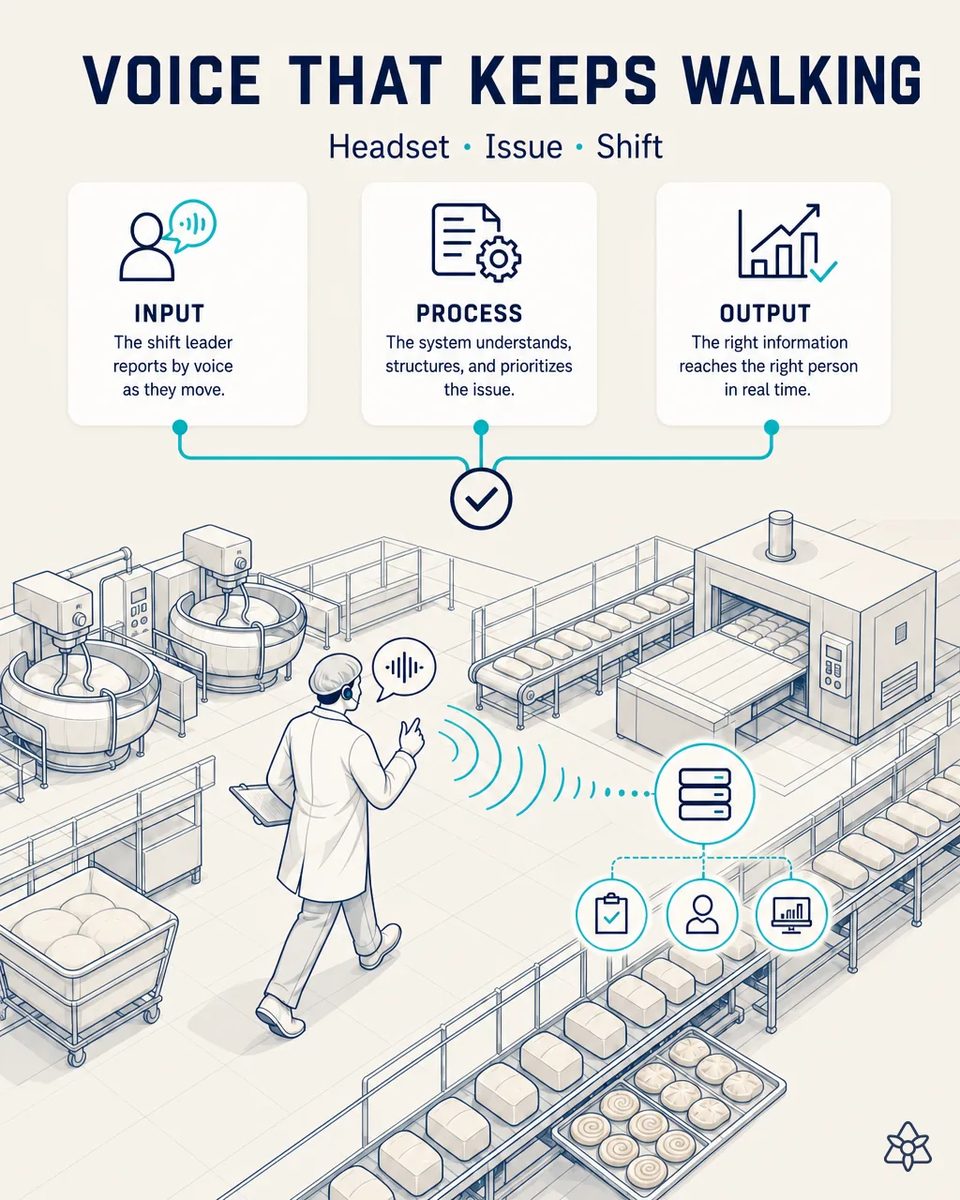
A shift leader in a sliced-bread plant spends hours walking between mixers, ovens and packaging lines, hands full. Everything they carry in their head dies at shift end because they can't stop to type. With iLEAN Connect's headset mode, they dictate while walking and the system structures it, stores it, and replies within seconds.
The first symptom of a stoppage is heard on the floor and never written down.
Critical operational knowledge — especially early symptoms of mechanical or process failure — lives in the shift leader's head and never enters the system until it becomes a stoppage or a major issue.
- The shift leader spends hours walking between mixers, the divider, the tunnel oven and the slicer and bagger lines, hands full and never near a keyboard.
- They are the first to hear a bearing on the spiral cooler, see dough sticking on the molder or notice the oven belt tracking off center.
- None of that enters the system, because recording it means stopping, walking to the office and typing. It survives as a comment at shift handover, at best, and is gone by the third shift.
- So the symptom only becomes data when it turns into a stoppage, which is the most expensive moment to find out: the line is down, the spare is not in stock and the route trucks are waiting.
Connect in headset mode with a custom wake-word — the leader talks, iLEAN structures.
Connect's voice mode with a custom wake-word. The language model structures the dictation as an issue linked to the active line and shift, with priority and destination role, and replies by voice or by push to a supervisor's tablet.
The early warning already exists: it is in the shift leader's ears and eyes. The headset only gives it a way into the system at the moment it happens, tied to the line and the shift, so maintenance sees the pattern before the line stops. It records what the leader chooses to say, nothing more.
Today's floor knowledge versus floor knowledge captured by voice
| Aspect | Today | With iLEAN Connect |
|---|---|---|
| Early failure symptom | Dies at shift end | Enters the system as it is said |
| Noise on the spiral cooler | Mentioned at handover, maybe | Logged against that asset and line |
| Who gets the warning | Whoever the leader bumps into | The destination role, with priority |
| Effort for the shift leader | Stop and type | Speak while walking |
| The line's history | In one person's memory | Cross-referenced automatically |
| Operators' conversation at the bakery | — | Never recorded |
Impact estimate — to be validated with your maintenance manager.
The block below is an estimate to be validated against your plant's actual data. We put it forward so the committee has an order of magnitude; we refine it during the assessment.
- No standalone payback: this is an enabling piece. We do not put a month range on it because its return shows up in other cases, not on its own.
- Its value is strategic: it is the precondition for catching failures early and reducing unplanned downtime, as the flagship case (12) shows.
- Knowledge that dies at shift end starts entering the system in real time and gets laid against each line's history, so a symptom heard on Monday and again on Thursday is recognized as the same one.
- The maintenance manager is the right person to size it, because the gain appears as stoppages that never happen and corrective repairs that become planned ones.
Enabling piece for early failure detection — strategic value, a precondition for reducing unplanned downtime (see case 12, flagship). Estimate to validate with the maintenance manager.
And the fair question from the production manager
“Is this a way to keep tabs on my team?” — no. iLEAN listens to the shift leader, not to the operators, and only after the wake-word they choose to say. There is no continuous recording and no location tracking. Structuring a dictated issue into line, asset and priority is an anchored task, where the best models drop below 1.5% error [1], and the leader hears back what was logged.
[1] OpenAI paper "Why Language Models Hallucinate", 2025 — on the reliability of AI in anchored tasks.
What people ask about the shift leader's headset
Does it hold up next to a running tunnel oven and mixers?
That is the design condition. The headset works alongside hearing protection and speech recognition is tuned for plant noise and bakery vocabulary such as divider, molder, proofer and cooler.
What does the shift leader hear back?
A short voice confirmation of what was logged, or a push to the supervisor's tablet when the issue needs a decision. It replies within seconds, so the leader keeps walking toward the next line without stopping at a screen.
How does it know which line the issue belongs to?
From what the leader says and from the active line and shift at that moment. If it is ambiguous, it asks back instead of guessing. The leader answers in one word and keeps walking, and the issue is stored with the right line.
Why is there no month range for the headset?
Because it saves no money by itself: it feeds early symptoms to maintenance. The return appears as stoppages avoided, which is counted in the flagship case rather than twice.
Can maintenance query what was dictated last month?
Yes. Every issue is stored with line, asset, shift and date, so a recurring noise on the same cooler shows up as a pattern, not as three separate anecdotes.
More cases from this series
- Coder without typingiLEAN stitches the date/batch coder to the ERP via API: a batch change is a tap in the ERP, not typing…
- Supplier alert in secondsiLEAN reads the flour supplier's email at zero latency, cross-references active ERP orders, and suggests…
- Lab Excel, into the ERPiLEAN Connect absorbs the lab's quality Excel and pushes it to the ERP after verification, with up to…
- Camera reads vintage panelAn external camera reads a 15-20-year-old proofing-chamber panel and digitizes its curve without…
- Paperless line startupHow Connect digitizes the Production Order and oven startup log with two phone photos, at zero latency,…
- Delivery note photo to ERPPhotograph the delivery note and pallet labels; iLEAN extracts batch and expiry and verifies to ERP in…
Tell us how many stoppages last quarter had a symptom someone noticed first.
We work on your plant's real data, not ours. Assessment with no commitment.
Request estimated ROI within 48h ‹ See all cases of industrial bakery See food industry