Delivery note photo to ERP
The truck arrives with flour, yeast or premixes. Instead of typing the delivery note line by line into the ERP, the receiving manager takes a photo. iLEAN Connect digitizes the note and the pallet labels in seconds and, after one tap, inserts it into the ERP.
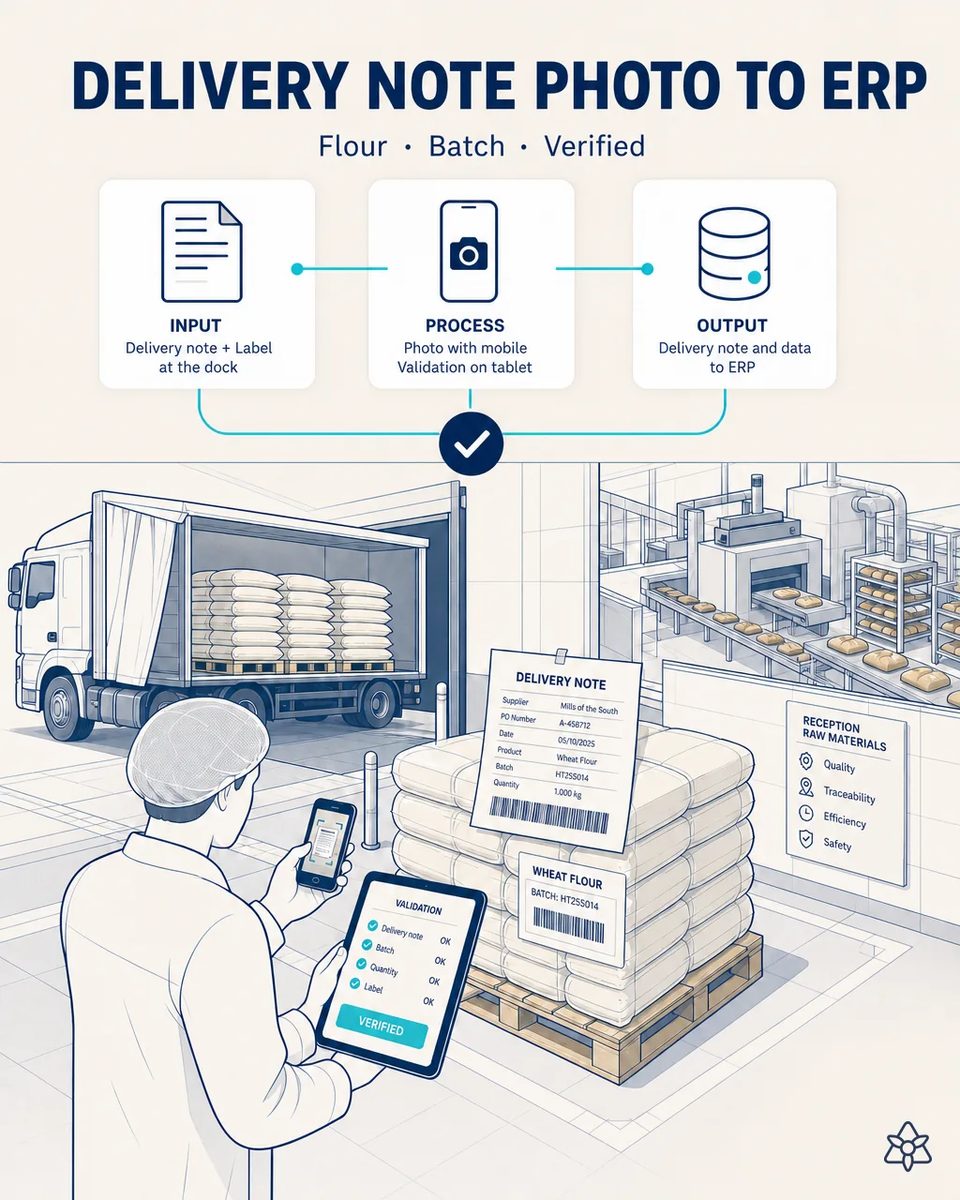
Bakery traceability starts at a keyboard on the receiving dock.
The truck waits racking up demurrage while someone types, or gets rushed and batches get logged wrong — surfacing weeks later in a quality issue that's impossible to trace precisely.
- The truck arrives with flour sacks or bulk, yeast, improvers or premixes: a delivery note with several lines and pallets labeled with batch and expiry.
- There are two ways out and both are bad. The truck waits while someone types every line, racking up demurrage, or it gets rushed and batches are logged wrong. With several trucks a morning, the dock becomes the first bottleneck of the day.
- A wrong flour batch is invisible on the day, and so is a missing expiry date on a yeast pallet. It surfaces weeks later, in a quality issue that can no longer be traced to the sacks that caused it.
- Meanwhile the receiving module needs several ERP licenses just so people can type what is already printed on paper and labels.
Connect in photo-of-paper mode — delivery note and pallet labels, no supplier change needed.
Connect's photo-of-paper mode. Vision AI reads the delivery note's layout without asking the supplier to change theirs, and reads GS1-128, QR, barcode or plain OCR on the pallet labels. Verification with one tap on an industrial tablet.
The supplier does not have to change its delivery note and the dock does not need a new scanner. One photo of the note and the labels is enough for batch and expiry to reach the ERP correctly the first time, which is the first link every later trace depends on.
Receiving by keyboard versus receiving by photo at the bakery
| Aspect | Today | With iLEAN Connect |
|---|---|---|
| Truck waiting at the dock | Around 45 minutes | A few minutes |
| Flour and yeast batch numbers | Typed under pressure | Read from note and label |
| Expiry of each pallet | Often skipped | Extracted and stored |
| Note-versus-label mismatch | Nobody checks it | Flagged before booking |
| Tracing a batch back to the mill | Broken when a typo slipped in | Complete, via photo and GS1 |
| Receiving-module ERP seats | Several active | One, the manager who verifies |
Impact estimate — to be validated with your bakery's numbers.
The block below is an estimate to be validated against your plant's actual data. We put it forward so the committee has an order of magnitude; we refine it during the assessment.
- 💰 CFO angle: the ERP receiving module typically needs several active licenses; with Connect only the manager verifies with one tap: a typical 50-70% reduction in receiving and warehouse seats.
- Estimated payback 3-8 months.
- From long truck demurrage to minutes per truck, every day of the week, including the early-morning deliveries when the dock has the fewest people.
- Hidden batch errors at receiving go to zero, so a flour complaint can be traced back to the exact sacks and the exact mill batch, instead of widening the search to a whole week of deliveries.
The ERP's receiving module typically requires several active licenses. With Connect, only the manager verifies with one tap — a typical 50-70% reduction in receiving/warehouse module licenses. Estimated payback of 3 to 8 months. Estimate to validate.
And the fair question from the production manager
“Every mill and every yeast supplier prints a different delivery note — will it read them all?” — yes, without asking any of them to change: the model extracts the layout with no template per supplier, and labels are read through GS1-128, QR or barcode, or plain OCR where none exists. It is an anchored task, where the best models drop below 1.5% error [1], and the manager confirms with one tap before the receipt is booked.
[1] OpenAI paper "Why Language Models Hallucinate", 2025 — on the reliability of AI in anchored tasks.
What people ask about booking flour receipts by photo
Does it work for bulk flour delivered to the silo?
Yes. With bulk there are no pallet labels, so the delivery note and the weighbridge ticket carry the batch, and both are read the same way before the silo is assigned.
What is read from the pallet label?
Batch and expiry above all, through GS1-128, QR or barcode where present, and through OCR when the label is plain text. Quantity is checked against the delivery note line, and a short delivery is flagged before the truck leaves.
What if the note says one batch and the label another?
The mismatch is highlighted in the summary before the manager confirms. Today nobody makes that check with a truck waiting at the dock and the driver asking to leave.
Do we need to buy scanners for the dock?
No. The phone or the industrial tablet camera is enough. If you already have scanners that work well, they can be used as well. The point is that the dock does not need new hardware to start.
Is this a sensible first case to deploy?
Yes. The result is visible from the first truck, it does not depend on other cases, and it closes the first link of traceability from mill to loaf. It is also one of the easiest to measure: minutes per truck, before and after.
More cases from this series
- Coder without typingiLEAN stitches the date/batch coder to the ERP via API: a batch change is a tap in the ERP, not typing…
- Supplier alert in secondsiLEAN reads the flour supplier's email at zero latency, cross-references active ERP orders, and suggests…
- Voice that keeps walkingThe shift leader dictates issues while walking the floor with a headset; iLEAN structures them and…
- Lab Excel, into the ERPiLEAN Connect absorbs the lab's quality Excel and pushes it to the ERP after verification, with up to…
- Camera reads vintage panelAn external camera reads a 15-20-year-old proofing-chamber panel and digitizes its curve without…
- Paperless line startupHow Connect digitizes the Production Order and oven startup log with two phone photos, at zero latency,…
Tell us how long a flour truck waits at your dock before it is booked in.
We work on your plant's real data, not ours. Assessment with no commitment.
Request estimated ROI within 48h ‹ See all cases of industrial bakery See food industry