NFC juice control with AI — premium doesn't sell with a Brix out of band.
NFC juice sells at a premium over reconstituted concentrate — and the retailer defends it with Brix, authenticity and cold-chain testing. iLEAN cross-checks the refractometer, the NIR, the pasteurizer curve and batch traceability so the deviation shows up at the line, before the truck is loaded. The person signs.
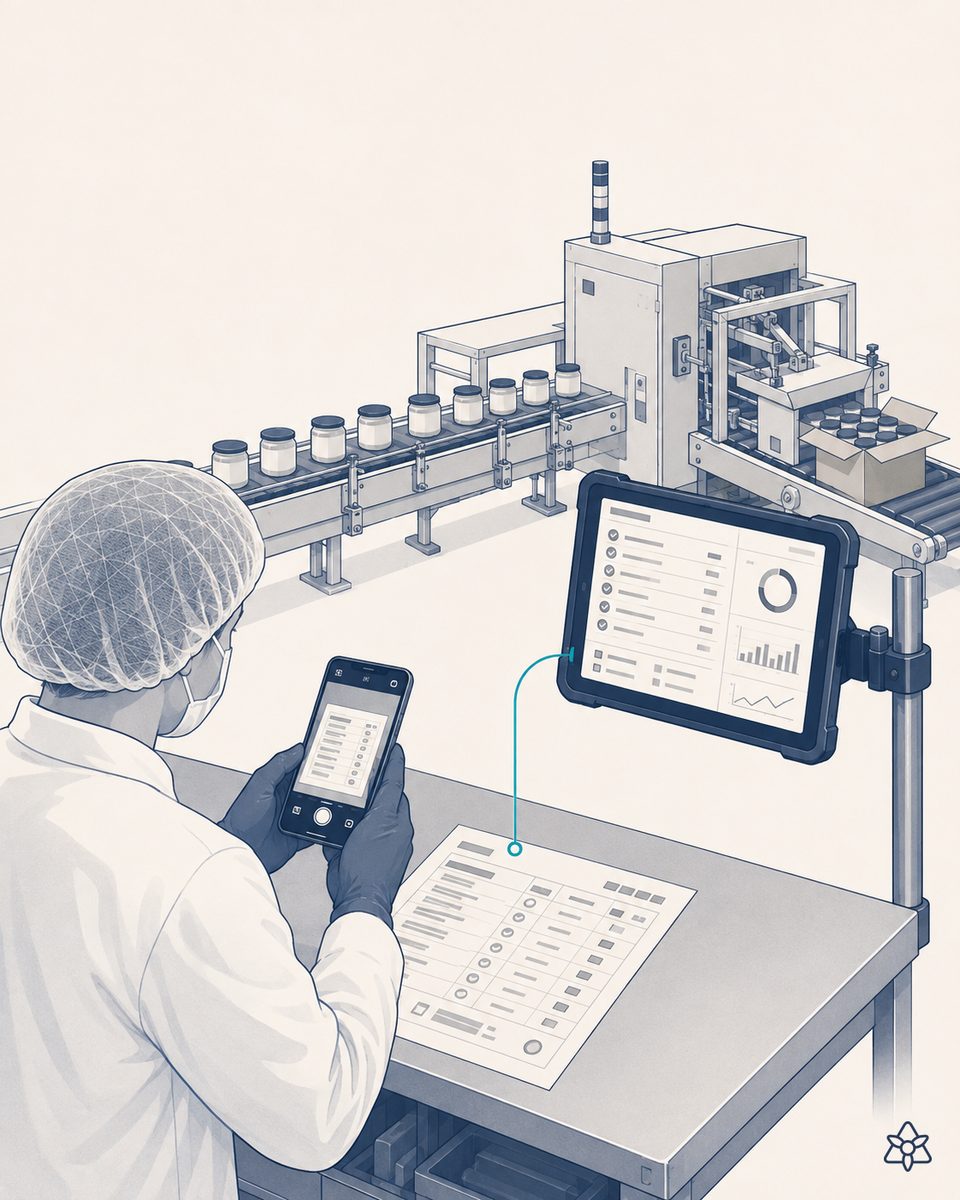
Brix, pulp, color, cold chain and authenticity — all five at once.
NFC juice competes on a category label: extracted directly from the fruit, never concentrated, never reconstituted, no added sugar (Directive 2012/12/EU, RD 781/2013). That promise turns daily operations into a cross-check of five variables that are almost never in the same place:
- Natural Brix — the measured sweetness of the batch. It changes with the season, the variety, the supplier's batch. Drift outside the retailer's contractual band and there is a penalty; drift far outside and the load is rejected.
- Pulp profile — cloud/serum ratio, visible sedimentation in the bottle. It decides the premium mouthfeel; the customer notices before the lab does.
- Color and authenticity — orange with a touch of mandarin costs less but is a different product. SGF-IRMS at an external lab decides officially; in the plant, the anomaly has to be caught before bottling.
- Cold chain — NFC lives refrigerated. One hour of refrigeration failure in distribution shortens shelf life and triggers a shelf complaint.
- Traceability — fruit batch, pasteurization curve, packaging, pallet, truck. Every retailer asks for its own evidence pack.
The quality manager carries it all in their head and across four tabs. The classic system works 99% of the time. The 1% that fails is the retailer test that rejects the load.
iLEAN doesn't add one more system — it seals the cracks between refractometer, pasteurizer, filler and ERP.
The problem isn't a lack of sensors: a modern NFC plant has an inline refractometer, a turbidimeter, NIR, pasteurizer sensors. It's that each one speaks a different protocol and nobody cross-checks all five at the same time. The operator watches the active screen and, by the time the Brix drifts, there are thousands of liters already upstream. iLEAN acts as the putty that fills those gaps, without forcing you to replace the refractometer or the pasteurizer.
Edge sees the bottle and the pulp. Connect reads the refractometer, the pasteurizer, the cooling tunnel. The agent cross-checks against recipe, season and retailer, and holds before packing. The person signs — never the other way around.
The three iLEAN pieces applied to NFC control:
- Edge — a machine-vision (CNN) terminal over the packing line: juice color in the bottle, visible sedimentation, fill level, packaging integrity, litho/label reading. If something doesn't add up (color off-pattern for the active SKU, atypical sedimentation, a label from last season), it fires the actuator in milliseconds. It works without a network: the line doesn't go blind even if the WiFi drops.
- Connect — captures the inline refractometer, the turbidimeter, the NIR, the pasteurizer curve and the cooling tunnel, truck dataloggers, and the SKU recipe whether it comes from the ERP, the MES or the Excel where R&D updates the variety blend each season. It also captures what arrives from outside (a band change from the US retailer, an alert from the fruit supplier about a change in size grade or growing zone) at second zero.
- Agent — cross-checks Brix, pulp, color, pasteurization curve, fruit batch, cold chain and the retailer's contractual band. If the drift points to low Brix at a season changeover or to an authenticity anomaly, it doesn't send an email at 10 pm: it holds the batch and alerts the quality lead. The person validates and signs; the line doesn't restart on its own. And it prepares the per-batch dossier for the retailer and for IFS/BRC/FSSC audits, automatically.
Classic NFC plant vs. NFC plant cross-checked with iLEAN
| Aspect | Classic control (sensors + checklist) | With iLEAN Edge + Connect + Agent |
|---|---|---|
| Brix and pulp reading | Refractometer + turbidimeter checked once per shift | Continuous data, cross-checked with recipe and season |
| Detecting out-of-band Brix | When the operator notices or in retailer testing | Automatic hold before packing |
| Authenticity (blend with concentrate or variety) | SGF-IRMS at an external lab, days later | Anomaly detected in line + targeted sampling |
| Cold chain | Datalogger reviewed on arrival at the customer | Continuous tracking, alert before the limit |
| SKU changeover (orange → blend) | Paper checklist, shift lead's signature | Recipe + dosing + label verified at once |
| IFS/BRC/retailer audit | Rebuilt by hand, weeks | Per-batch dossier, automatic, with curves |
Impact estimate for your plant — to be validated with your numbers.
The block below is an estimate to be validated with the specific data of your plant. We put it forward so the committee has an order of magnitude; we refine it during the diagnostic.
- NFC plant with 1-3 packing lines, a blend of orange, mandarin and apple, exporting to the EU and other markets with premium retail accounts.
- Edge + Connect pilot on one line (refractometer and turbidimeter already installed + camera over the bottle + integration with the pasteurizer, the cooling tunnel and the ERP). First value expected within a few weeks: holds on batches with out-of-band Brix and an agent that prepares the spec sheet for the retailer instantly.
- Indicative payback between 4 and 9 months, depending on how often retailer penalties hit for Brix or cold chain and on the quality hours spent rebuilding traceability.
- The hard levers are: preventing shipments rejected in retailer testing, cutting penalties for out-of-band Brix ≥ 30%, reducing cold-chain waste in distribution, and cutting the time spent preparing spec sheets and audit dossiers.
And the quality director's reasonable doubt
“What if the AI gives me a false authenticity positive and blocks a good batch?” — the system doesn't block: it holds and proposes targeted SGF sampling. The person validates and signs. Hallucination is a problem of free generation; in anchored tasks (reading the refractometer, the NIR and bottle color, and comparing against the batch's historical pattern), the best models brought error below 1.5% [1]. And the three-ring architecture guarantees that critical OT operations are only ever executed by a person.
[1] OpenAI paper “Why Language Models Hallucinate”, 2025 — on the reliability of AI in anchored tasks.
How it connects with other solutions in the beverages and juices cluster: flash juice pasteurization · plant-based beverage control · bulk wine control.
What people ask about AI control for NFC juice
What defines an NFC juice and why is it controlled differently?
NFC = Not From Concentrate: juice extracted directly from the fruit, pasteurized and packed without ever being concentrated and reconstituted with water. Directive 2012/12/EU (transposed into Spanish law as RD 781/2013) distinguishes it from juice made from concentrate and has banned added sugars in fruit juice since 2013. The category competes at a premium price against reconstituted concentrate — which is why authenticity, natural Brix, pulp profile and the cold chain are controlled with extra rigor.
How are Brix and pulp measured in line without stopping production?
With inline refractometers (Brix, soluble solids), turbidimeters (fine pulp, cloud/serum ratio), NIR spectroscopy for the full profile, and Edge with machine vision (CNN) over the bottle itself for color and visible sedimentation. Connect reads every sensor every few seconds; the agent cross-checks against the SKU recipe (freshly squeezed orange juice vs. a blend with mandarin) and the incoming fruit batch. If the Brix drifts outside the retailer's contractual band, it holds the batch before packing.
How is the cold chain of an NFC juice secured from plant to shelf?
NFC juice usually ships refrigerated, with a shelf life of several weeks versus months for UHT juice from concentrate. The cold chain starts at the post-pasteurization buffer tank and ends on the supermarket shelf. iLEAN Connect captures sensors from the tank, the pasteurizer, the cooling tunnel, the pallet cold room, the truck datalogger and, where a retailer portal is available, the shelf reading. A prolonged temperature deviation is cross-checked against the pasteurization curve and the packaging batch, and the call — hold or expedited shipping — is made based on remaining shelf life.
What authenticity problems do NFC juices have and how are they detected?
The typical risks: undeclared addition of juice from concentrate to cut cost (fraud), blending with a cheaper citrus variety (mandarin in orange), pulp added or removed without declaring it. The gold-standard tests are SGF-IRMS (isotopes) at an external lab, but fast in-plant detection comes from cross-checking NIR, cloud/serum ratio and color against the fruit supplier's historical pattern. An anomaly triggers SGF sampling and a hold. The agent prepares the file for the customer who asks — not out of distrust, but so the retailer receives the proof before requesting it.
How much does it cost to implement AI control in an NFC juice plant?
The order of magnitude of an Edge + Connect pilot on an NFC juice line is close to that of any pilot in a beverage food plant: an initial investment covering refractometer/turbidimeter/NIR where missing + cameras + integration with the pasteurizer, the filler and the ERP, plus an annual license. The reasonable payback presented to the committee runs several months — the hard lever is preventing shipments rejected in retailer testing, cutting penalties for out-of-band Brix and reducing cold-chain near-misses in distribution. We ask for your plant's data and send you the estimated ROI in 48h.
More cases in food
- Milk fat control with AI — the lab knows, the line doesn't, and the batch is already made.iLEAN reads the MilkoScan/Foss, cross-references recipe and whole/skim balance and proposes the inline…
- MAP packaging with AI — a bad mix or a micro-leak should not be discovered when the customer returns the product.iLEAN measures CO2/N2/O2 in line, detects MAP tray leaks and extends shelf life without pulling…
- Multihead weigher with AI — so you know which head is giving away grams.iLEAN detects per-head calibration drift, overfill and jams on multihead weighers — before the bag, not…
- Automated nutrition labeling with AI — changing one ingredient shouldn't mean reviewing hundreds of labels.iLEAN computes the nutrition panel from the recipe, generates the Nutri-Score and mass-updates every…
- Olive oil mill traceability with AI — segregating PDO and organic without slowing the yard down at the height of the harvest.iLEAN captures every weighbridge intake by photo, follows the batch to the tank and generates the…
- Predictive maintenance of HTST pasteurizers — the unplanned stop costs entire shifts.iLEAN combines vibration, differential pressure and temperature to predict HTST heat-exchanger failures…
Tell us your case and in 48h we'll send you the estimated ROI of this AI project for your NFC juice plant.
We work on your plant's real data, not ours. Diagnostic with no commitment.
Request estimated ROI in 48h See food industry