Plant-based beverage control with AI — a cross-contact allergen gives no warning; it shows up in RASFF.
A multi-SKU plant-based beverage line (oat, almond, soy, rice, coconut) crosses at least five allergens under EU Regulation 1169/2011 — and calcium and vitamin fortification leaves little margin. iLEAN cross-checks recipe, CIP report and declaration before the aseptic stage, and holds the batch when something does not add up. The person signs.
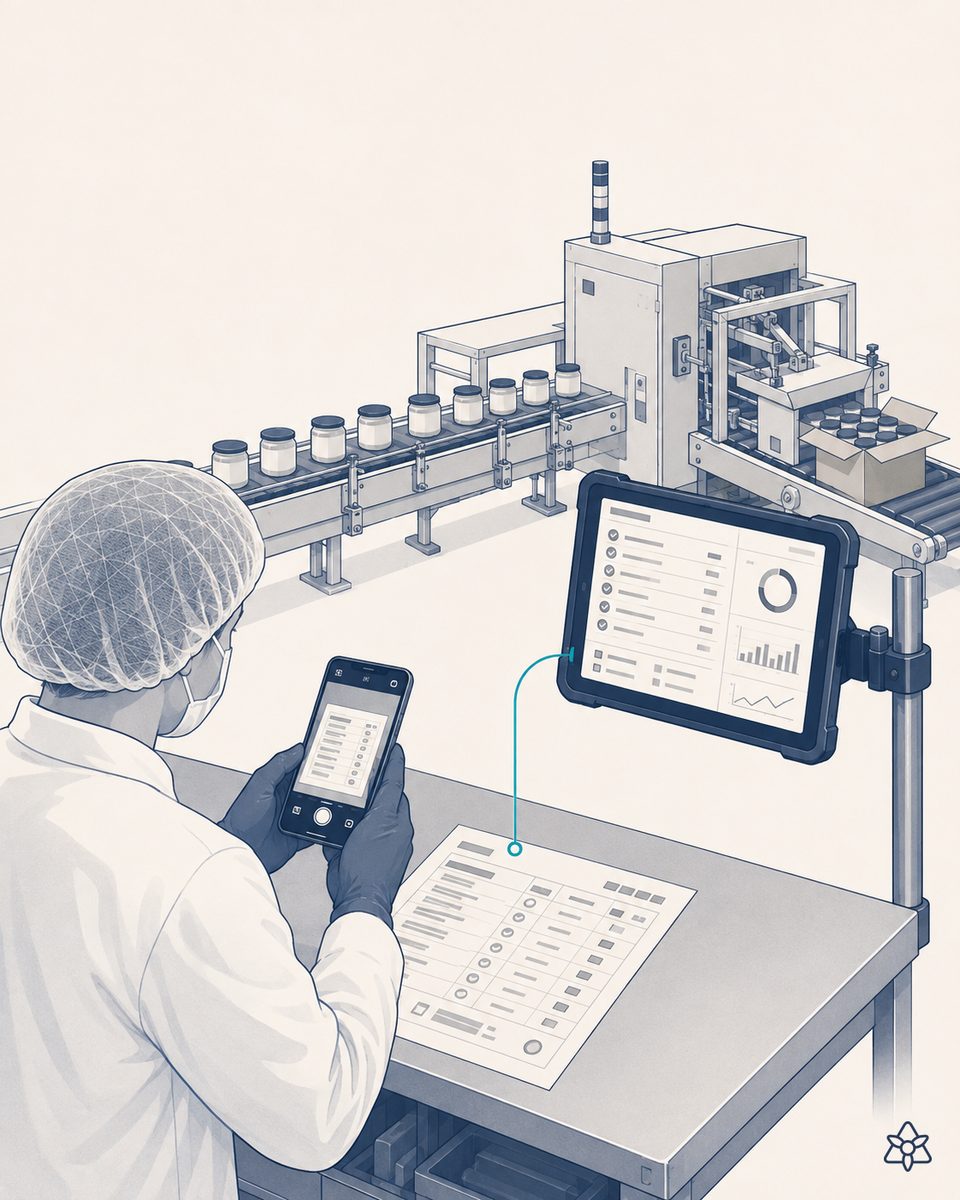
A line shared across five allergens does not forgive a half-done CIP.
The typical plant-based beverage plant has grown by stacking SKUs on the same infrastructure: one UHT, one aseptic filler, one bottling line. That is good lean — but it accumulates risk:
- Interim CIP between oat → almond — switching from a gluten-containing cereal (non-certified oat) or tree nuts, depending on the recipe; a short rinse leaves traces.
- Variable fortification — calcium, vitamin D and vitamin B12 at different dosing rates per SKU, on pumps that are sometimes shared.
- A small special-recipe batch — the operator loads the previous SKU's recipe out of habit; the label declares one thing, the tank carries another.
- An aseptic stage that forgives nothing — if the CIP is incomplete, the microbiological problem shows up late, in the market.
The quality manager knows it, which is why there are checklists, the CIP PLC and sampling. It works 99% of the time — and the remaining 1% is what ends up in AESAN, RASFF or with a retailer pulling the batch. Every allergen recall is hard cost (product off the shelf, reverse transport, destruction) plus brand cost, which weighs more in the medium term.
iLEAN does not add a fourth UHT — it seals the cracks between the recipe, the CIP and the label.
The problem is not a lack of control: it is information in islands (recipe in the ERP, CIP in the PLC, fortification dosing in Excel, label in yet another system) that nobody cross-checks in the very second of the SKU changeover. iLEAN acts as putty between the systems you already have, without asking you to change the UHT, the aseptic unit or the bottling line.
Connect reads recipe, CIP and fortification. Edge sees the label before palletizing. The agent checks against the allergen regulation and, if something does not add up, holds the batch. The person signs — never the other way around.
The iLEAN pieces applied to plant-based beverage control:
- Connect — captures the CIP report from the PLC (cycle, temperature, conductivity, rinse duration), the actual fortification dosing, the recipes from the ERP/MES and the production orders. It also captures what arrives from outside (a calcium supplier change by email, a retailer audit alert by WhatsApp) at second zero.
- Agents — cross-check the data at every SKU changeover: did the CIP cover the allergens to be removed? Is fortification in range for the declared SKU? Does the label loaded in the printer match the actual recipe? If something does not add up, they hold the batch before the aseptic stage and alert the quality manager. They do not send an email at 10 p.m. — they block the startup and reach the manager on their live channel.
- Edge — a vision terminal (CNN) over the packing line. It reads the printed label (allergen list, declared fortification, batch date) and checks it against the batch's actual recipe and the CIP dossier. Works without a network: if the plant loses WiFi, Edge keeps reading and holding.
Classic control vs. cross-checked control with iLEAN
| Aspect | Checklist + PLC + sampling | With iLEAN Connect + Agents + Edge |
|---|---|---|
| CIP between two plant-based SKUs | Cycle launched, validated after the fact | Validated against the next SKU's recipe, before startup |
| Fortification | Dosing read on a sheet | Read in line, checked against the declared recipe |
| Label vs. recipe | Visual check at SKU changeover | Edge reads 100% before palletizing |
| Small special batch | Risk of loading the previous recipe | The agent confirms recipe vs. order and vs. label |
| Operation without network | n/a | Edge keeps operating with its own light |
| File for the IFS/BRC auditor | Manual reconstruction | Per-batch dossier, automatic |
Impact estimate for your plant — to be validated with your numbers.
The block below is an estimate to be validated with the specific data of your plant. We put it forward so the committee has an order of magnitude; we refine it during the diagnostic.
- Plant with 1-2 UHT + aseptic lines shared across oat, almond and soy (at least), fortification with calcium + vitamins, exporting to several markets.
- Connect + Agents pilot on CIP/recipes + Edge over the packing line. First value expected within a few weeks: the first block of an SKU changeover with an insufficient CIP or a swapped label.
- Indicative payback between 4 and 9 months. Reduction of recalls/incidents from undeclared allergens ≥30% (sub-sector inferred estimate, to be validated).
- The hard lever is a single avoided allergen recall: product recovered from the shelf, reverse transport, destruction, brand damage. One recall pays for the pilot.
And the quality manager's reasonable doubt
“What if the AI gets it wrong reading a label or a CIP report?” — hallucination is a problem of free generation, not of anchored tasks. In tasks where the AI merely recontextualizes a piece of data from one system to another (reading the label, reading the CIP report, comparing against the recipe), the best models brought error below 1.5% [1]. And even so, what is critical is never decided alone: iLEAN holds the batch and the person signs. The three safety rings are there precisely for this.
[1] OpenAI paper “Why Language Models Hallucinate”, 2025 — on the reliability of AI in anchored tasks.
Related cluster: allergen labeling in cheese dairies, yogurt fermentation, nutrition labeling.
What people ask about plant-based beverage control
Which allergens are critical on a multi-SKU plant-based beverage line?
Plant-based beverages that share a line (oat, almond, soy, rice, coconut) touch at least five of the 14 allergens in EU Regulation 1169/2011: gluten (oat not certified gluten-free), tree nuts (almond, hazelnut, cashew), soy, dairy (if the line is shared with milk drinks or mixed plant-based creams) and peanut in some premium formulations. Cross-contact between tanks, heat exchangers and the aseptic stage is the critical point — all the more in plants that share UHT and bottling across several plant-based SKUs.
How do you make sure the interim cleaning between two plant-based SKUs was complete?
By cross-checking three sources: the CIP report from the PLC (which cycle ran, temperature, conductivity, rinse time), the production order (which SKU ends, which SKU starts, which allergen changes) and the rapid test (ATP or final conductivity). iLEAN Connect captures all three, the agent compares them against the declared recipe of the next SKU and, if the CIP does not cover the allergens to be removed (for example, going from almond to a nut-free oat), it blocks the startup of the next batch. The person signs.
How does iLEAN control calcium, vitamin and mineral fortification?
Fortification is a sensitive point: too little delivers less than declared (a regulatory and labeling problem), too much burns cost and, for some minerals, exceeds limits. iLEAN Connect reads the actual dosing (scales, peristaltic pumps) at second zero and the agent cross-checks it against the declared recipe and the live batch volume. If dosing drifts out of range, it warns the operator before the tank is closed. The later lab results stay linked to the batch in the dossier — there is nothing to rebuild.
Does it work if the line has an old UHT/aseptic unit with its own SCADA?
Yes. iLEAN Connect connects to the UHT/aseptic SCADA at three levels: direct integration if it has OPC-UA, reading the SCADA's local PC if it is an isolated proprietary system, or a photo of the panel from the app if there is only an analog panel. It does not force you to change the UHT, the aseptic unit or the bottling line. Edge is added on the packing line to verify label vs. recipe (declared allergens, fortification, batch date) before palletizing.
How much does it cost to implement AI control on a plant-based beverage line?
The order of magnitude of an Edge + Connect pilot on a multi-SKU plant-based beverage line is comparable to other food pilots: terminals + cameras + SCADA/PLC integration + ERP/MES integration, plus the annual license. A reasonable payback is several months; the hard lever is a single avoided recall for an undeclared allergen (which usually covers the pilot on its own) plus less scrap from insufficient CIP and better OEE. We ask for your line's data and send you the estimated ROI in 48h.
More cases in food
- PDO wine labeling with AI — a misplaced control seal is not a fine, it is a disqualified vintage.How iLEAN cross-checks the regulatory council seal, the bottled batch and the sulfite declaration to…
- Pet food extrusion with AI — the SKU changeover is the most expensive moment of the day. And it hinges on an Excel file the operator never read.iLEAN cross-checks kibble vision, moisture, density and recipe to stabilize pet food extrusion — less…
- Industrial artificial intelligence in rawhide chew treat factoriesTwelve real industrial AI cases in rawhide chew treat plants: paperless capture, in-line vision and an…
- Industrial AI in precooked frozen food factoriesTwelve real industrial AI cases in precooked frozen food factories: paperless capture, in-line vision…
- Premium seafood — the value is in the cold chain, and in being able to prove it.Documented iLEAN cases in premium seafood: cold chain, origin traceability, MSC certification and…
- Individual traceability for almadraba bluefin tuna — one lost tag is one fish out of the market.How iLEAN captures the ICCAT tag, GBYP and eBCD piece by piece for almadraba bluefin tuna with vision in…
Tell us your case and in 48h we'll send you the estimated ROI of this AI project for your plant-based beverage line.
We work on your plant's real data, not ours. Diagnostic with no commitment.
Request estimated ROI in 48h See food industry