Grape must traceability with AI — from vineyard to tank without rebuilding anything by hand.
Tracing a must means tying together what happened in the plot, on the weighbridge, in the press and in the tank — data that today lives in four different systems and a logbook. iLEAN captures it at second zero with Connect and weaves it into a live per-must dossier with Agents. The winemaker decides and signs; the system just takes away the nightmare of rebuilding the chain.
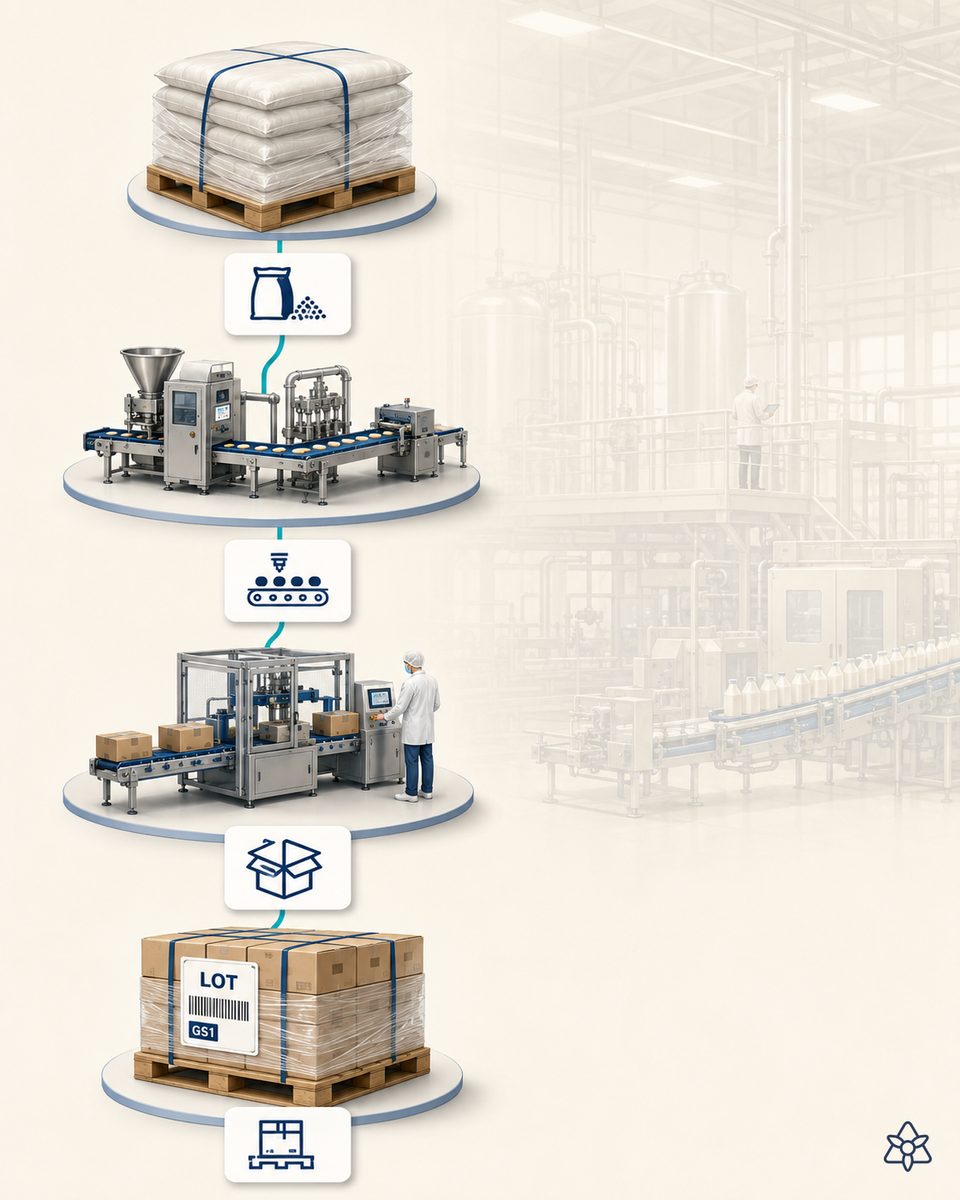
Must traceability breaks between the weighbridge and the tank, and nobody notices until months later.
During harvest, the pace rules: trucks on the weighbridge, the destemmer starting up, the press finishing a cycle, a tank waiting for the next transfer. The winemaker has to decide in minutes what goes where, and traceability is left behind in notes:
- Plot delivery note — on paper or in the grower's app, with variety, plot and probable alcohol.
- Weighbridge ticket — weight, plate number and, if you are lucky, the refractometer reading.
- Press report — pressing program, yield, free-run must vs. press must.
- Tank report — what went in, what was sulfited, what was transferred out later.
Four systems or four logbooks. The day the regulatory council asks for the traceability of tank 12 on a specific date, or a customer exports to a market that demands the vineyard of origin, somebody spends weeks rebuilding the chain — and sometimes it cannot be rebuilt in full. The tank gets declassified “for insufficient traceability”, not for any real defect. That is hard cost in lost capacity.
iLEAN does not ask you to change your weighbridge or your press — it captures what is already there and weaves it by must.
The problem is not a lack of information, it is information on islands that nobody joins up while the harvest is still running. iLEAN acts as putty between weighbridge, destemming, press and tank, without asking you to change a machine or your winery ERP.
Connect captures the delivery note, the weighbridge, the press panel and the cellar hand's voice. The agent weaves the live per-must dossier: every plot in every tank, at every moment. The person signs — never the other way round.
The iLEAN pieces applied to must traceability:
- Connect — captures at three levels: if the weighbridge has a modern panel, integration; if it has an old local PC, log reading; if it is analog, a photo of the weight and the ticket from the app. Same with the press and the transfer panels. The cellar hand's app lets them dictate by voice (“tank 12 receiving must from plot A-17, 4,300 kg, probable alcohol 13.2”) and that enters as structured data.
- Agents — one agent per winery keeps the live mass balance: every time something goes into or out of a tank, it recalculates the exact composition (plot, variety, free-run/press must, sulfiting). If a transfer order would blend musts that the PDO rules do not authorize, the agent blocks it before the valve is opened and warns the winemaker. If the council asks for the traceability of any tank on any date, it generates the dossier in minutes.
- Edge (optional) — for wineries with optical grape sorting or visual control of free-run vs. press must, Edge adds inline vision over the intake belt or the press outlet, feeding the same dossier.
Manual traceability vs. live traceability with iLEAN
| Aspect | Logbook + spreadsheet + winery ERP | With iLEAN Connect + Agents |
|---|---|---|
| Plot delivery note | Paper or a standalone grower app | Captured at second zero, tied to the weighbridge ticket |
| Blends in the tank | Notes in the logbook, easy to forget | Live mass balance per tank |
| Sulfiting and corrections | Lab sheet, copied into the ERP | Built into the must dossier |
| Unauthorized transfer order | Caught afterwards, if at all | The agent blocks it before the valve is opened |
| Query from the regulatory council | Manual reconstruction, weeks | Per-tank/per-must dossier in minutes |
| The veteran who retires | Leaves with half the knowledge | The pattern stays captured and repeatable |
Impact estimate for your plant — to be validated with your numbers.
The block below is an estimate to be validated with the specific data of your winery. We put it forward so the committee has an order of magnitude; we refine it during the diagnostic.
- Mid-sized winery (cooperative or estate), machine harvesting from several plots, pneumatic presses, several dozen tanks.
- Connect + Agents pilot across one harvest (capturing weighbridge + press + transfer panels + the cellar hand's app, with a live mass balance). First value expected within a few weeks — the first per-must dossier the regulatory council asks for is delivered in minutes instead of weeks.
- Indicative payback between 4 and 9 months, depending on the winery's volume and how often the council queries or audits. Response time to a documentary audit cut by ≥30%.
- The hard lever is one single tank saved from declassification for insufficient traceability in a vintage, plus the winemaker hours freed from manual reconstruction.
And the winemaker's reasonable doubt
“What if the AI gets a weighbridge reading wrong and it slips into the dossier?” — the reliability of AI in anchored tasks (reading a ticket, reading a weight, reading a variety) is not the reliability of free generation. In recontextualization tasks, the best models brought error below 1.5% [1]. And even so, every transfer and every tank closing is signed by a person. iLEAN proposes and warns; the winemaker decides. The three safety rings exist for exactly this.
[1] OpenAI paper “Why Language Models Hallucinate”, 2025 — on the reliability of AI in anchored tasks.
Related wine cluster: PDO wine labeling, wine vintage traceability.
What people ask about grape must traceability
What has to be traced in a grape must for a PDO audit?
Must traceability covers the whole chain from vineyard to tank: plot of origin (cadastral reference, variety, harvest date), intake (plate number, gross weight/tare, probable alcohol, sanitary condition), destemming and crushing, pressing (pressure curve, yield), sulfiting and corrections, and destination tank with its blends and flows. Every regulatory council requires you to be able to rebuild that chain per must and per tank on request. Today it is done by hand with several spreadsheets and a cellar logbook — which works until the day it does not.
How do you stop a tank from blending musts the PDO rules do not allow?
By cross-checking, in real time, the transfer orders (which tank receives which must) against the council's declaration (which blends are authorized for that PDO) and against each tank's history (what it held before). iLEAN Connect captures the cellar hand's spoken orders through the earpiece, the flows from the transfer panel and the plot delivery notes, and an agent blocks the transfer if the blend is not authorized — before the valve is opened, not after. The person signs.
Is iLEAN any use if the winery is small and has no modern MES or SCADA?
Yes — that is exactly the most common situation, and the one iLEAN is designed to solve. iLEAN Connect captures data at three levels: if the weighbridge or the press has a modern panel, direct integration; if they have an old, isolated local computer, Connect reads from that local computer; if all they have is an analog panel, the cellar hand photographs it from the app and the reading enters as structured data. It does not force you to change your weighbridge, your press or your tanks. It fills the gaps your winery ERP does not fill.
What happens to traceability when a tank is racked several times during fermentation?
That is where classic traceability breaks down. Every transfer is noted in the logbook, but blends, drawing off and topping up make the real content of a tank on a given date nearly impossible to reconstruct weeks later. iLEAN Agents maintains a live mass balance per tank — every time must or wine goes in or out, the agent updates the composition and stores the snapshot. If the council asks for the traceability of tank 12 on a specific date, the dossier comes out in minutes, not weeks.
What does it cost to digitize must traceability in a mid-sized winery?
A typical Connect + Agents pilot for must traceability in a mid-sized winery is cheaper than an Edge pilot — because almost all the value lies in capturing what already exists (weighbridge, press, panels, the cellar hand's voice) and orchestrating it, with no new vision hardware. A reasonable payback is a matter of several months, and the hard lever is the avoided cost of a challenged PDO audit or of a tank you have to declassify because its traceability cannot be reconstructed. We ask for your winery's data and send you the estimated ROI in 48h.
More cases in food
- Zero labeling recalls — the iLEAN agentic system.Real iLEAN case: how a coordinated AI system makes sure every package carries exactly what it should,…
- Glass and metal detection in packing with AI — one foreign body on the shelf is a mass recall.iLEAN combines X-ray, metal detection and AI vision to reject contaminants on the packing line without…
- Industrial AI for gourmet croquette and appetizer plantsReal industrial AI cases at gourmet croquette and appetizer plants: paperless capture, in-line vision…
- Iberian pork — the seal is worth exactly what the traceability behind it is worth.Documented iLEAN cases in Iberian cured meats: RD 4/2014 seal traceability, breed grading, PDO…
- Bellota/cebo grading in the montanera — the vet's eye, amplified, with no animal slipping through.iLEAN Vision grades Iberian pigs as bellota, cebo de campo or cebo at the handling pen with AI vision…
- Botillo IGP Bierzo smoking and curing with AI — you don't replace the traditional smokehouse, you measure it.How iLEAN Edge governs the smoke curve, temperature, humidity and per-piece weight of Botillo IGP from…
Tell us your case and in 48h we'll send you the estimated ROI of this AI project for your winery.
We work on your plant's real data, not ours. Diagnostic with no commitment.
Request estimated ROI in 48h See food industry