Bellota/cebo grading in the montanera — the vet's eye, amplified, with no animal slipping through.
Grading bellota, cebo de campo and cebo in the handling pen is decided in seconds: morphology, coat, hoof, entry and exit weight, ear tag. iLEAN Vision is the component that assists the vet out in the field with AI vision and a tablet app, anchors the data to RIBER, and always hands the signature back to the person. The AI proposes — the vet decides.
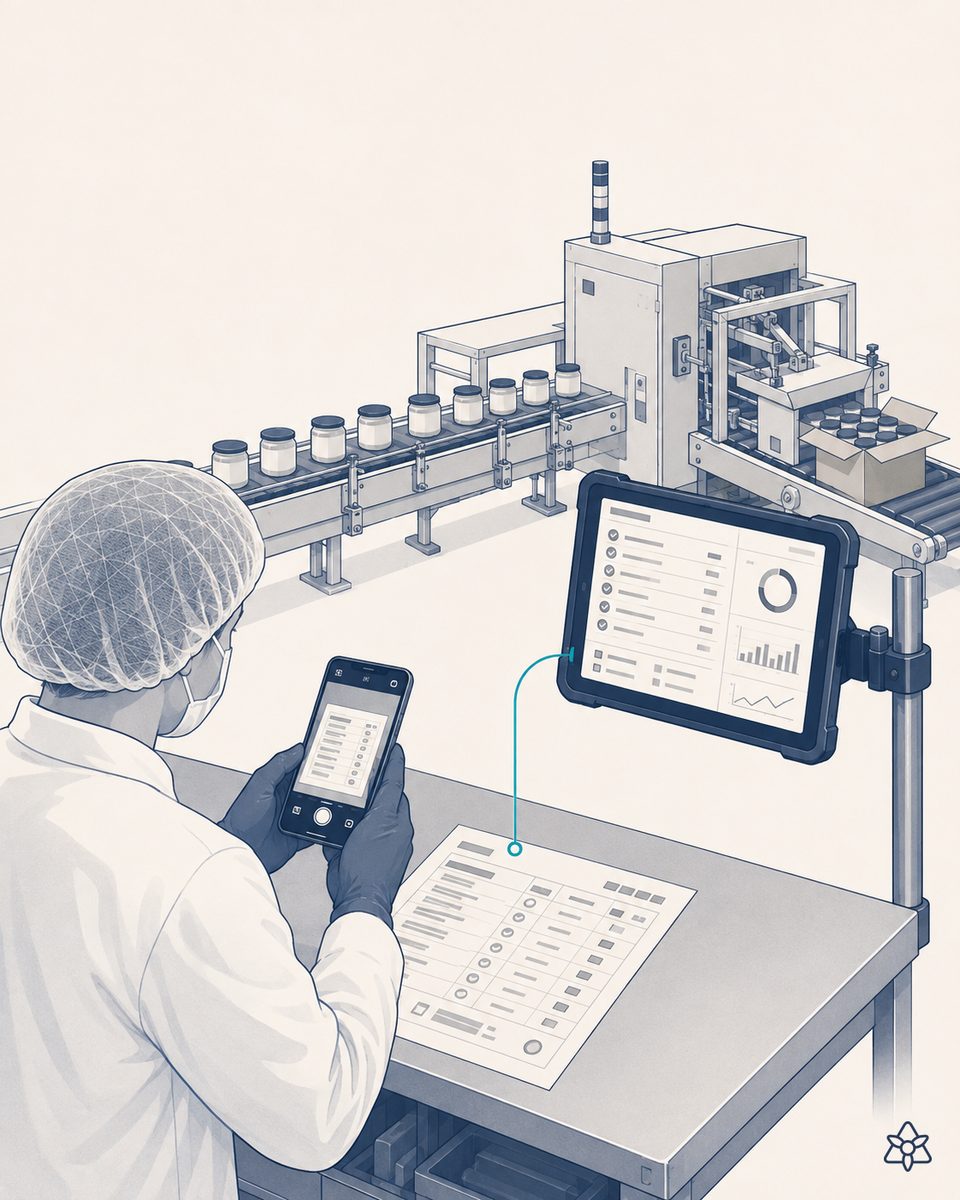
The grade is decided in the pen, but the data lives in four different places.
When the animals go into or come out of the montanera, that is where the vet settles the commercial designation of a ham that will be cured two years later. The grade is the intersection of four realities that are rarely in the same place at the same time:
- What you see on the animal — coat, hair, back profile, ham conformation, hoof. Judged as it goes through the race.
- Entry and exit weight — the real weight gain over the montanera. Usually sitting on a scale that spits out a ticket, or in a spreadsheet.
- Available area and stocking rate — compliance with RD 4/2014 lives on a site map and in a field logbook.
- The ear tag and the batch — RIBER traceability. Sometimes paper, sometimes SIGGAN, sometimes both and they do not agree.
The vet cross-references it all mentally, writes a note in the logbook and signs. Most of the time it works. And when it does not work, it is not an internal telling-off: it is a downward regrade at the slaughterhouse or, worse, a non-conformity from the certifier. A career's worth of the vet's judgement is locked in their head — the day they retire, it walks out with them.
iLEAN does not replace the vet — it acts as a safety net and captures their judgement as an in-house capability.
The grading problem is not a lack of information: it is information living in islands (animal, scale, estate map, ear tag) that, at the critical moment — the seconds the pig is in the race — never reaches the person who signs already cross-referenced. iLEAN acts as the putty that fills those gaps, without asking you to change RIBER, SIGGAN or the way you manage the dehesa.
Vision sees the animal in the race. The app captures the scale and the ear tag. The agent cross-references the field logbook and RD 4/2014 and proposes a grade. The vet signs — never the other way round.
The iLEAN pieces applied to grading during the montanera:
- iLEAN Vision (Edge + CNN) — a terminal with a camera over the race in the handling pen. It reads coat, hair, back profile and ear tag in a single pass. The CNN runs locally: it works even if the estate has no coverage. Every animal is recorded with a photo and the extracted traits.
- Connect — captures the scale (whether it is a modern one or an old indicator head printing tickets), the estate map, notes dictated by the farmer or the technician, and the latest RIBER update. It also captures what arrives from outside (an instruction from the certification body, a change of criteria from the retailer) at second zero.
- Agent — cross-references animal + scale + area + RD 4/2014 and proposes a grade with a confidence level and reasons (the traits that justify it). If the proposal changes between entry to and exit from the montanera, it flags it. The person validates.
Traditional handling vs. a handling pen with iLEAN Vision
| Aspect | Traditional handling | With iLEAN Vision + field app |
|---|---|---|
| Capturing the animal's traits | Field logbook + the vet's memory | AI camera on the race, traits extracted in one pass |
| Cross-referencing the scale | Scale ticket by hand, spreadsheet afterwards | Scale read by Connect, anchored to the ear tag |
| Checking area / stocking rate | Map + logbook, reviewed later | Stocking rate calculated live by the agent |
| The vet's knowledge | In their head, gone on retirement | Captured as model criteria (with their signature) |
| Works with no coverage | n/a | Vision runs locally and syncs on the way back |
| File for the certifier (ENAC) | Rebuilt by hand, batch by batch | Per-ear-tag dossier with photo, weight and signature |
Impact estimate for your plant — to be validated with your numbers.
The block below is an estimate to be validated with the specific data of your estates. We put it forward so the committee has an order of magnitude; we refine it during the diagnostic.
- An Iberian pig operation with several dehesa estates, handling close to a thousand pigs in the montanera, with bellota certification managed today via logbook, spreadsheets and SIGGAN.
- Vision pilot on one estate (terminal + camera over the race + field app + integration with RIBER and the scale). First value expected within a few weeks.
- Indicative payback between 4 and 9 months, depending on how often downward regrading happened last season and how many vet-hours go into reconciling paperwork today.
- Expected reduction in manual reconciliation work ≥ 30%; the rest translates into fewer arguments with the certifier and less risk of a non-conformity.
And the vet's reasonable doubt
“What if the AI gets it wrong and grades an animal badly?” — hallucination is a problem of free generation, not of anchored tasks. In tasks where the AI simply reads traits and proposes a grade against a known regulation, the best models brought error below 1.5% [1]. And even so, what is critical is never decided alone: iLEAN proposes and the vet signs. The three safety rings exist precisely for this.
[1] OpenAI paper “Why Language Models Hallucinate”, 2025 — on the reliability of AI in anchored tasks.
What people ask about bellota/cebo grading in the montanera
What is the technical difference between bellota, cebo de campo and cebo under RD 4/2014?
Royal Decree 4/2014 (the Iberian Standard) grades the final product into four designations — bellota, cebo de campo, cebo, plus the breed-purity claim (100/75/50). Bellota requires a final feeding phase in the montanera on acorns and grass over the dehesa, with a minimum area per animal and weight gain above a set threshold. Cebo de campo requires free-range rearing with authorized feed. Cebo allows intensive rearing. The difference is settled out in the field during the montanera, not at the slaughterhouse — which is why the critical moment for grading is the handling pen on the way in and on the way out.
How does iLEAN Vision assist the vet in the handling pen?
iLEAN Vision is an AI vision component plus a field app. As the animal moves through the handling pen, a camera captures morphology (coat, hair, back profile, ham conformation), hoof and ear tag in a single pass. The neural network cross-references those traits with the history of the batch, the estate and the weight curve. On the tablet, the vet sees a proposed grade together with the confidence level and the traits that justify it. The vet signs or corrects — the AI assists, it never decides alone. That turns a career's worth of the vet's judgement into part of the system instead of leaving it locked in their head.
What happens when a pig does not meet bellota criteria at the exit pen?
The system separates the animal and regrades it to cebo de campo or cebo based on the real data: weight gain, days in the montanera and available area. The trace stays anchored to the ear tag, the batch and the estate, with photo and timestamp, ready for the certification body (ENAC) and for the MAPA inspector. No parallel spreadsheets that get rewritten, no corridor arguments. The seal placed on the cured ham years later matches, with nothing made up, what the animal actually did out on the dehesa.
Does it work if the estate has no mobile coverage or WiFi?
Yes. The Edge terminal that comes with Vision runs its CNN locally — it grades and records even if the estate sits deep in the dehesa with no coverage. What is critical cannot depend on connectivity. When the technician gets back into a covered area, the device syncs with Central. The agents consolidate the data and prepare the batch file for the certifier. The vet reviews the complete batch from the tablet, in the car or back at the office, before signing.
How long does it take to start a Vision pilot on an Iberian pig operation?
The method is the usual iLEAN one — a few days of immersion with the farm team, a first capability running within a few weeks (coat and ear tag reading plus a proposed grade in the pen), a pilot line on one estate, and the rollout to the remaining estates carried out by the customer's own trained people. The initial investment covers terminal + camera + app + integration with RIBER. Indicative payback lands in the range of a few months once you value the drop in downward regrading and the hours saved in handling. We ask for your data and send you the estimated ROI in 48h.
More cases in food
- Industrial AI for gourmet croquette and appetizer plantsReal industrial AI cases at gourmet croquette and appetizer plants: paperless capture, in-line vision…
- Grape must traceability with AI — from vineyard to tank without rebuilding anything by hand.How iLEAN ties plot, weighbridge, destemming, pressing and tank into one dossier per must — so the…
- Iberian pork — the seal is worth exactly what the traceability behind it is worth.Documented iLEAN cases in Iberian cured meats: RD 4/2014 seal traceability, breed grading, PDO…
- Botillo IGP Bierzo smoking and curing with AI — you don't replace the traditional smokehouse, you measure it.How iLEAN Edge governs the smoke curve, temperature, humidity and per-piece weight of Botillo IGP from…
- Catalan fuet white bloom Penicillium with AI — the bloom needs a hundred eyes, not one.How iLEAN Vision verifies the white bloom (Penicillium nalgiovense) on Catalan fuet during curing, batch…
- Chorizo cular IGP Salamanca with AI — the specification is met in the cellar, not on paper.How iLEAN Edge governs stuffing, drying room and curing of Chorizo Cular IGP Salamanca with sensors and…
Tell us your case and in 48h we'll send you the estimated ROI of this AI project for your Iberian pig operation.
We work on the real data from your estates, not ours. Diagnostic with no commitment.
Request estimated ROI in 48h See Iberian