Catalan fuet white bloom Penicillium with AI — the bloom needs a hundred eyes, not one.
The white bloom of Penicillium nalgiovense is the signature of a well-cured Catalan fuet — but covering 8,000 pieces a shift evenly depends on humidity, ventilation, seeding and luck. iLEAN Vision checks every piece during curing and raises the alert before packing when the bloom does not take hold or green mold appears. The person signs.
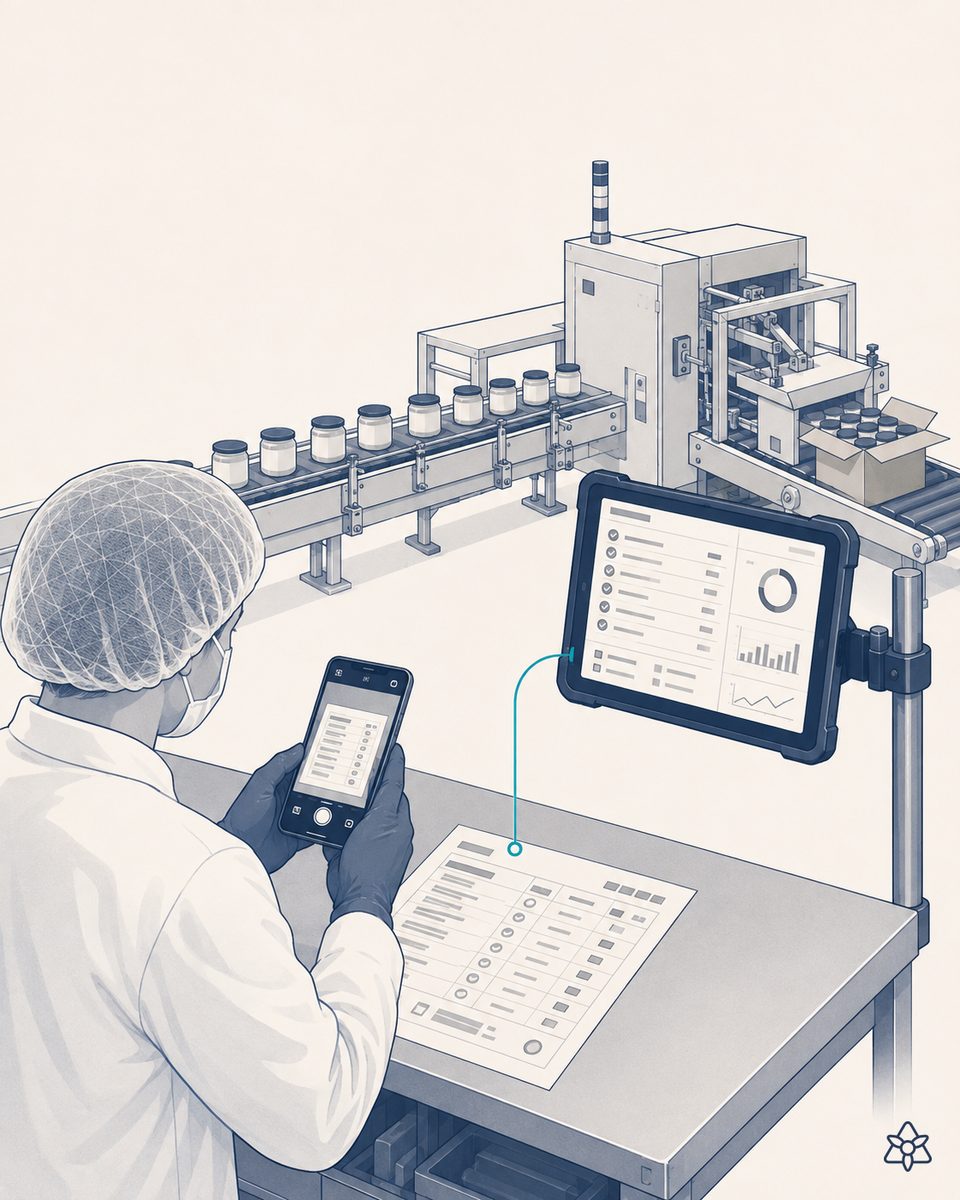
The bloom is obvious at a glance — but that glance does not scale.
A well-cured piece of fuet is recognizable from a meter away: uniform Penicillium coverage, whitish-gray color, no bald patches, no green spots. The master sausage maker sees it. The problem starts when it has to be seen on every one of the 4,000-8,000 pieces that go to packing each day, across several cellars at the same time:
- Coverage is not uniform — bald patches in the middle, too much at the ends, one piece with green mold mixed into a rack of a hundred. So common it is almost taken for granted.
- The veteran cannot be in two cellars at once — and when he retires, his judgment leaves with him. It is the most expensive island of knowledge the plant has.
- The costly mistake reaches packing — a piece with unwanted mold, pulled from the shelf by a consumer or a retailer, weighs more than a hundred perfect pieces. And an artisan fuet brand is built over years and broken by a single photo.
The classic system (operator + the master's round + rejecting by eye) works 99% of the time. That remaining 1% is the one that makes the news.
iLEAN Vision learns your bloom — the one on your brand's fuet, not the one in a textbook.
The problem with the white bloom is not a lack of product knowledge: it is craft that does not scale. iLEAN acts as the putty that fills the gap between the master's eye and the thousands of pieces that go through every shift, without asking you to change the cellar or the packing line.
Vision learns the bloom on your fuet. It looks at every piece as it leaves the cellar. It flags the deviations for the master. The person signs — Vision never rejects on its own.
The iLEAN pieces applied to the white bloom on Catalan fuet:
- Edge / Vision — a terminal with CNN cameras trained on real pieces from your factory. It recognizes the coverage, color and uniformity of the Penicillium nalgiovense bloom and tells green mold, black mold or missing coverage apart. It works in milliseconds per piece. It works without a network: if the plant loses WiFi, Vision keeps looking and keeps recording.
- Connect — captures the batch recipe, the starter culture used, the humidity and ventilation curve of the cellar and the master sausage maker's notes. If a deviation repeats, the agent cross-references that data and suggests where to look for the root cause — a new culture, a fan running below spec, a cellar with high humidity.
- Agent — proposes which pieces to hold for human inspection, which cellar to review and which tentative adjustment to apply. It does not reject on its own. It does not change the cellar on its own. It calls the master sausage maker through whichever channel he uses and lays out the data. The person validates and signs — that is what separates an IRIS system from a dark factory.
Inspection by eye vs. assisted Vision with iLEAN
| Aspect | Inspection by eye + the master's round | With iLEAN Vision + Connect + Agent |
|---|---|---|
| Coverage per piece | Visual sampling, assumed for the rest | Verified 100%, piece by piece and batch by batch |
| Green mold detection | Only if the master walks past the right rack | In milliseconds, on every piece at the exit |
| Root cause of bald patches | The master's intuition | Humidity and ventilation curve cross-referenced per cellar |
| The veteran's knowledge | Lives in his head | Captured as a model trained on his criteria |
| Batch file | Rebuilt by hand | Automatic dossier with a photo of every piece |
| Operation without a network | n/a | Vision keeps looking with its own light |
Impact estimate for your plant — to be validated with your numbers.
The block below is an estimate to be validated with the specific data of your plant. We put it forward so the committee has an order of magnitude; we refine it during the diagnostic.
- Mid-sized cured sausage plant with 2-4 curing cellars, several fuet references, calibers such as extra and secallona.
- Vision pilot in one cellar and one exit point toward packing (cameras + integration with the batch recipe from the ERP/MES + an alert channel to the master sausage maker). First value expected within a few weeks.
- Indicative payback between 4 and 9 months, depending on the cost of a piece rejected too late and the frequency of incidents with unwanted mold over the past few years.
- Expected floor for improvement: a reduction of ≥ 30% in pieces reaching packing with defective coverage.
- The hard lever: a single recall for unwanted mold pays for a good part of the pilot.
And the master sausage maker's reasonable doubt
“What if Vision mistakes a bald patch for bloom, or the other way round?” — hallucination is a problem of free generation, not of anchored tasks. Recognizing bloom coverage on a piece is an anchored task: the network compares against real patterns from your factory, validated by the master. In anchored tasks, the best models brought error below 1.5% [1]. And even so, what is critical is never decided alone: iLEAN flags, the master signs. The three safety rings exist precisely for this.
[1] OpenAI paper “Why Language Models Hallucinate”, 2025 — on the reliability of AI in anchored tasks.
What people ask about the white bloom on Catalan fuet with AI
What is the white bloom on fuet, and why does getting it right matter?
The white bloom on Catalan fuet is the natural coating of Penicillium nalgiovense, the noble mold seeded onto the casing during curing. It does three things at once: it protects the piece from unwanted molds (Aspergillus, green molds), it regulates surface humidity and it contributes aromatic profile. A bloom that covers evenly is the sign of a well-cured fuet; bald patches, green spots or uneven coverage are the sign that something went wrong — humidity, temperature, ventilation, or a starter culture that never took hold.
How does iLEAN Vision verify Penicillium coverage on every piece?
iLEAN Vision installs CNN cameras in the curing cellar and at the exit point toward packaging. The neural network is trained to recognize the coverage, color and uniformity of the Penicillium nalgiovense bloom, and to tell it apart from unwanted green or black molds. Piece by piece, batch by batch and cellar by cellar, it records the coverage percentage and alerts the master sausage maker whenever a piece drifts outside the corridor — before packing, not after. The person validates; the line does not reject on its own.
What does iLEAN do if a piece comes out with green mold instead of white bloom?
When Vision identifies a colony of green or black mold on a piece, the agent flags it as suspect and proposes three things at once: hold the piece for human inspection, cross-reference the cellar and the batch with neighboring pieces to see whether it is a pattern or an isolated case, and review the humidity and ventilation curve for the last few hours in that cellar. A person always signs off on any rejection — the agent never throws product away on its own.
Does iLEAN work for branded fuet made to an artisan recipe?
Yes — Vision is trained on real pieces from your factory, not on a generic model. If your fuet has an artisan recipe, natural casing, a specific caliber and a bloom profile that defines your brand, the model learns that profile as its reference. Detecting the deviation against your pattern is what matters, not against someone else's. And, as with any Edge pilot, the first value arrives within a few weeks using data from your plant.
Does Vision replace the master sausage maker's eye?
No. It amplifies it. The master sausage maker is still the one who decides, who signs off on rejections and who adjusts the cellar. Vision contributes what a person cannot: looking at 4,000 pieces coming out of the drying room every shift, recording the data and flagging the first piece outside the corridor before it becomes forty. Assist and simplify — not replace. The master's judgment is the most valuable thing in the plant; iLEAN protects it, it does not replace it.
More cases in food
- Iberian pork — the seal is worth exactly what the traceability behind it is worth.Documented iLEAN cases in Iberian cured meats: RD 4/2014 seal traceability, breed grading, PDO…
- Bellota/cebo grading in the montanera — the vet's eye, amplified, with no animal slipping through.iLEAN Vision grades Iberian pigs as bellota, cebo de campo or cebo at the handling pen with AI vision…
- Botillo IGP Bierzo smoking and curing with AI — you don't replace the traditional smokehouse, you measure it.How iLEAN Edge governs the smoke curve, temperature, humidity and per-piece weight of Botillo IGP from…
- Chorizo cular IGP Salamanca with AI — the specification is met in the cellar, not on paper.How iLEAN Edge governs stuffing, drying room and curing of Chorizo Cular IGP Salamanca with sensors and…
- The Iberian color seal — a wrongly placed color is not an operator slip, it is a non-conformity.iLEAN Tracer verifies the black/red/green/white Iberian color seal against RD 4/2014, ties piece, batch…
- Trimming and dressing of cured ham with AI — the last pass, without losing the piece.iLEAN Vision assists pre-sale trimming of cured ham: rind, unwanted mold and dressing consistent piece…
Tell us your case and in 48h we'll send you the estimated ROI of this AI project for your Catalan fuet.
We work on your plant's real data, not ours. Diagnostic with no commitment.
Request estimated ROI in 48h See food industry