Trimming and dressing of cured ham with AI — the last pass, without losing the piece.
Pre-sale trimming and dressing of cured ham is the final adjustment before the customer — and one cut too many is value going into the bin. iLEAN Vision assists the master trimmer with a piece-by-piece map of rind, mold and areas to dress. The person cuts — the camera proposes.
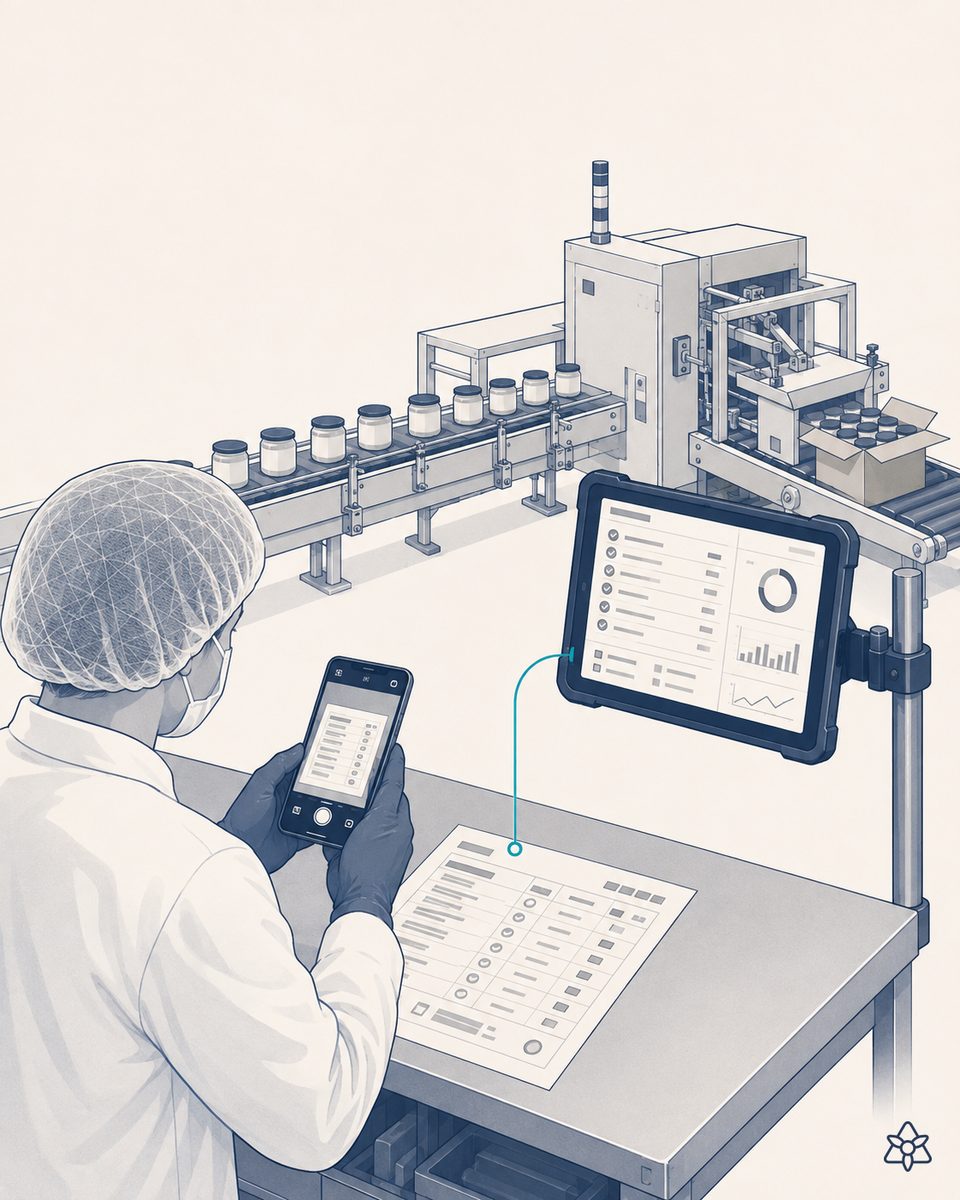
The last pass is what decides whether the piece is premium or drops to second grade.
A cured ham reaches the trimming bench after 24, 30 or 36 months in the cellar. The piece already is what it is — what the master trimmer decides over the next few minutes is how the customer sees it: how much rind comes off, which mold gets scraped away, which area gets dressed with fat.
- One pass too many with the knife: noble fat lost, commercial weight down, margin evaporated.
- One pass too few: unwanted mold visible to the customer, scorched rind that should not be there, a return from the distributor.
- Piece-to-piece variability: 7 kg vs 9 kg, acorn-fed vs field-fed, a winter batch vs a summer one. The master's criteria have to be readjusted every few pieces, and by piece 300 of the shift they no longer see it the way they saw piece 5.
The knowledge sits with the master. The problem is that there is only one, and the bench holds four trimmers. When they retire, half the plant walks out with them — and nobody has time to write it all down by hand.
iLEAN Vision does not replace the master — it puts a safety net under the knife.
The answer is not to automate trimming (the dark-factory counter-model). It is to capture the veteran's eye and leave it in place as a permanent capability of the plant, assisted on every piece. iLEAN acts as the putty that fills the gap between the master's criteria and the operation of a full shift.
Edge sees the piece before the cut. It proposes the map: what to remove, what to dress, what to leave. The master cuts and signs. The camera learns from every signature — and it proposes for piece 300 the way it did for piece 5.
The iLEAN piece applied to trimming and dressing of cured ham:
- iLEAN Vision (Edge) — a camera terminal (CNN) over the trimming bench. It reads the whole piece in milliseconds: recoverable rind, damaged rind, patches of noble vs unwanted mold, areas to dress with fat. It projects the map onto the piece or onto a side screen. It works with no network: if the plant loses WiFi, Edge keeps proposing, because what is critical cannot depend on connectivity.
- Capturing the master's criteria — every time the master confirms or adjusts a proposal, that decision is recorded. The camera does not learn from a generic manual: it learns from the master in your cellar, with the flora of your cellar and the customers of your channel. When the master retires, their criteria stay.
- Piece-level traceability — the agent records the proposed map, the human decision, the weight before and after, and the commercial destination. The dossier is built with nobody typing — useful for audits, for IFS/BRC and for the PDO dossier where it applies.
Manual trimming vs. trimming assisted with iLEAN Vision
| Aspect | Manual bench | With iLEAN Vision |
|---|---|---|
| Cutting criteria | In the master's head, undocumented | Per-piece map + recorded human decision |
| Consistency across pieces | Drops as the shift wears on | Constant from piece 1 to piece 800 |
| Telling flora apart (noble vs unwanted) | The master's trained eye | Camera trained on the flora of your cellar |
| Loss of product to over-trimming | Varies by operator | Conservative map proposed; the master decides |
| Capturing the knowledge | Leaves with the master on retirement | Stays as a plant capability |
| Dossier per batch/piece | Rebuilt by hand afterwards | Automatic, with before/after photos |
Impact estimate for your plant — to be validated with your numbers.
The block below is an estimate to be validated with the specific data of your plant. We put it forward so the committee has an order of magnitude; we refine it during the diagnostic.
- Iberian ham trimming bench, several trimmers, a mix of acorn-fed and field-fed, multiple weights, output to both the premium channel and distribution.
- Edge pilot on a single station (camera + side screen + integration with the ERP/MES and the scale). First value expected within a few weeks: the cutting map starts serving after only a handful of pieces, once the camera is calibrated with the real flora of the cellar.
- Indicative payback between 4 and 9 months, depending on your current over-trimming cost and on the share of pieces that today drop to second grade on appearance.
- Hard levers: a reduction of ≥ 30% in losses from over-trimming, a better premium / second-grade mix, and the capture of the master's criteria as a plant asset. Conservative figures, not a shiny ceiling.
And the master trimmer's reasonable doubt
“What if the camera gets it wrong and proposes a bad cut?” — hallucination is a problem of free generation, not of anchored tasks. When the AI limits itself to recognizing flora and geometry on a specific piece and proposing a map, the best models brought error below 1.5%[1]. And even so, what is critical is never decided alone: the camera proposes, the master cuts, the system records. The three safety rings exist precisely for this.
[1] OpenAI paper “Why Language Models Hallucinate”, 2025 — on the reliability of AI in anchored tasks.
What people ask about trimming and dressing cured ham with AI
What does trimming and dressing a cured ham before sale involve?
Trimming is the last pass before the ham goes out to the customer: removal of damaged or scorched rind, elimination of unwanted mold (black, green, fuzzy), scraping of oxidized areas, and dressing with fat to even out the appearance and improve how the piece keeps. It is master trimmer work: one pass too many is value going into the bin; one pass too few is a piece the customer rejects.
How does the AI decide where to trim the rind without losing the piece?
iLEAN Vision projects a piece-by-piece map onto the ham: which rind is recoverable, where there is genuine scorching or cracking, and which areas are dressing (not cutting). The master trimmer sees the proposal and decides. Nobody takes their hand away from them: what is taken away is the “do I cut or not?” repeated a hundred times a day over pieces of different weight and curing age. The camera proposes; the master cuts.
Does the system tell noble mold (Penicillium) apart from unwanted mold?
Yes. The surface flora of a ham cured in a cellar is not one single thing: there is white-bluish Penicillium that is part of the curing process, and there are black, green and fuzzy molds that are defects and get removed. iLEAN Vision is trained on the real flora of your cellar (not the flora in a textbook) and learns to tell the good from the bad according to your criteria, not according to a generic manual.
Does AI vision work with hams of uneven weight and curing age?
That is exactly where it adds the most. A line with identical pieces can be trimmed by a new operator; the real problem is variability: 7 kg vs 9 kg, 24 months vs 36 months, an acorn-fed batch vs a field-fed one. The camera is calibrated per family and keeps the criteria constant across the shift, so piece number 300 is not trimmed differently from piece number 5 because the master is tired.
Who signs off on the final cut — the AI or the master trimmer?
The master trimmer, always. iLEAN assists, it does not decide: it proposes the cutting and dressing map, and the master validates it with the knife. iLEAN's three safety rings are designed precisely for this: so that the system only lets a person carry out operations that touch the finished product. The AI is the safety net, not the trapeze.
More cases in food
- Catalan fuet white bloom Penicillium with AI — the bloom needs a hundred eyes, not one.How iLEAN Vision verifies the white bloom (Penicillium nalgiovense) on Catalan fuet during curing, batch…
- Chorizo cular IGP Salamanca with AI — the specification is met in the cellar, not on paper.How iLEAN Edge governs stuffing, drying room and curing of Chorizo Cular IGP Salamanca with sensors and…
- The Iberian color seal — a wrongly placed color is not an operator slip, it is a non-conformity.iLEAN Tracer verifies the black/red/green/white Iberian color seal against RD 4/2014, ties piece, batch…
- Digital probe tasting of Iberian ham with AI — the taster's verdict, piece by piece.iLEAN Connect digitizes horse-bone probe tasting: voice, photo and per-piece data to rebuild the…
- PDO Dehesa de Extremadura — bellota-cebo traceability per piece, not per aggregated batch.How iLEAN Tracer builds bellota-cebo traceability and an auditable per-piece dossier for PDO Dehesa de…
- PDO Guijuelo — audit day arrives with the dossier already done, not with the plant queuing up to build it.How iLEAN Tracer (Connect + Agents + Edge) builds continuous PDO Guijuelo auditing: bellota, salting,…
Tell us your case and in 48h we'll send you the estimated ROI of this AI project for your trimming bench.
We work on your plant's real data, not ours. Diagnostic with no commitment.
Request estimated ROI in 48h See food industry