The Iberian color seal — a wrongly placed color is not an operator slip, it is a non-conformity.
The black, red, green or white seal that goes on the piece is the final signature of what the animal did out in the dehesa, under RD 4/2014. iLEAN Tracer ties the color to the RIBER record, to the ITSA report and to the batch, verifies it on the sealing line with AI vision, and sets the piece aside before it reaches the market if something does not add up. The quality manager signs — the batch does not close on its own.
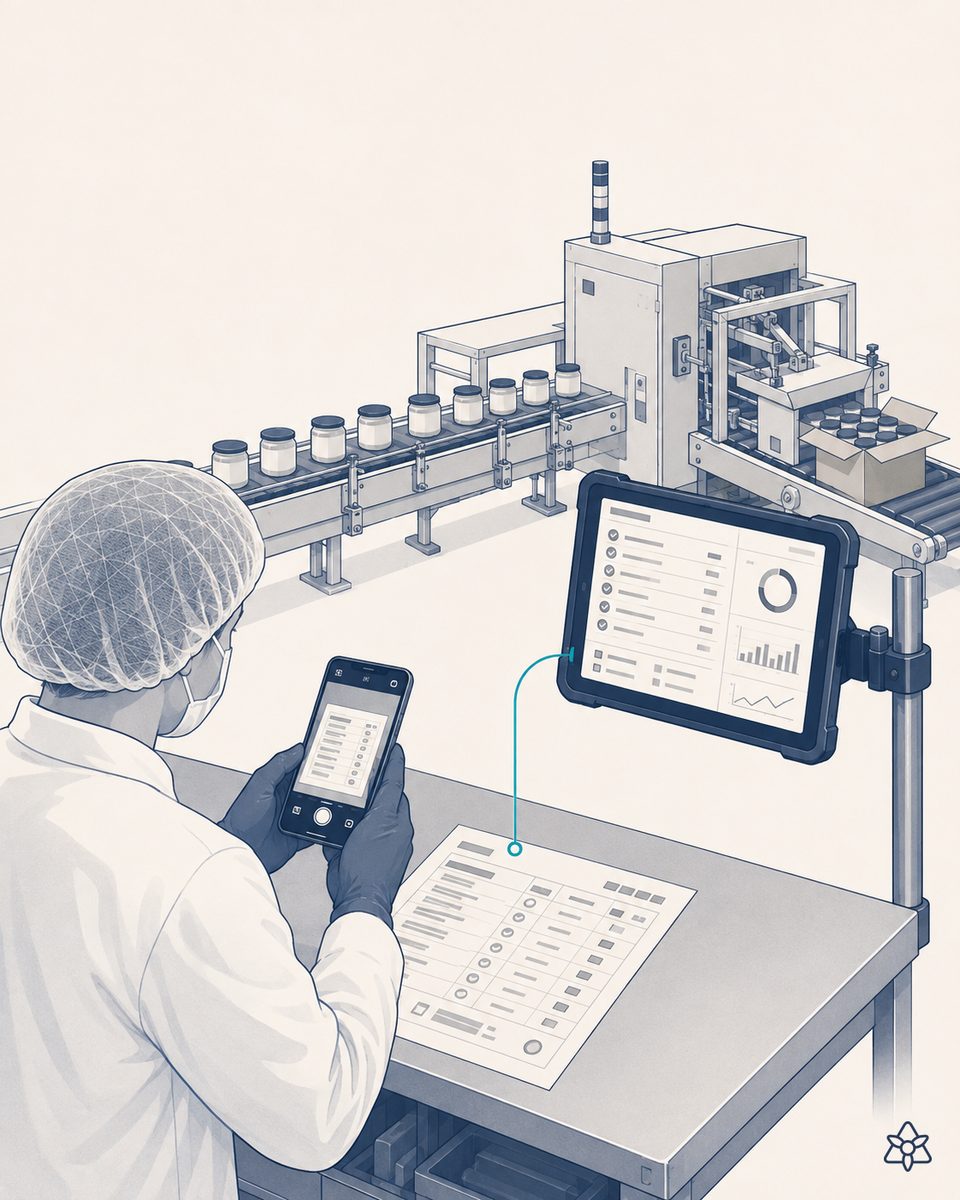
The color of the seal sums up three years in the dehesa — and on the line it takes three seconds.
A correctly sealed piece is the conclusion of a long file: the pig's final feeding regime (acorn-fed, field grain-fed or grain-fed), breed purity (100/75/50), curing, cutting room. The operator fitting the seal on the line has no time to audit any of it — they trust what arrives on the batch delivery note and what the internal label says.
- What the animal did — lives in RIBER, in SIGGAN and in the certification body's ITSA reports. Often in PDF, sometimes in an API, almost never connected to the drying plant's ERP.
- What the cutting room recorded — weight, carcass mark, batch. Lives in the MES or on a barcode label.
- What gets decided at sealing — color, seal number, piece. Lives in a gun and a sticker.
The quality manager knows all this, but cannot be in three places at once. The classic system works 99% of the time. That 1% is the one that opens a Ministry of Agriculture case, suspends a certification or reaches the press. A single seal in the wrong color is hard cost and brand damage.
iLEAN does not add another system — it seals the cracks between RIBER, the ERP and the sealing line.
The problem with the seal is not a lack of information: it is information living in islands (RIBER, ITSA, MES, seal gun) that, at the critical moment (the piece passing the station), never reaches the person who signs already cross-referenced. iLEAN Tracer acts as the putty that fills those gaps, without asking you to change your RIBER process, your certifier, or your room.
Connect captures RIBER, ITSA and the MES. Edge sees the color of the seal and the piece. The agent cross-references it against RD 4/2014 and, if it does not add up, sets the piece aside. The person signs — never the other way round.
The iLEAN pieces applied to the Iberian color seal:
- Connect — captures from RIBER, from SIGGAN, from the certification body's ITSA reports, from the cutting room's MES and from planning. It also gathers what arrives from outside (a change of criteria from the certifier, an instruction from the Ministry, a requirement from the retailer) at second zero, without anyone having to forward anything.
- Edge — a terminal with AI vision (CNN) on the sealing line. It reads the color of the seal fitted, the piece number and the carcass mark. It works locally: if the drying plant loses the network, it keeps verifying and setting pieces aside.
- Agent — cross-references the sealed piece with the full batch file (feeding regime, purity, batch, room). If the color does not match what RIBER says, it sets the piece aside and alerts the quality manager through whichever channel they use. The person validates; the line does not restart on its own.
Sealing on trust vs. sealing verified with iLEAN Tracer
| Aspect | Traditional sealing | With iLEAN Tracer (Connect + Edge + Agent) |
|---|---|---|
| Cross-reference with RIBER/ITSA | Batch delivery note on paper or PDF | Connect captures and anchors to the ear tag at second zero |
| Color verification | Operator + internal checklist | Edge sees the color and cross-references it with the file |
| Batch change on the line | Assuming the gun is loaded with the right color | The agent blocks it if the batch does not match the loaded color |
| Error detection | Later audit or inspection | In line, before packing, in milliseconds |
| Operation without a network | n/a | Edge keeps verifying with its own light |
| File for the certifier (ENAC) and the Ministry | Manual rebuild per batch, weeks | Per-piece dossier with photo, RIBER record and signature |
Impact estimate for your plant — to be validated with your numbers.
The block below is an estimate to be validated with the specific data of your room. We put it forward so the committee has an order of magnitude; we refine it during the diagnostic.
- Mid-sized drying plant with a multi-line sealing room, multi-designation (black/red/green/white), integration with RIBER and with the ITSA reports of the ENAC-accredited certification body.
- Tracer pilot on one line (Edge with vision over the sealing station + Connect reading RIBER/MES + an agent cross-referencing RD 4/2014). First value expected within a few weeks.
- Indicative payback between 4 and 9 months, depending on the historical frequency of non-conformities and the average documented reprocessing cost over recent financial years.
- Expected reduction in the risk of incorrect designation ≥ 30%; the rest translates into less argument with the certifier and a better audit trail.
And the quality manager's reasonable doubt
“What if the AI gets it wrong and lets a badly sealed piece through?” — hallucination is a problem of free generation, not of anchored tasks. In tasks where the AI merely recontextualizes a piece of data from one system into another (reading the color of the seal and comparing it with the batch's RIBER record), the best models brought error below 1.5% [1]. And even so, what is critical is never decided alone: iLEAN sets aside the piece and the person signs. The three safety rings exist precisely for this.
[1] OpenAI paper “Why Language Models Hallucinate”, 2025 — on the reliability of AI in anchored tasks.
What people ask about the Iberian color seal
What does each seal color mean under RD 4/2014?
Royal Decree 4/2014 establishes four seal colors for cured Iberian ham, according to the final feeding regime and breed purity. Black: 100% Iberian acorn-fed. Red: Iberian acorn-fed (75% or 50% crossbreeds). Green: Iberian field grain-fed. White: Iberian grain-fed. The color is not a commercial decision: it is the visible conclusion of what happened out in the dehesa, in the fattening unit and in the cutting room — and it has to be verifiable backwards, piece by piece.
How does iLEAN Tracer verify the seal in line?
iLEAN Tracer is the traceability piece of iLEAN: it cross-references Connect (capturing the RIBER record, the feeding regime registered during the montanera and the cutting room) with Edge (vision over the sealing line). When a piece reaches the sealing station, Edge reads the color assigned by the operator, cross-references it with the batch file and with the ITSA/RIBER records, and raises an alert if the color does not match what the animal actually did. The piece is set aside before it moves on to packing. The quality manager signs — the system does not close the batch on its own.
What is the risk if the seal color does not match the RIBER record?
The legal and commercial risk is high. The regional inspectorate or the Ministry of Agriculture can open sanction proceedings for incorrect designation; the certification body (ENAC-accredited) can suspend the batch's certification; the retail chain can demand withdrawal from the shelf and reprocessing. And, what weighs most in the medium term, the brand damage of an acorn-fed Iberian ham reported in the press as wrongly sealed is very hard to reverse. iLEAN Tracer is precisely the net that catches that 1% which does make the headlines.
Does it integrate with SIGGAN, RIBER and the certification body's ITSA reports?
Yes. iLEAN Connect captures from RIBER and SIGGAN as if they were one more island — whether the information comes through a modern API, a CSV export or a PDF someone drops into a shared folder. The ITSA reports (technical health reports on feeding) are anchored to the batch and to the piece. Integration is neither a magic button nor free, but it is no longer a one-year project: AI drove the cost of integration through the floor. Every farm, every fattening unit and every slaughterhouse ends up tied to the seal that reaches the market, with no parallel spreadsheets being rewritten.
How much does it cost to implement Tracer in a mid-sized drying plant?
The order of magnitude of a Tracer pilot in the sealing room of a mid-sized drying plant covers an Edge terminal + a camera over the line + integration with RIBER/ITSA/ERP, plus an annual license. A reasonable payback to present to the committee is several months: the hard lever is a single non-conformity avoided (reprocessing, loss of the acorn-fed designation, brand damage). We ask for your plant's data and send you the estimated ROI in 48h, with your numbers, not ours.
More cases in food
- Botillo IGP Bierzo smoking and curing with AI — you don't replace the traditional smokehouse, you measure it.How iLEAN Edge governs the smoke curve, temperature, humidity and per-piece weight of Botillo IGP from…
- Catalan fuet white bloom Penicillium with AI — the bloom needs a hundred eyes, not one.How iLEAN Vision verifies the white bloom (Penicillium nalgiovense) on Catalan fuet during curing, batch…
- Chorizo cular IGP Salamanca with AI — the specification is met in the cellar, not on paper.How iLEAN Edge governs stuffing, drying room and curing of Chorizo Cular IGP Salamanca with sensors and…
- Trimming and dressing of cured ham with AI — the last pass, without losing the piece.iLEAN Vision assists pre-sale trimming of cured ham: rind, unwanted mold and dressing consistent piece…
- Digital probe tasting of Iberian ham with AI — the taster's verdict, piece by piece.iLEAN Connect digitizes horse-bone probe tasting: voice, photo and per-piece data to rebuild the…
- PDO Dehesa de Extremadura — bellota-cebo traceability per piece, not per aggregated batch.How iLEAN Tracer builds bellota-cebo traceability and an auditable per-piece dossier for PDO Dehesa de…
Tell us your case and in 48h we'll send you the estimated ROI of this AI project for your sealing room.
We work on your plant's real data, not ours. Diagnostic with no commitment.
Request estimated ROI in 48h See Iberian