PDO Dehesa de Extremadura — bellota-cebo traceability per piece, not per aggregated batch.
PDO Dehesa de Extremadura requires you to prove, piece by piece, that the pig was raised on the right dehesa, ate what the regime says it ate and was cured inside the protected area. Today that chain is rebuilt by hand whenever the Regulatory Council calls. iLEAN Tracer (Connect + Agents + Edge) captures every stage at source and builds the per-piece dossier continuously. The person signs.
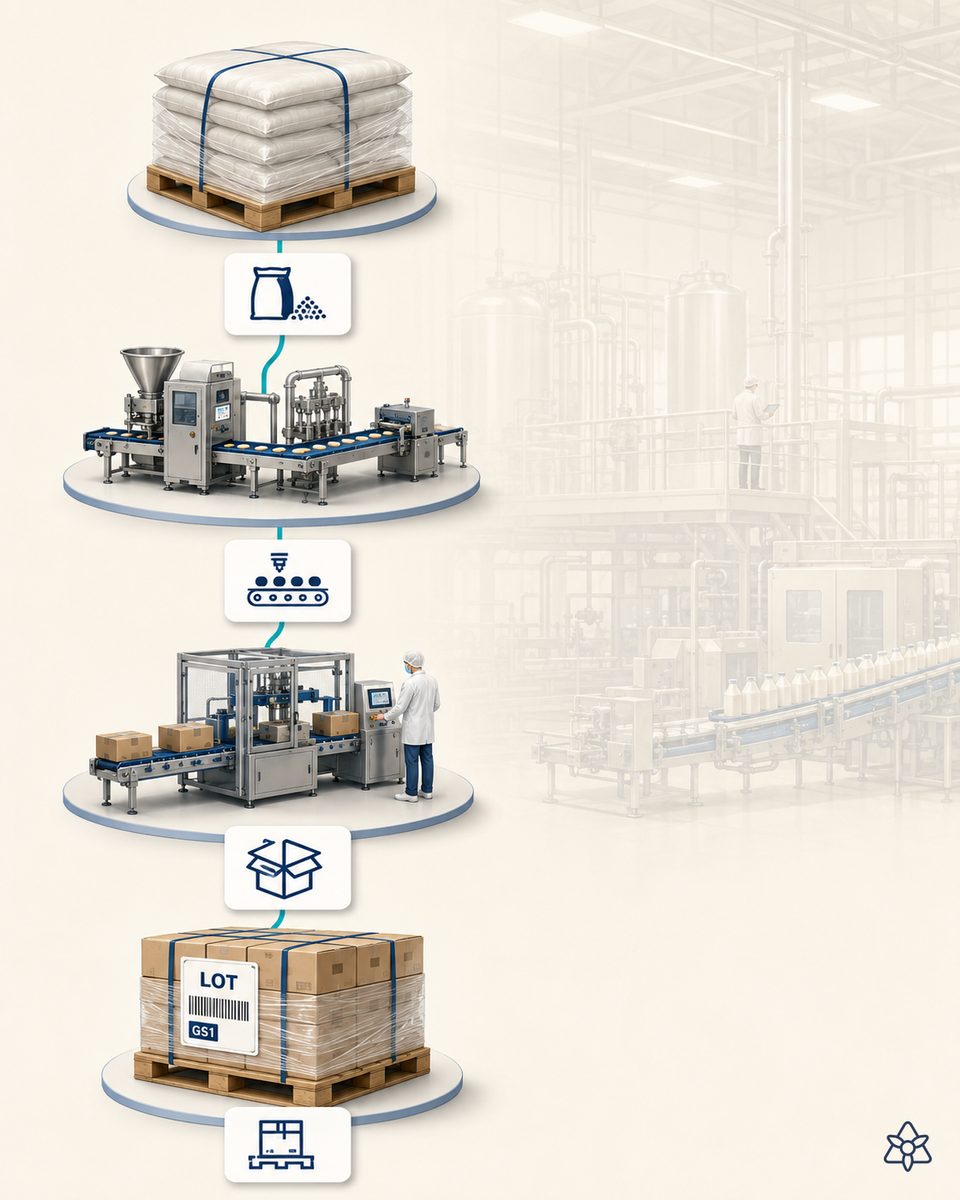
A piece is only worth what its whole chain proves — and the chain lives in pieces across four systems.
PDO Dehesa de Extremadura does not certify a batch: it certifies one specific piece. And to certify it, it demands to know, without ambiguity:
- Which dehesa the pig came from — the montanera census, inside the protected area.
- What it ate — bellota, cebo de campo or cebo, with weigh-in and weigh-out for the montanera.
- What breed it was — a 100% Iberian or 75/50% breed certificate, with the chip linked to the animal.
- How it was cured — drying room and cellar inside the PDO area, with a controlled curve and the Council's seal.
Every stage is recorded somewhere different: the census in the Regulatory Council's database, the scale on the farm, the breed certificate on a sheet from the vet, the drying room in SCADA, the seal in the ERP. When the auditor turns up and asks about piece X, somebody has to rebuild the entire chain by hand — and sometimes you find out a link is missing when it can no longer be fixed. The piece falls out of PDO or, worse, stays in with incomplete evidence and the Council finds it on the next visit.
iLEAN Tracer captures every stage at source — the chain is not rebuilt, it is built live.
The PDO traceability problem is not missing data: there is data at every stage. The problem is that the data lives in islands and only gets assembled by hand, too late. iLEAN Tracer acts as the putty that fills the gaps, without asking you to change your ERP, your SCADA or the Council's database.
Connect captures everything from the dehesa to the seal. Edge reads the chip and the stamp in the plant. The agents cross-reference the PDO specification and build the per-piece dossier continuously. The person signs — never the other way round.
The iLEAN pieces applied to PDO Dehesa de Extremadura:
- Connect — captures the dehesa census during the montanera, the weigh-in/weigh-out from the stockman's scale, the vet's breed certificate (photo or app), the curve from the drying room SCADA, the cellar readings, the seal from the ERP. And it captures what comes from outside at second zero: an email from the Regulatory Council with a change to the specification, a message from the US importer with a new FDA requirement, a report from the stockman about an incident during the montanera.
- Edge — a terminal with vision and RFID reading on the farm scale and at the cellar sealing station. It reads the chip on the animal and on the piece, and associates photo, weight and PDO reference at second zero. With no network, it keeps reading.
- Agents — cross-reference everything with the PDO Dehesa de Extremadura specification and, in parallel, with the importer's requirements (US FDA, China GACC, premium EU retailer). If a piece has a broken chain, they raise the flag before sealing. If a piece already certified as PDO needs to ship to the USA, the dossier is recontextualized into the FDA format without anyone copying a field.
Traceability rebuilt by hand vs. continuous traceability with iLEAN Tracer
| Aspect | Classic PDO compliance | With iLEAN Tracer |
|---|---|---|
| Traceable unit | Aggregated batch, with interpolation | Individual piece, by chip and seal |
| Montanera census | The stockman's paper sheet | Connect captures it at second zero |
| Montanera weigh-in/weigh-out | The scale logbook | Edge reads chip + scale and links them |
| Broken chain before sealing | Found during the audit | The agent raises the flag |
| Dossier for FDA / GACC / US retailer | Manual reformatting, weeks | Recontextualized automatically |
| Quality team hours per audit | Weeks | Hours |
Impact estimate for your plant — to be validated with your numbers.
The block below is an estimate to be validated with the specific data of your plant. We put it forward so the committee has an order of magnitude; we refine it during the diagnostic.
- A PDO Dehesa de Extremadura plant with its own or contracted dehesas, a natural drying room and cellar, x pieces/year under PDO, part of the production exported to the USA or China.
- Tracer pilot with Connect out on the dehesa (scale + census + breed certificate), Edge at the sealing station and agents that build the per-piece dossier with PDO + FDA + GACC outputs. First value within a few weeks.
- Expected reduction in quality-team hours per audit above 30% against the baseline. Expected reduction in pieces that fall out of PDO because of incomplete documentation, above 30%.
- Indicative payback between 4 and 9 months, depending on PDO volume per year and the share of production exported with a per-piece dossier.
- Hard levers: one piece recovered for PDO that would previously have dropped out (bellota PDO price >> cebo price) — that pays for weeks of pilot. A single export pallet return avoided — that pays for the entire pilot.
And the CAIO's reasonable doubt
“What if the AI invents evidence that is not there?” — hallucination is a problem of free generation, not of anchored tasks. Here the AI only recontextualizes real data (the chip reading, the SCADA curve, the photo of the seal) into the PDO specification format or the FDA format. In tasks anchored to the source, the best models brought error below 1.5% [1]. And even so, what is critical is never decided alone: the agent prepares, the quality team signs. The three safety rings exist precisely for this.
[1] OpenAI paper “Why Language Models Hallucinate”, 2025 — on the reliability of AI in anchored tasks.
What people ask about AI traceability for PDO Dehesa de Extremadura
What defines PDO Dehesa de Extremadura and how does it differ from the other Iberian PDOs?
PDO Dehesa de Extremadura protects hams, shoulders and loins from Iberian pigs raised on the Extremaduran dehesa (Cáceres and Badajoz), under a bellota or cebo de campo regime, and cured inside the geographic area delimited by its Regulatory Council. What sets it apart from Guijuelo, Los Pedroches or Jabugo is the specific dehesa, the curing microclimate and the Council's product specification. Every PDO demands its own evidence chain: the head of livestock on the correct dehesa, the certified feeding regime, curing inside the protected area, and the Regulatory Council's seal.
How do you prove the bellota-cebo regime of one specific piece to an auditor?
By cross-referencing four sources that today are almost never together: (1) the census of the animal on the dehesa during the montanera; (2) the weigh-in and weigh-out of the montanera (bellota-fed livestock puts on a characteristic amount of weight); (3) the breed certificate for the pig; (4) slaughter and sealing with the PDO stamp. iLEAN Tracer captures all four at source — chip, scale, the Council's database, ERP — and builds the dossier per piece, not per aggregated batch. The auditor asks about piece X and the answer comes out in seconds.
What happens when a piece does not meet the PDO Dehesa de Extremadura specification?
Today the auditor is the one who finds out — and you lose the piece or, worse, you lose the Regulatory Council's trust in the plant. With iLEAN Tracer the logic changes: the agent compares every piece against the specification continuously, while it cures. If a link in the chain is missing (the scale did not read the chip, the dehesa of origin does not fall inside the PDO area, the feeding regime is not certified), it raises the flag before the piece moves on to sealing. That piece leaves the PDO flow and goes to the category it does meet, without contaminating the dossier.
Does iLEAN Tracer also work for sales to the USA, China and other markets that demand per-piece traceability?
Yes. The evidence layer Tracer builds is the same one for the PDO's Regulatory Council, for the FDA (US importer), for AQSIQ/GACC (China), or for premium European retailers asking for per-piece traceability. What changes is the output format of the dossier — and the agent handles that by recontextualizing the same base data. A PDO-certified piece is automatically ready to meet export requirements. EU Regulation 1151/2012 on PDO/PGI fits into the same evidence chain.
How much does it cost and when do you see the first saving?
The typical pilot covers Connect (capturing the dehesa census, the scale, the breed certificate and the ERP) + Edge devices for chip and seal + agents that build the per-piece dossier. First value shows up within a few weeks: a pilot batch comes out with a complete, automatic PDO file. Indicative payback between 4 and 9 months, depending on PDO volume per year, the time your team currently spends on compliance and the percentage of pieces that fall out of PDO today because of incomplete documentation. Estimate to be validated with your numbers.
More cases in food
- The Iberian color seal — a wrongly placed color is not an operator slip, it is a non-conformity.iLEAN Tracer verifies the black/red/green/white Iberian color seal against RD 4/2014, ties piece, batch…
- Trimming and dressing of cured ham with AI — the last pass, without losing the piece.iLEAN Vision assists pre-sale trimming of cured ham: rind, unwanted mold and dressing consistent piece…
- Digital probe tasting of Iberian ham with AI — the taster's verdict, piece by piece.iLEAN Connect digitizes horse-bone probe tasting: voice, photo and per-piece data to rebuild the…
- PDO Guijuelo — audit day arrives with the dossier already done, not with the plant queuing up to build it.How iLEAN Tracer (Connect + Agents + Edge) builds continuous PDO Guijuelo auditing: bellota, salting,…
- PDO Jabugo cellar curing with AI — governing the curve without replacing the master.iLEAN Edge governs the temperature and humidity curve in a PDO Jabugo cellar, by vintage and hall —…
- PDO Los Pedroches bellota 100% — the premium category is defended pig by pig, not batch by batch.How iLEAN Tracer builds bellota 100% traceability pig by pig for PDO Los Pedroches: holm-oak grove,…
Tell us your case and in 48h we'll send you the estimated ROI of this AI project for your PDO Dehesa de Extremadura traceability.
We work on your plant's real data, not ours. Diagnostic with no commitment.
Request estimated ROI in 48h See Iberian