RASFF and AESAN alerts with AI — a 10 pm alert should not wait until the next morning.
A RASFF alert at 10 pm should trigger immediate action. iLEAN captures it at second zero, cross-references it with your batches and only alerts the team if you are affected — with the official notification already drafted so the person can review and sign it. The official channel does not wait; the classic system does.
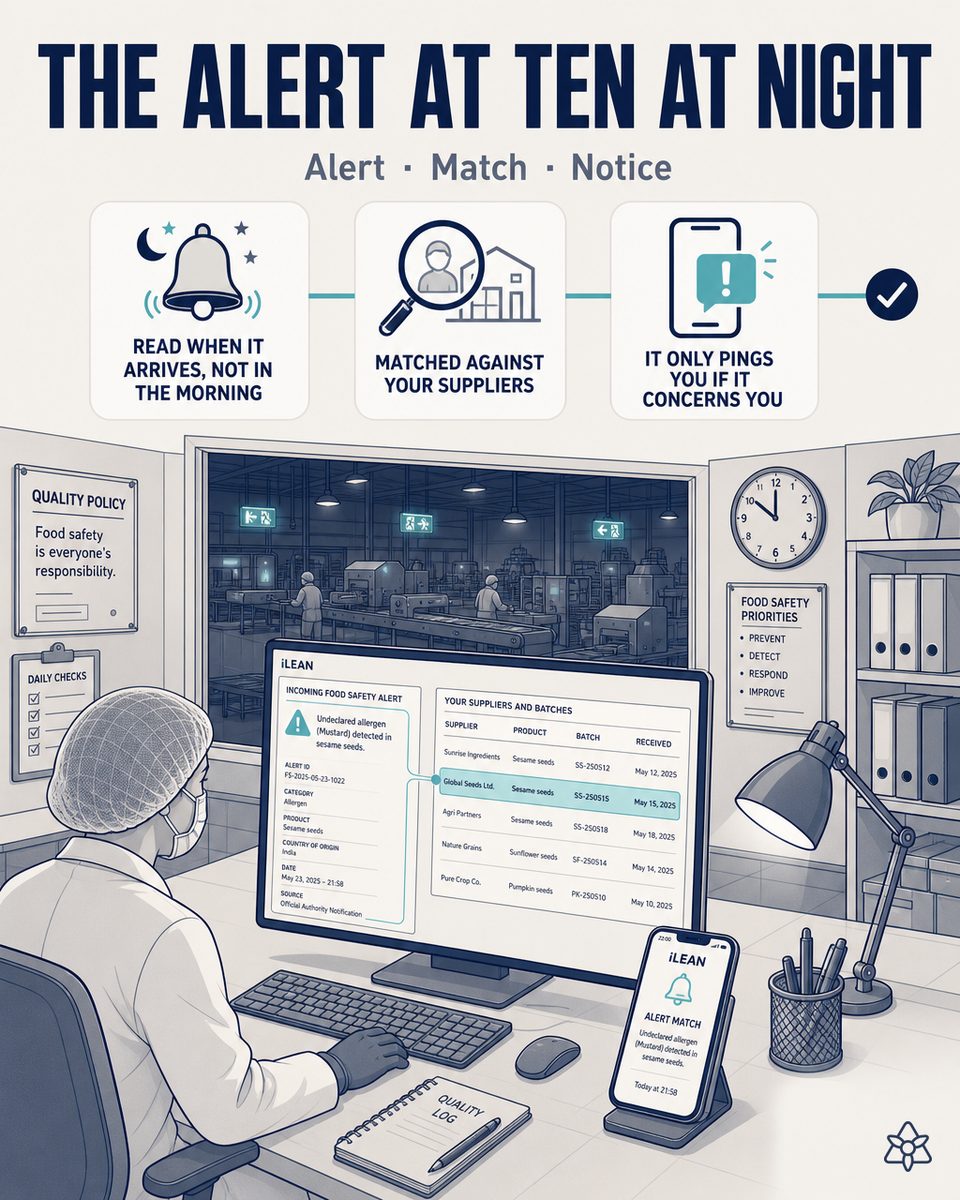
The alert arrives late or not at all — and when it does, nobody knows if it concerns us.
The classic flow of a food safety alert is fairly predictable and, at the same time, fragile:
- The European Commission publishes a RASFF notification at 7:30 pm about a contaminant in an ingredient from a European supplier.
- The quality manager sees it the next morning, if they check the portal — and not everyone does every day.
- They start searching by hand in the ERP to see whether that supplier has sold them material; if so, which batches it entered; if they find the batches, which SKUs used them; if they find the SKUs, which customers they shipped to.
- By the time the full picture is together, hours have passed. Some batches are already in the retailer's channel. And the official notification to AESAN or the regional authority still has to be written.
If the alert comes from the FDA (Reportable Food Registry) or the British FSA, the process doubles across other languages and other portals. If the supplier warned you before the official channel did — an email at 10:00 pm or a WhatsApp on Saturday — that information gets lost because nobody was looking. And the line, meanwhile, keeps packing product that may have to be recalled within 48 hours.
The cost of responding late is not the fine: it is the amount of product that enters the channel between the moment the alert became public and the moment your team reacts.
iLEAN does not add another portal to check — it listens on every channel and only alerts you if it concerns you.
The critical information in a food safety alert almost never comes in through a sensor: it comes in through an email from the authority, an official RSS feed, a WhatsApp from the supplier, a call from the importer. And it almost never reaches the decision-maker in time. iLEAN acts as the putty that joins external capture (all those channels) with your internal data (suppliers, batches, SKUs, distribution) — without asking you to change your ERP, your MES, or who receives the emails.
Connect captures RASFF, AESAN, FDA, FSA, the supplier's email and WhatsApp. The Tracer agent cross-references your batches. The Writer agent drafts the official notification. The person signs — the response goes out with your stamp, not an automatic one.
The iLEAN pieces applied to food safety alert management:
- Connect — outward and inward listening. It captures the RASFF, AESAN, FDA and FSA feeds and any subscriptions you already have. And it also captures the supplier's email, the importer's sales rep's WhatsApp, the transcribed call. At second zero, all of that is usable data. Connect is bidirectional: it also prepares the reply through the same channel it came in on.
- Tracer agent — cross-references the alert with your supplier base, received batches, produced batches, SKUs, shipping dates and commercial distribution. If the alert has nothing to do with you, it never enters your system. If it potentially affects you, it calculates the scope (which batches, which customers, how much) before anyone asks.
- Writer agent — prepares the draft of the official notification to the competent health authority and the message to the retailer/importer, with the Tracer's data already cross-referenced. The quality manager reviews and signs. What used to take half a day comes down to 15 minutes over an already solid draft.
The three safety rings guarantee that no notification goes out without a human signature and that critical data stays in ring 1 at your plant (see IRIS architecture).
Manual portal checks vs. cross-referenced monitoring with iLEAN
| Aspect | Manual process + Excel | With iLEAN Connect + Tracer + Writer |
|---|---|---|
| Alert capture | Someone checks the portal in the morning | Second zero, 24/7, multichannel |
| Relevance filter | Manual — everything gets a quick skim | Automatic cross-check against your supplier/SKU catalog |
| Cross-reference with your own batches | Manual ERP search, takes hours | Tracer does it in seconds on your data |
| Notification to the authority | Written from scratch, half a day | Draft ready — the person reviews in 15 min |
| Capture of the supplier's warning | Only if the email reaches an active inbox | WhatsApp + email + call — everything enters the system |
| Product exposure window in the channel | Hours or days | Minutes — the decision speeds up where it costs the most |
Impact estimate for your plant — to be validated with your numbers.
The block below is an estimate to be validated with the specific data of your chain. We put it forward so the committee has an order of magnitude; we refine it during the diagnostic.
- Company with 20-100 active suppliers, several destination markets (EU + UK + US), a history of 1-3 RASFF alerts touching you laterally per year.
- Deployment of Connect (official feeds + the quality team's email + WhatsApp) + Tracer and Writer agents integrated with your ERP. First value expected within a few weeks — the RASFF feed cross-referenced with your supplier base delivers results from day one.
- Expected reduction in the time between alert publication and team response of ≥30% (often much more, but that is the defensible floor).
- Indicative payback between 4 and 9 months. The hard lever is a single recall contained in time: product held in the warehouse before it enters the channel, instead of recovered from the shelf. That difference pays for the pilot with room to spare.
The CAIO's argument — AI reliability in anchored tasks
"What if the AI filters wrong and misses an alert that did concern me?" — that is the right question. Hallucination is a problem of free generation, not of anchored tasks. Cross-referencing the name of a supplier cited in RASFF against your supplier base and checking whether they have shipped you material is exactly an anchored task: the AI recontextualizes one piece of data (the alert text) into another (the supplier table) and triggers the chain. In this kind of task, the best models brought error below 1.5% [1]. And even so, the system is designed to prefer the false positive over the false negative: if there is doubt, it alerts you; you decide in 30 seconds whether to dismiss or escalate. The human signature is non-negotiable.
[1] OpenAI paper "Why Language Models Hallucinate", 2025 — on the reliability of AI in anchored tasks.
What people ask about managing RASFF and AESAN alerts with AI
How does it monitor RASFF in real time?
RASFF (Rapid Alert System for Food and Feed) publishes European Commission notifications on its portal and by subscription. iLEAN captures them at second zero — via the official feed and the RSS — and applies filters relevant to your catalog: product, ingredient, supplier, origin, batch number when available. If an alert has nothing to do with you, it never enters your system; if it potentially affects you, it triggers the internal chain without waiting for someone to see it in the morning.
And for the US market (FDA)?
Yes. In the US the equivalent is the Reportable Food Registry and the FDA Enforcement Reports. iLEAN monitors both channels with the same agent and applies the same filtering logic against your catalog. If you export to the UK, we also add the FSA Food Alerts. The idea is that your team should not have to manually review three different portals every morning; the agent does it and only alerts you if you are affected.
Does it generate the recall notification?
Yes — and this is the heart of the value. When there is a match with one of your batches, the Writer agent prepares the draft of the official notification (to AESAN, the regional health authority, the retailer, the importer) with the cross-referenced data: affected product, batches involved, quantities, commercial distribution, identified risk. The quality manager reviews and signs — the notification never goes out without a human signature. What used to take half a day comes down to a 15-minute review of an already solid draft.
Who receives the internal alert?
The list is configurable per plant and per severity — quality manager, leadership, logistics manager, sales, etc. And through whatever channel each person uses: email for some, WhatsApp for others, a call with a pre-recorded response for whoever is on the floor without email. iLEAN Connect is bidirectional; it does not just listen, it also speaks. The alert arrives before anyone forwards anything or calls a meeting.
Does it work with external suppliers?
Yes, and this is half the value. Many RASFF alerts start at the supplier (an ingredient with a contaminant, a non-compliant packaging material). iLEAN cross-references the alert with your supplier base and your received batches; if the supplier named in RASFF has shipped you material in recent months, it surfaces as a priority even if the alert concerns a different product. And if the supplier warns you before RASFF does — by email or WhatsApp — Connect captures that message and triggers the chain all the same, without waiting for the official channel.
More cases in food
- Vannamei shrimp farming — the night that takes out a whole cycle should not catch you asleep.iLEAN Edge tracks dissolved oxygen, ammonia and mortality 24/7 in Vannamei shrimp ponds and alerts the…
- Table olive traceability with AI — from the grove to the shelf, without rounding up spreadsheets the night before the audit.How iLEAN cross-references origin, fermentation, grading and packing to deliver a per-batch dossier for…
- Real AI cases in processed cheese12 real AI cases for plants that cut, slice and pack cheese: zero labeling recalls, paperless batch…
- Raw milk traceability from farm to plant — one record for every liter received, not five islands nobody cross-checks.iLEAN ties tanker, route, time and intake analysis into a single record for every liter of raw milk that…
- AI control of chilled ready meals — short shelf life, multi-SKU, zero margin for error.How iLEAN cross-checks cold chain, MAP, allergens and expiry dates in chilled ready meals with Edge +…
- Real AI cases in the food industryReal AI cases in the food industry: dairy, meat, beverages, frozen foods and ingredients, plus labeling,…
Tell us your case and in 48h we'll send you the estimated ROI of this AI project for your quality team.
We work on your chain's real data, not ours. Diagnostic with no commitment.
Request estimated ROI in 48h See food industry