Table olive traceability with AI — from the grove to the shelf, without rounding up spreadsheets the night before the audit.
Table olive traceability breaks between the delivery note on the dock, the fermentation tank and the label on the jar. iLEAN binds the three realities together — parcel of origin, tank/brine and packing line — and delivers a per-batch dossier ready for IFS, BRC and FSMA. The person signs — the file builds itself.
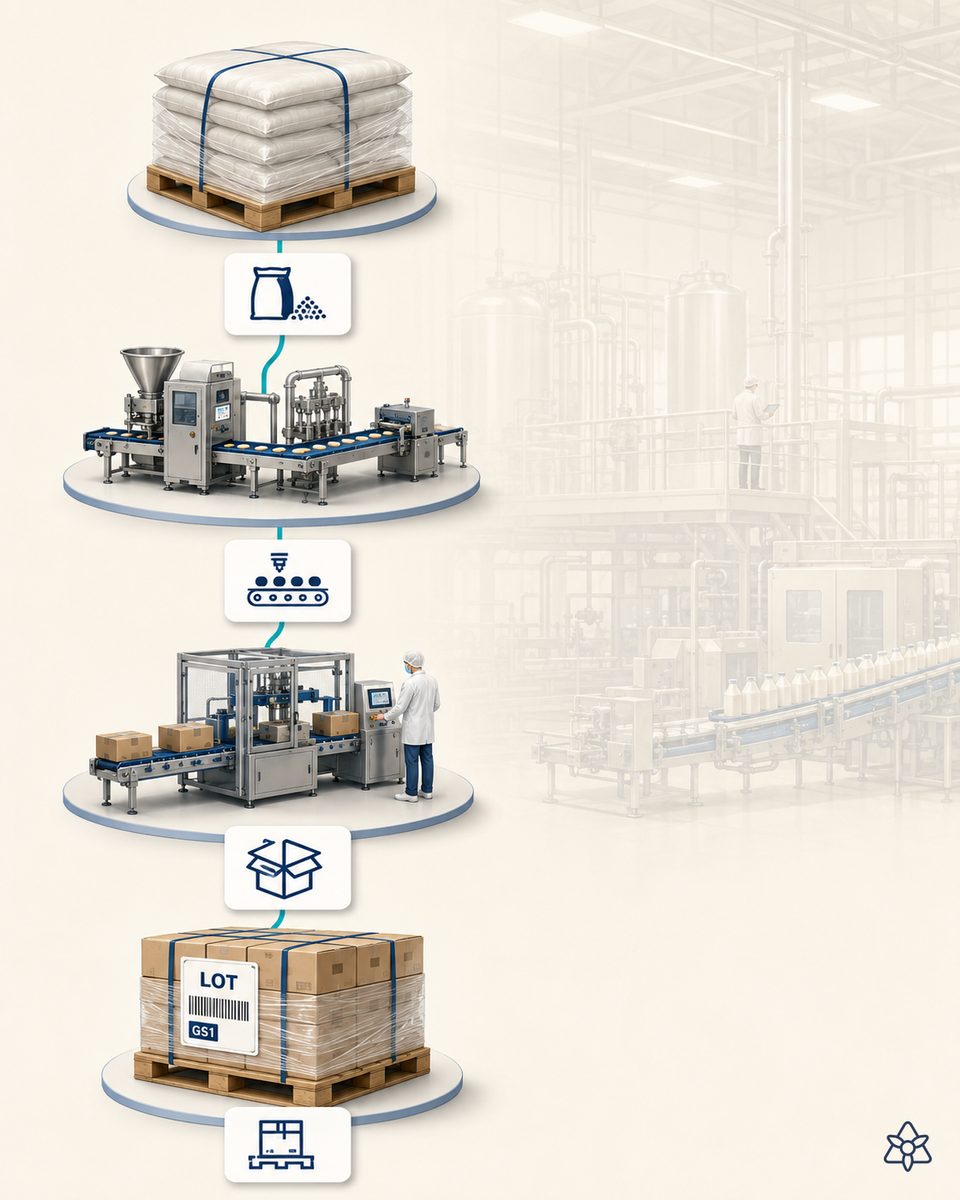
The batch lives in three worlds that hardly ever talk to each other.
A table olive crosses three worlds before it reaches the shelf, and each one keeps its share of the truth on a separate island:
- The grove and the dock — variety, parcel, harvest date, weight, on a delivery note the carrier hands over on paper. The dock operator writes it into a notebook or a spreadsheet.
- Fermentation — tank, brine, date in, fermentation time, the NaOH batch used for the lye treatment in Spanish-style processing. In the cellar supervisor's notebook, or in a vertical MES nobody else in the plant ever opens.
- Packing — size grade, format, packing date, heat treatment, printed code. In the ERP, in the line MES, or in whatever the inkjet prints at that moment.
As long as everything is fine, nobody asks. The day a retailer wants a dossier within 24h, or the night before an IFS audit, or when a food safety alert comes in about a specific parcel — somebody sits down and starts collecting fragments: a call to the carrier, a spreadsheet tab from the cellar supervisor, a photo of the notebook. The traceability exists, but it has to be rebuilt by hand every time. And every rebuild is an hour in which the plant is not producing.
iLEAN does not add another database — it seals the cracks between the ones you already have.
Table olive traceability does not break for lack of systems: it breaks because the three worlds do not talk to each other at second zero. iLEAN is the putty that fills the joints between the dock, the cellar and the line, without asking you to change any of the three. You do not knock down the wall, you fill the gap.
Edge reads the container and the code. Connect captures the delivery note and the tank record wherever they live. The agent closes the per-batch dossier and leaves it on the quality manager's desk. The audit starts with everything already on the table.
The three iLEAN pieces applied to preserved table olives:
- Edge — terminals with machine vision (CNN) at size grading and packing. They read size grade, container format and the inline printed batch code without the operator writing anything down. If the code does not match the production order, product is held before palletizing. It works with no network: if the plant loses WiFi, it keeps reading and keeps holding.
- Connect — captures the carrier's delivery note by photo or voice on the dock, reads the tank record from the cellar supervisor's notebook (photographed, dictated or integrated), and also picks up what arrives from outside (an importer's email with a new retailer rule, a WhatsApp from the brine supplier). Everything comes in and becomes usable data.
- Agent — keeps the balance of each tank, cross-references it with the packing line and closes the per-batch file. For a food safety alert on a parcel, it tells you within minutes which packed batches contain it. For an IFS/BRC/FSMA audit, it hands over the dossier already built. It exports nothing on its own — the person validates and signs.
Reconstructed traceability vs. continuous traceability with iLEAN
| Aspect | Today — reconstructed traceability | With iLEAN Edge + Connect + Agent |
|---|---|---|
| Receiving on the dock | Paper delivery note, operator's notebook | Delivery note captured by photo/voice in Connect |
| Fermentation tank balance | Cellar supervisor's notebook | Continuous, automatic balance |
| Batch changeover at packing | Paper checklist, shift lead's signature | Edge verifies format + code + recipe |
| Batch dossier for the retailer | Hours collecting spreadsheets, photos and phone calls | Signed PDF in minutes |
| Food safety alert on a parcel | A day lost hunting for where it went | List of batches and shipments in minutes |
| IFS/BRC/FSMA audit | The week before spent firefighting | A living file, ready whenever they ask |
Impact estimate for your plant — to be validated with your numbers.
The block below is an estimate to be validated with the specific data of your plant. We put it forward so the committee has an order of magnitude; we refine it during the diagnostic.
- Mid-sized table olive packer, 15-25 fermentation tanks, 2 glass packing lines + 1 pouch line, exporting to the EU and the US.
- Pilot: Connect on the dock and in the cellar + Edge on one packing line + dossier agent. First value expected within a few weeks — the first complete batch dossier generated on its own.
- Indicative payback between 4 and 9 months, depending on audit frequency, retailer demands and the documented cost of each manual traceability rebuild.
- Hard measurable lever: ≥ 30% reduction in quality hours spent rebuilding files, and a response to a parcel-level food safety alert in minutes instead of a day.
And the quality manager's reasonable doubt
“What if the agent gets a dossier wrong?” — hallucination is a problem of free generation, not of anchored tasks. Here the AI invents nothing: it reads a delivery note, cross-references it with the tank record, cross-references that with the container code and packages what already exists. In tasks anchored to a source, the best models brought error below 1.5%[1]. And even so, no dossier goes out signed without the person. The three safety rings exist precisely for this.
[1] OpenAI paper “Why Language Models Hallucinate”, 2025 — on the reliability of AI in anchored tasks.
What people ask about table olive traceability with AI
What does traceability require today for export table olives?
EU Regulation 178/2002 sets one-step-forward / one-step-back traceability as the baseline, and the private schemes (IFS, BRC, FSSC 22000) plus the FSMA 204 rule for entering the US additionally require a per-batch dossier in under 24h — parcel of origin, size grade, brine/fermentation, packing plant, heat treatment, shipment. iLEAN cross-references those sources at second zero and delivers the dossier without anyone having to round up spreadsheets.
How is the batch identified in the field without weighing everything by hand?
Connect captures the carrier's delivery note by photo or voice as it is unloaded (variety, parcel, harvest date, weight), and Edge reads the line's size grading with machine vision. The operator does not have to enter anything twice: once it is in the system, it is already cross-referenced with the brine batch and the packing run. The capture gradient adapts to each plant — from a delivery note photographed on the dock to direct integration with the dock scale where there is one.
What if I have olives from several varieties in the same fermentation tank?
The agent keeps the tank balance: what went in, when, from where, and how it is split out toward the packing lines. If a batch on the shelf mixes cornicabra and hojiblanca, it is declared correctly on the label. If a food safety alert touches a specific parcel, the system tells you within minutes which packed batches contain that olive and where they are — with no need to stop production to rebuild it in a spreadsheet.
Does it work equally well for green olives and natural black olives?
Yes. The process is different (anaerobic lactic fermentation for Spanish-style green olives, controlled oxidation for black), but the traceability problem is the same: cross-referencing origin, tank, date and packing line. iLEAN adapts to your plant's rhythm — slow fermentation, or cooked and packed within hours — without asking you to change your ERP, your tanks or your brine supplier.
What about packing in glass vs. can vs. pouch?
Edge reads the container code, the label and the batch code printed by the inline inkjet, whether it is glass with a twist-off cap, an easy-open can or a flexible pouch. If the printed batch does not match the production order and the agent's recipe, it holds the product before palletizing. The person validates and signs. The line does not restart on its own, but neither does it stop for no reason: it only holds what shows a deviation.
Related: olive oil mill traceability · FSMA export to the US · continuous IFS/BRC audit
More cases in food
- Smoked salmon fillet inspection — the line speed does not wait, and neither does the operator's eye.How iLEAN Vision inspects skin remains, pin bones and gaping in smoked salmon fillets at high line…
- Cooked mussels with closed shells — the belt crew should not have to catch every single one.iLEAN Vision spots mussels with closed shells after the steam tunnel in a cannery and fires the ejector…
- Vannamei shrimp farming — the night that takes out a whole cycle should not catch you asleep.iLEAN Edge tracks dissolved oxygen, ammonia and mortality 24/7 in Vannamei shrimp ponds and alerts the…
- Real AI cases in processed cheese12 real AI cases for plants that cut, slice and pack cheese: zero labeling recalls, paperless batch…
- RASFF and AESAN alerts with AI — a 10 pm alert should not wait until the next morning.iLEAN monitors RASFF/AESAN, cross-references alerts with your batches and drafts the official…
- Raw milk traceability from farm to plant — one record for every liter received, not five islands nobody cross-checks.iLEAN ties tanker, route, time and intake analysis into a single record for every liter of raw milk that…
Tell us your case and in 48h we'll send you the estimated ROI of this AI project for your olive packing plant.
We work on your plant's real data, not ours. Diagnostic with no commitment.
Request estimated ROI in 48h See food industry