Smoked salmon fillet inspection — the line speed does not wait, and neither does the operator's eye.
A pin bone, a piece of skin or a case of gaping that reaches packing is a retailer return — and a hard cost. iLEAN Vision inspects the smoked salmon fillet at the real speed of the line, proposes ejection and leaves the operator only the borderline cases; the person signs. The line does not slow down.
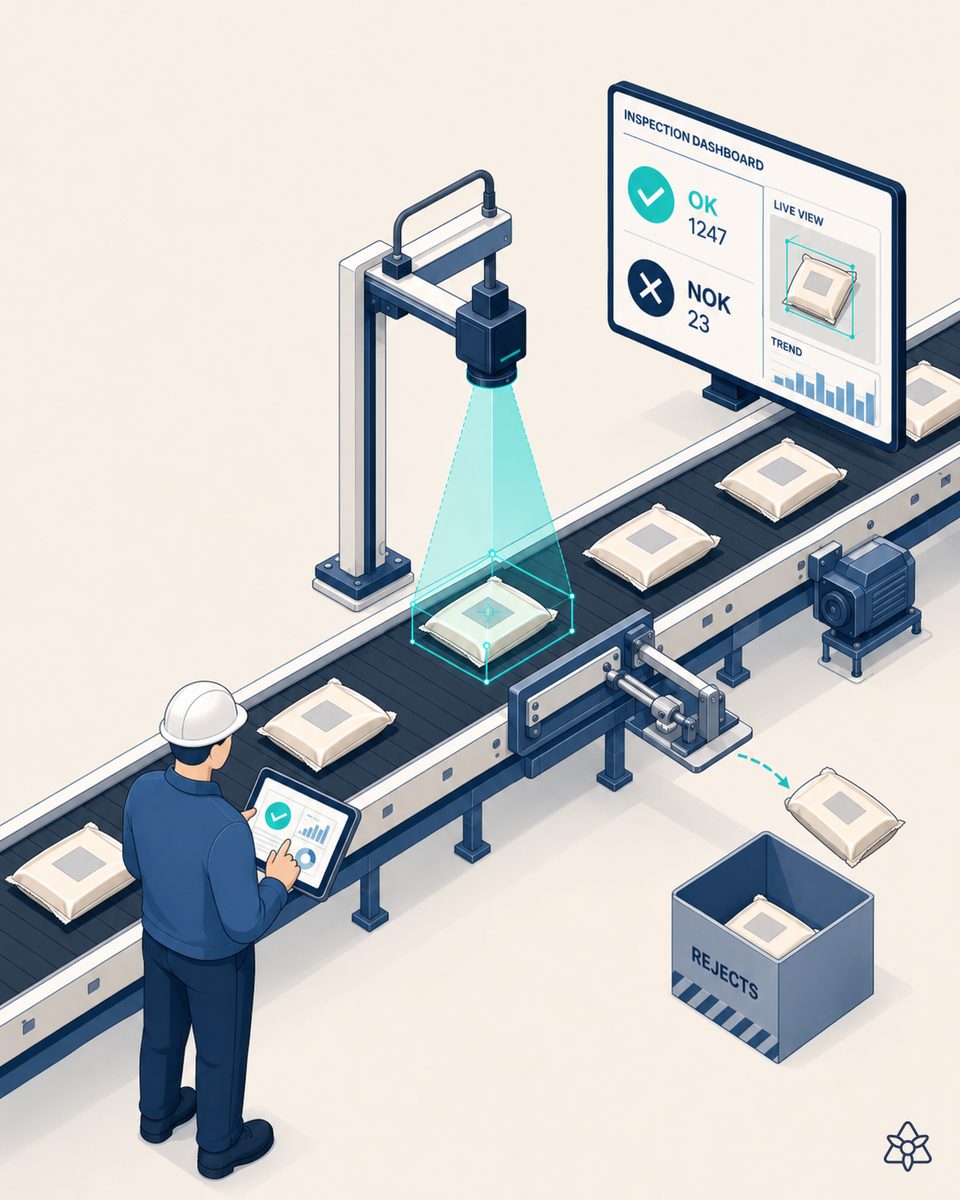
Three small defects that reach the shelf as one whole return.
On a sliced smoked salmon line, the final inspection operator has to watch thousands of fillets go by every shift. The defects that slip through are always the same:
- Pin bones — the fine bones in the loin the pin bone remover did not finish pulling. Almost invisible, painful for the customer.
- Skin remains — fragments left after skinning, especially near the tail.
- Gaping — separation between the myocommata that ruins the presentation of the sliced product.
The operator has years of training behind them, but the speed of the line does not wait, and visual fatigue is real: after a certain point, the eye stops seeing what it saw in the first hour. The classic system (operator + rhythm) works 99% of the time — and that 1% is a pallet returned by the retailer with hard costs (pulling it from the shelf, destruction, a possible penalty) and brand costs, which weigh more in the medium term.
iLEAN Vision does not replace the operator — it takes away the dumb work and leaves them the hard part.
The problem is not that operators cannot see: it is that the real speed of the line, sustained shift after shift, is not a sustainable human task. iLEAN acts as the putty that fills that gap: it filters out the thousands of good fillets, flags the clear defects for ejection, and leaves the operator only the borderline cases — the grey decision, the odd piece. Without asking you to change the line or to touch the machine cabinet PLC.
Vision filters the 99% that is good. The operator decides the borderline case. The line does not slow down, and quality goes up.
The three iLEAN pieces applied to smoked salmon inspection:
- Edge — a terminal with a high-resolution camera (and, where the sub-sector allows it, a hyperspectral or multiline channel to detect pin bones under the flesh) over the belt. A CNN trained on thousands of real fillets from your own line, calibrated by the operator who owns the station. It works with no network — if the plant loses WiFi, Edge keeps inspecting.
- Connect — captures retailer rejections (returns, claims, photos) through whatever channel they arrive on (email, PDF, WhatsApp) and feeds them back into the model's training. Every defect that slipped through becomes a new example so it does not happen the next time.
- Agent — cross-references Vision's proposals, the line's history and the shift's performance. If the defect rate rises, it raises a signal to the shift lead so they can look upstream (skinner, pin bone remover, raw material batch). The shift lead signs off the action — the line does not reprogram itself.
Inspection by eye vs. cross-checked inspection with iLEAN
| Aspect | Inspection by the operator's eye | With iLEAN Vision (Edge + Connect + Agent) |
|---|---|---|
| Coverage | Every fillet, at line rhythm | Every fillet, with no fatigue, in milliseconds |
| Fine pin bones | High risk after a certain point in the shift | Trained CNN, a continuous second opinion |
| Borderline cases | Snap decision, no time | Filtered to the operator for unhurried validation |
| Feedback learning | Returns stay buried in email | Connect captures them and retrains the model |
| Operation with no network | n/a | Edge keeps inspecting locally |
| Line speed | Drops with operator fatigue | Holds shift after shift |
Impact estimate for your plant — to be validated with your numbers.
The block below is an estimate to be validated with the specific data of your plant. We put it forward so the committee has an order of magnitude; we refine it during the diagnostic.
- Plant with a high-speed slicing line, a mix of formats (packs, slices, variable weight) and at least one demanding retailer.
- Vision pilot with an Edge camera over the final inspection belt + Connect for returns + a pattern agent. First value expected within a few weeks (detection above 90% on the main defects — a conservative floor).
- Expected reduction in returns for pin bone/skin/gaping of ≥ 30% — a conservative floor.
- Indicative payback between 4 and 9 months, depending on line volume and the average cost of a return and a claim. A single avoided return of a whole pallet because of pin bones pays for a good part of the pilot.
And the quality manager's reasonable doubt
“What if the AI ejects good fillets because it misread a shadow?” — hallucination is a problem of free generation, not of anchored tasks. In tasks where the AI simply classifies an image against a pattern learned from thousands of real examples from the line itself, the best models brought error below 1.5% [1]. And even so, the borderline cases reach the operator already filtered, and the operator signs; a doubtful piece never goes to reject on its own. The three safety rings exist precisely for this.
[1] OpenAI paper “Why Language Models Hallucinate”, 2025 — on the reliability of AI in anchored tasks.
What people ask about defect inspection in smoked salmon
Which typical defects reach the packing stage in smoked salmon?
Three main families: skin remains the skinner did not finish removing, pin bones (the fine bones in the loin the pin bone remover missed) and gaping (separation of the myocommata that ruins the presentation of the sliced fillet). On top of those come color defects from brine marking and mucus residue. In sliced smoked salmon packing, any of the three comes back as a retailer return and as a hard cost for the line.
How does iLEAN Vision detect such a fine pin bone?
iLEAN Edge combines a high-resolution camera with tailored lighting and, where the sub-sector allows it, a hyperspectral or multiline channel that picks up the bone signature under the flesh. A CNN trained on thousands of real fillets from the line proposes a pin bone mark with a confidence level. If confidence is high, it fires the actuator (ejector or diverter); if it is medium, it flags the fillet as "check" and the operator validates in a second. It works with no network: if the plant loses WiFi, Edge keeps inspecting and holding locally.
Does it keep up with the speed of a high-output line?
Yes. iLEAN Vision is designed to run at the real speed of a smoked salmon slicing line: the CNN processes locally with millisecond latency and the actuator fires within the belt's window. The line does not slow down. What changes is that the borderline cases (a fillet with a mild defect, a grey decision) reach the operator already filtered, instead of forcing them to look at every fillet — and that is what sustains quality without losing rhythm.
Does it replace the visual inspection operators?
No. We plant our flag on assist and simplify, not on automating people away. iLEAN Vision lets the operator do the work where they add value — the borderline case, the grey decision, the odd piece — and takes away the dumb work of staring at thousands of good fillets in a row. The operator ends the shift less burned out and making fewer mistakes; the plant gains sustained line speed. The person signs — always.
How does it integrate with the line's current ejector?
iLEAN Edge integrates with the existing actuator (air ejector, diverter, stack light) via dry contact or fieldbus, depending on what is already there. If the line does not yet have an ejector, we propose one as part of the pilot. We design the integration so that there is no need to touch the line PLC in the critical OT ring — Edge coexists with the existing system and fires the actuator like one more input, with no rewriting of machine logic.
More cases in food
- High FCR in seabass and seabream — every kilo of feed that sinks to the bottom is margin thrown away.How iLEAN Vision reads the behavior of seabass and seabream schools in open-sea cages and adjusts feed…
- Grading Skrei into A and B cannot depend on how tired the last shift of the season is.iLEAN Vision grades Skrei cod fillets A/B (color, firmness, integrity) on the line for premium European…
- The MSC dossier for a Skrei batch takes hours to build by hand — and days to rebuild when the auditor calls.How iLEAN Writer builds the MSC dossier for every Skrei batch (catch date, FAO area, Norwegian seal)…
- Cooked mussels with closed shells — the belt crew should not have to catch every single one.iLEAN Vision spots mussels with closed shells after the steam tunnel in a cannery and fires the ejector…
- Vannamei shrimp farming — the night that takes out a whole cycle should not catch you asleep.iLEAN Edge tracks dissolved oxygen, ammonia and mortality 24/7 in Vannamei shrimp ponds and alerts the…
- Table olive traceability with AI — from the grove to the shelf, without rounding up spreadsheets the night before the audit.How iLEAN cross-references origin, fermentation, grading and packing to deliver a per-batch dossier for…
Tell us your case and in 48h we'll send you the estimated ROI of this AI project for your smoked salmon line.
We work on your plant's real data, not ours. Diagnostic with no commitment.
Request estimated ROI in 48h See premium seafood