Cooked mussels with closed shells — the belt crew should not have to catch every single one.
After the steam tunnel in a mussel cannery, a mussel with a closed shell is a defect that cannot reach the can. Today it is separated by eye, with all the fatigue that implies. iLEAN Vision detects the closure with a CNN and fires the ejector in milliseconds — the person moves from discarding to supervising, without touching line speed.
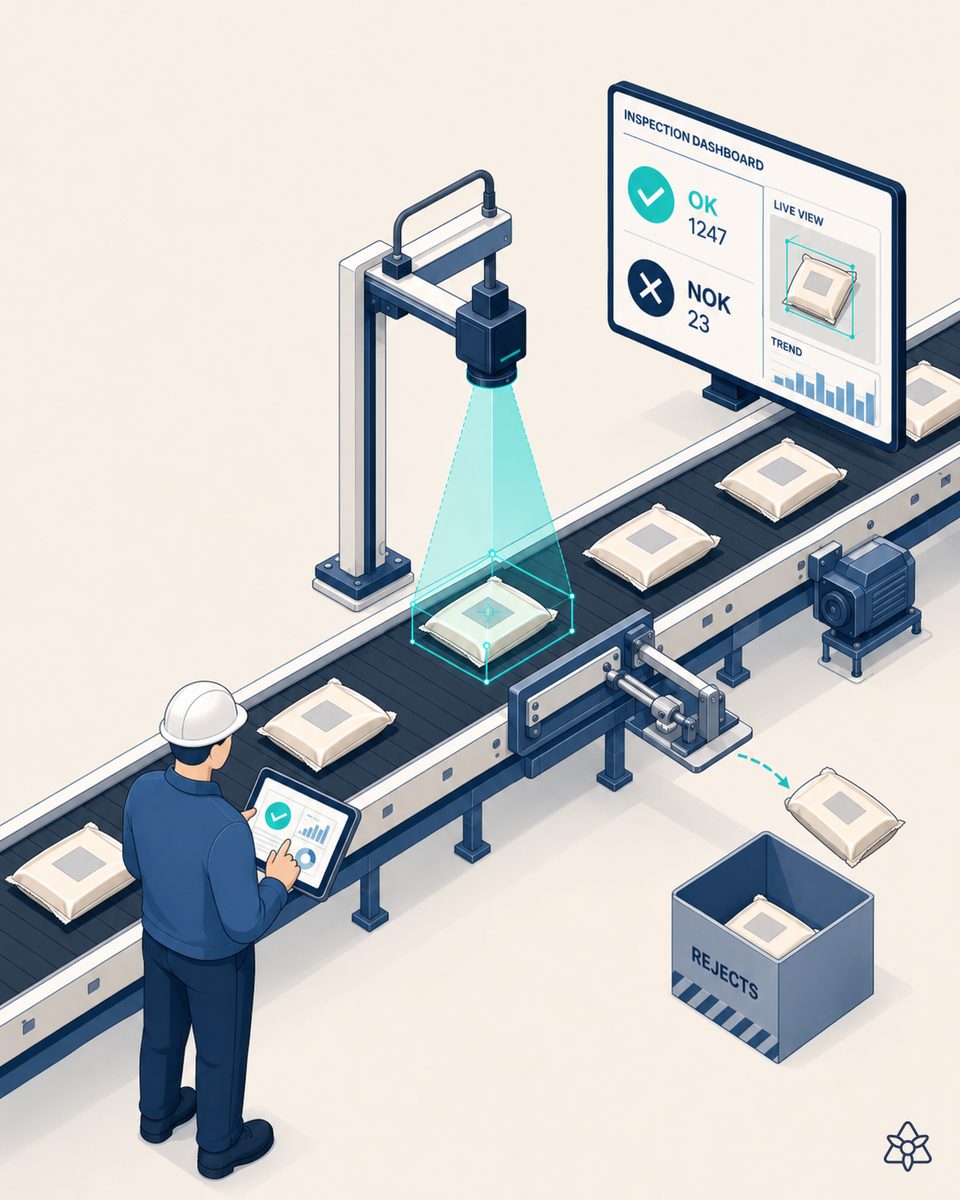
The belt out of the cooker demands an eye that never gets tired.
In a premium mussel cannery the flow is brutal: after the steam tunnel the mussels come down the belt mostly open, shells spread like a butterfly. The ones that did not open are a defect and cannot reach the can — anything that does not open under steam was most likely already dead beforehand, and that compromises the food safety quality of the finished product.
The separation is done by eye, with several people watching the belt. Three realities make the job harder than it looks:
- Line speed — thousands of mussels per hour, seconds of viewing time per unit.
- Visual fatigue — hot steam, yellow light, vibration. One hour straight and the eye starts letting things through.
- Excess caution — by the end of the shift, good product ends up being discarded "just in case". That is avoidable scrap.
The result: a percentage of closed mussels slips into the can (retailer penalties, consumer complaints) and a percentage of good open ones gets thrown away (avoidable scrap). Both at once, on the same belt, with the quality manager unable to do much more than rotate the shifts.
iLEAN Vision frees the belt crew — it does not replace them, it promotes them to quality supervisors.
Shell closure is the classic industrial vision problem: a repetitive, critical visual decision at high speed. Industrial AI has been doing exactly this for decades. iLEAN Vision fits as the putty between the cooker belt and the quality system, without asking you to change the line.
Vision sees every mussel. The ejector takes out the closed ones. The person supervises the system and signs off the borderline cases — instead of burning out watching a belt for eight hours.
The iLEAN pieces applied to post-cooker shell closure:
- iLEAN Vision (Edge) — a camera with a CNN trained on samples from your own cannery, placed over the belt coming out of the steam tunnel. Controlled lighting, a decision in milliseconds. It signals the side pneumatic ejector that separates the closed ones. It works with no network.
- Connect — captures images of the doubtful rejects so the crew can validate them and retrain the model from a phone or a tablet. It also captures the batch and the line — which delivery was on the belt when the percentage of closed mussels rose, so you can investigate the raw material.
- Agent — cross-references the hourly closure rate detected with the batch of purified mussels that was on the belt, with the cooker cycle and with the delivery note of origin. If a delivery shows an abnormal closure rate, it alerts the quality manager and the purchasing manager — not to point fingers, but to handle the incident with the supplier before the can ships.
Discarding by eye vs. discarding by iLEAN vision
| Aspect | Belt with manual discarding | With iLEAN Vision + ejector |
|---|---|---|
| Decision per mussel | Belt crew — seconds per unit | CNN — milliseconds per unit, with no fatigue |
| Visual fatigue at the end of the shift | It shows: closed ones pass, good open ones get discarded | Constant from the start of the shift to the end |
| Closed mussels that reach the can | Residual rate varies by shift | Low, stable residual rate |
| Good product discarded | "Just in case" — avoidable scrap | The model decides with consistent criteria |
| Cross-reference with raw material | Not done; the complaint comes back from the shelf | Alerts the manager when a delivery's closure rate rises |
| Role of the belt crew | Discarding by hand, wearing themselves out | Supervising, validating doubtful cases, handling incidents |
Impact estimate for your plant — to be validated with your numbers.
The block below is an estimate to be validated with the specific data of your cannery. We put it forward so the committee has an order of magnitude; we refine it during the diagnostic.
- Premium Galician mussel cannery, 1-3 packing lines, multi-format (RR-90 can, glass, escabeche, in brine).
- Vision pilot on one belt coming out of the cooker (camera + lighting + ejector + integration with the MES batch). First value expected within a few weeks.
- Indicative payback between 4 and 9 months, depending on the current percentage of closed mussels reaching the can and the average cost of a retailer penalty.
- Reduction in avoidable "just in case" scrap of ≥ 30%, and a drop in the percentage of closed mussels reaching the can to a low, stable residual rate.
- The hard lever: retailer penalties avoided + good product recovered + relief from the fatigue of the belt crew, who move on to tasks that need judgment.
And the quality manager's reasonable doubt
“What if the AI discards good open ones by mistake?” — the model is trained on samples from your own belt and the doubtful rejects are audited with the person. Hallucination is a problem of free generation, not of tasks anchored to a specific visual decision (shell closed yes / no). In those tasks, the best models brought error below 1.5% [1]. And even so, the shift manager has the panel to review and correct the model. The three safety rings exist precisely for this.
[1] OpenAI paper “Why Language Models Hallucinate”, 2025 — on the reliability of AI in anchored tasks.
What people ask about detecting shell closure in cooked mussels
Why is a cooked mussel with a closed shell a defect?
Because a shell still closed after the steam tunnel means a mussel that did not open (most likely already dead before cooking), and that is a food safety quality defect: it must not be canned. If it reaches the can, the consumer notices, the shelf complains and the retailer applies a penalty. In a premium Galician mussel cannery, the difference between a flawless batch and a batch with claims is played out on the belt coming out of the cooker.
How are closed mussels separated from open ones today?
In most canneries the separation is done by eye by the belt crew — several people watching, discarding the ones they see closed. It works, but visual fatigue is real: at high line speeds and under the yellow light of the steam, closed ones slip through, and sometimes good open ones get discarded. The cost of fatigue and the discarding done out of an excess of caution are the usual levers to improve.
What does iLEAN Vision do over the belt coming out of the cooker?
iLEAN Vision is a camera with a convolutional neural network (CNN) trained to tell shell opening apart on the belt — it works from above the mussel, with controlled lighting, and sends the ones it detects as closed to the ejector (side air blasters). It decides in milliseconds and frees the crew from the fatigue of manual discarding; they move on to supervising and auditing the system instead of watching a belt. It works with no network: if the cannery loses its Internet connection, the camera and the ejector keep running.
Does iLEAN Vision replace the belt crew?
No. The person moves from discarding by hand — a tiring, repetitive task that is critical for quality — to supervising the system, auditing the doubtful rejects and validating the shift's defect curve. Plant capacity goes up because the expert eye is reserved for borderline cases instead of being burned out on thousands of mussels per hour. It is assist and simplify, not replace.
How long does it take to see first value from iLEAN Vision on a cannery line?
Weeks, not months. The typical pilot is: camera + lighting + ejector on one belt, with a first model trained on samples from your own plant. Useful detection arrives within a few weeks; the model sharpens with feedback from the belt crew and keeps improving. We refine the estimated ROI with your line's data — ask for the diagnostic in 48h.
More cases in food
- Grading Skrei into A and B cannot depend on how tired the last shift of the season is.iLEAN Vision grades Skrei cod fillets A/B (color, firmness, integrity) on the line for premium European…
- The MSC dossier for a Skrei batch takes hours to build by hand — and days to rebuild when the auditor calls.How iLEAN Writer builds the MSC dossier for every Skrei batch (catch date, FAO area, Norwegian seal)…
- Smoked salmon fillet inspection — the line speed does not wait, and neither does the operator's eye.How iLEAN Vision inspects skin remains, pin bones and gaping in smoked salmon fillets at high line…
- Vannamei shrimp farming — the night that takes out a whole cycle should not catch you asleep.iLEAN Edge tracks dissolved oxygen, ammonia and mortality 24/7 in Vannamei shrimp ponds and alerts the…
- Table olive traceability with AI — from the grove to the shelf, without rounding up spreadsheets the night before the audit.How iLEAN cross-references origin, fermentation, grading and packing to deliver a per-batch dossier for…
- Real AI cases in processed cheese12 real AI cases for plants that cut, slice and pack cheese: zero labeling recalls, paperless batch…
Tell us your case and in 48h we'll send you the estimated ROI of this AI project for your cannery.
We work on your line's real data, not ours. Diagnostic with no commitment.
Request estimated ROI in 48h See food industry