Vannamei shrimp farming — the night that takes out a whole cycle should not catch you asleep.
In a Vannamei pond, a drop in dissolved oxygen or a spike in ammonia at 4 in the morning can take the harvest with it. Today that risk is covered with spot samples, basic probes and the technician's experience. iLEAN Edge reads every pond 24/7, learns its normal pattern and alerts the technician on duty before the crisis. The person decides the maneuver.
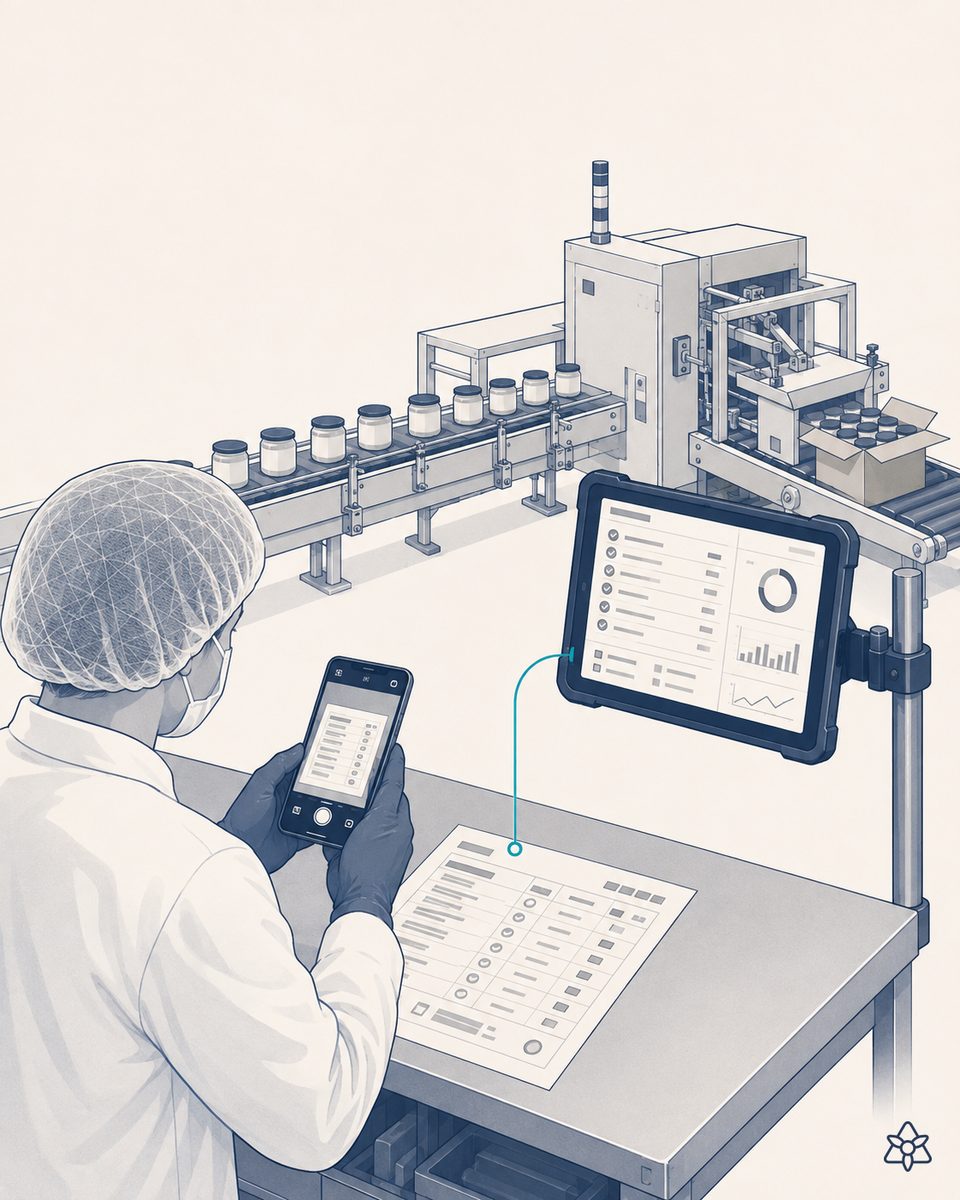
The crisis arrives at 4:00, when nobody is watching the water.
A Vannamei shrimp farm lives off a delicate operation: water, biology and time. Three parameters are enough to kill an entire cycle:
- Low dissolved oxygen. In densely stocked ponds, especially on a hot night with no wind, O2 starts falling around 02:00 and can push the pond below the lethal threshold before dawn.
- Accumulated ammonia (NH3-N). Organic matter + stocking density + high pH = ammonia released in its toxic form.
- Thermal or pH shock, especially in outdoor ponds when the weather turns abruptly.
The operation covers this as best it can: a handheld probe several times a day, fixed probes with a data logger in the important ponds, a technician doing rounds. But at 4 in the morning, on a farm with twelve ponds, what you have is one technician on duty, a phone and a lot of luck. By the time mortality starts, it is already too late — the water does not recover on its own, and rescuing the pond is a matter of minutes. An oxygen crisis can wipe out the equivalent of months of grow-out in a single night.
iLEAN Edge does not replace the technician — it gives them an assistant that never sleeps.
The problem is not a shortage of probes: it is information that reaches the decision-maker too late. iLEAN acts as the putty between the probes you already have, the veteran technician's knowledge and the control room, without asking you to change any of your equipment.
Edge reads every pond 24/7. The agent learns the normal pattern of each one. When a pond drifts out of it, the technician on duty gets a warning with time to spare — and the person decides the maneuver.
The iLEAN pieces applied to a Vannamei farm:
- iLEAN Edge — an industrial AI terminal in the control room, connected to the probes in each pond (dissolved O2, temperature, pH, ORP, and ammonia where applicable). Continuous capture, a model per pond (each one has its own pattern), an alert to the phone of the technician on duty and to the control room panel. It works with no network.
- Connect — captures the veteran technician's knowledge ("this pond always drops at 3 when there's a full moon") by voice, by WhatsApp or through the app, and turns it into a configurable early warning. It also captures the weather forecast at second zero, which on an outdoor farm is what changes the hand you are playing.
- Agent — cross-references the O2 curve with temperature, pond stocking density, the paddlewheel cycle and the weather forecast. If a pond enters the critical zone, it calls the technician on duty with the recommended maneuver (increase aeration, partial water exchange, check a specific paddlewheel). The agent proposes; the person decides and signs.
Spot sampling + night rounds vs. continuous iLEAN readings
| Aspect | Today | With iLEAN Edge + Agent |
|---|---|---|
| O2 / NH3 readings | Manual several times a day + fixed probe in some ponds | Continuous 24/7 per pond, cross-referenced in the control room |
| Detecting a pre-dawn drop | Depends on a round or on visible mortality | Phone alert as soon as the trend drifts out |
| Corrective maneuver | Reactive — once there is mortality | Anticipated — before the lethal threshold |
| The veteran technician's knowledge | In their head; it leaves when they do | Captured by Connect, stays as a farm capability |
| Cross-reference with the weather forecast | Checking a phone | Integrated, automatic alert during heat waves |
| Operation with no network | n/a | The control room keeps capturing and alerting locally |
Impact estimate for your plant — to be validated with your numbers.
The block below is an estimate to be validated with the specific data of your farm. We put it forward so the committee has an order of magnitude; we refine it during the diagnostic.
- Vannamei farm with 8-20 outdoor or covered ponds, paddlewheel aerators, basic O2 probes and a colorimetric ammonia kit, rotating technician on duty.
- Edge pilot in one sub-zone (instrumentation per pond + control room + phone alerts + integration with the weather forecast). First value expected within a few weeks: the first hot night already shows the difference between continuous data and spot sampling.
- Indicative payback between 4 and 9 months, depending on how often documented O2/NH3 mortality events occur and on the average cost of one event.
- Expected reduction in mortality from night-time events of ≥ 30%, with the capture of the veteran technician's knowledge as a permanent bonus.
- The hard lever: one single cycle saved — a single oxygen crisis avoided pays for the pilot and leaves the rest of the year as margin.
And the farm manager's reasonable doubt
“What if the AI raises a false alarm and has us mobilizing the team in the middle of the night for nothing?” — the model is tuned with data from your own farm and calibrated with the veteran technician. Alerts have thresholds per pond, not generic ones. Hallucination is a problem of free generation, not of anchored tasks like this one (probe → trend → alert), where the best models brought error below 1.5% [1]. And even so, an avoidable false-positive call a couple of times a month weighs infinitely less than a lost cycle. The three safety rings exist precisely for that — the person decides the maneuver.
[1] OpenAI paper “Why Language Models Hallucinate”, 2025 — on the reliability of AI in anchored tasks.
What people ask about Vannamei pond monitoring with AI
Which parameters kill a Vannamei shrimp cycle?
Three lead the list: low dissolved oxygen (sustained below 4 mg/L, especially in the small hours), high ammonia (elevated NH3-N in ponds with high stocking density or accumulated organic matter), and thermal or pH shock in outdoor ponds. Any one of them, in a single night, can cause a mass mortality event that wipes out several weeks of grow-out. The difference between a profitable cycle and a loss-making one is decided in a handful of critical hours, almost always before dawn.
How are those parameters controlled today on a Vannamei farm?
On many farms the usual mix is: manual samples (handheld probe, colorimetric kit) several times a day, fixed probes in some ponds with a local data logger, and the experience of the farm technician who "goes out to take a look" when something smells like trouble. It works — until it doesn't. Critical drops usually happen between 3 and 6 in the morning, exactly when nobody is sampling. The difference between catching it at 4:00 and catching it at 7:00 is, sometimes, the whole harvest.
What does iLEAN Edge do in a Vannamei shrimp pond?
iLEAN Edge is an industrial AI terminal installed in the farm control room, connected to the probes in each pond (dissolved O2, temperature, pH, ORP) and, where relevant, to ammonia probes. It captures continuously, learns the normal pattern of each pond (every pond is different), and alerts the technician on duty when a pond enters the critical zone — not on a fixed threshold, but on deviation from its own pattern. It works with no network: if the farm loses its Internet connection, the control room keeps raising alerts locally.
Why does an AI-based system detect earlier than a fixed probe threshold?
Because a fixed threshold fires when the problem is already there. A system that learns the normal pattern of one specific pond picks up the trend — a sustained oxygen drop at an unusual rate, a pH deviation that coincides with rising turbidity — before the threshold is crossed. It is predictive jidoka applied to water: we did exactly this 27 years ago in ceramics with the warping of the Marmaris tile, anticipating 30 minutes ahead that the piece would break (see the book case). The principle is the same.
Who decides the maneuver when an alert goes off?
The technician on duty. iLEAN assists and simplifies — it concentrates the information from the critical ponds, recommends a maneuver (increase aeration, do a partial water exchange, check a specific paddlewheel) and leaves the decision and the signature to the person. The system does not open valves or start paddlewheels on its own in critical operations. The management team chooses the level of autonomy ring by ring: many farms run with mandatory human validation, and that is exactly what the IRIS safety architecture allows.
More cases in food
- The MSC dossier for a Skrei batch takes hours to build by hand — and days to rebuild when the auditor calls.How iLEAN Writer builds the MSC dossier for every Skrei batch (catch date, FAO area, Norwegian seal)…
- Smoked salmon fillet inspection — the line speed does not wait, and neither does the operator's eye.How iLEAN Vision inspects skin remains, pin bones and gaping in smoked salmon fillets at high line…
- Cooked mussels with closed shells — the belt crew should not have to catch every single one.iLEAN Vision spots mussels with closed shells after the steam tunnel in a cannery and fires the ejector…
- Table olive traceability with AI — from the grove to the shelf, without rounding up spreadsheets the night before the audit.How iLEAN cross-references origin, fermentation, grading and packing to deliver a per-batch dossier for…
- Real AI cases in processed cheese12 real AI cases for plants that cut, slice and pack cheese: zero labeling recalls, paperless batch…
- RASFF and AESAN alerts with AI — a 10 pm alert should not wait until the next morning.iLEAN monitors RASFF/AESAN, cross-references alerts with your batches and drafts the official…
Tell us your case and in 48h we'll send you the estimated ROI of this AI project for your Vannamei farm.
We work on your ponds' real data, not ours. Diagnostic with no commitment.
Request estimated ROI in 48h See food industry