An injection press with no network can still give you data
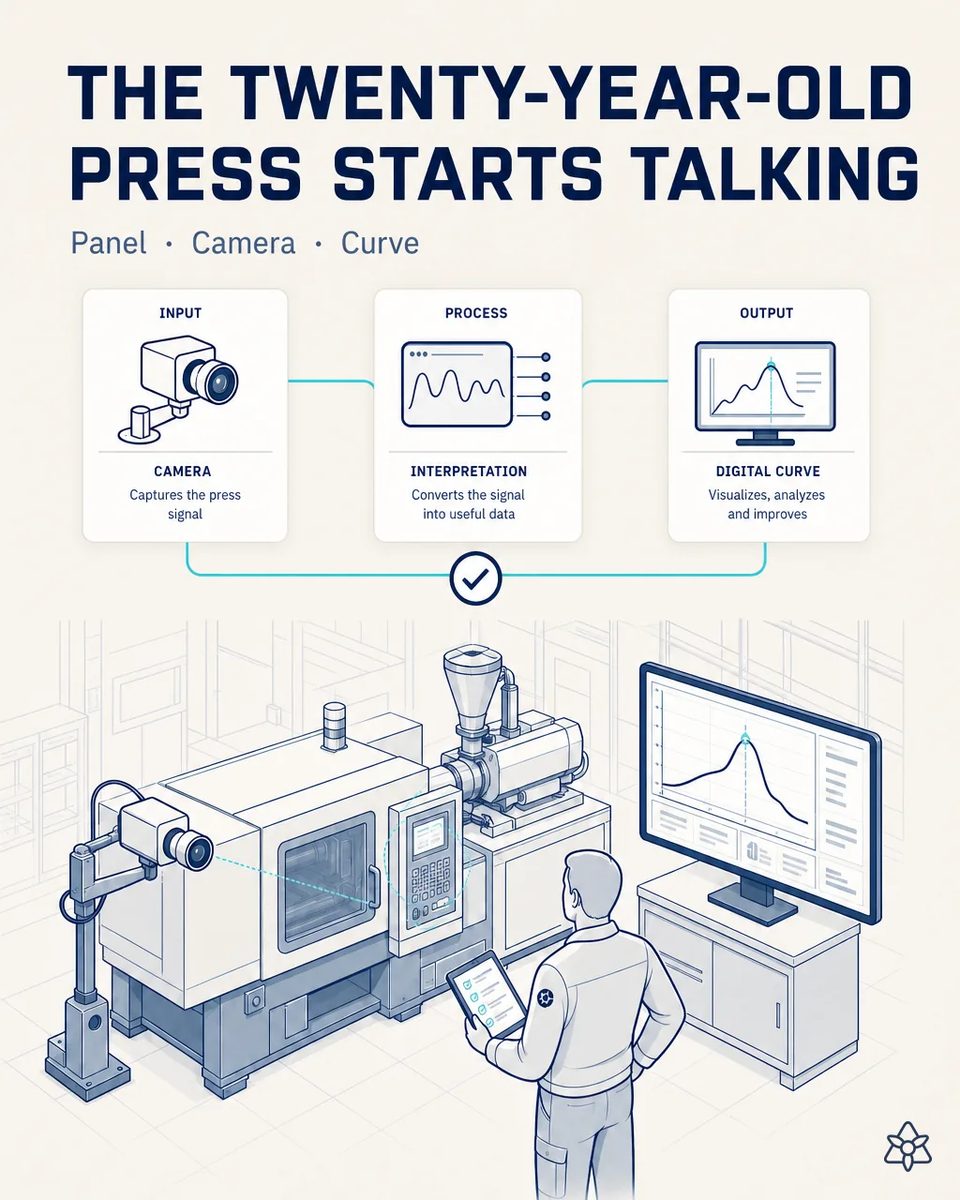
Any interiors molding shop runs five-year-old presses next to twenty-five-year-old ones. The old ones still produce good parts, which is why they are not replaced. But their panel is proprietary and isolated from the network, and it displays exactly what would be needed to explain why there are more sink marks this week. With iLEAN Connect an external camera pointed at the panel is enough: the press stays as it is, but the plant finally has its curve digitized.
The press that drifts most is the one that reports nothing.
Critical machines are, almost by definition, the ones you cannot stop and the ones you cannot touch. Nobody will authorize a control retrofit on a press running a live program, and the machine builder rarely opens the panel's protocol. The result is a data map with holes: the plant has process information from the new machines and none from the old ones, which are precisely the ones that drift most and contribute most to scrap. Switchover pressure, barrel temperature profile, actual cycle time, part counter and alarms are displayed on screen and lost right there. When a systematic defect appears — a run of sink marks, a weight difference between cavities — root cause analysis is done from memory and on the opinion of the most experienced setter. And the only "official" route to data is to budget a machine replacement, which costs hundreds of thousands of euros and weeks of reorganizing the shop floor.
- The presses that mold the biggest parts — instrument panel carriers, door panel substrates — are often the oldest, because they still make good parts. Their panel is proprietary and off the network.
- Switchover pressure, barrel temperature profile, cushion, actual cycle time, part counter and alarms are displayed on that screen and lost the moment the screen changes.
- When a run of sink marks or a weight difference between cavities appears, root cause is done from memory and on the opinion of the most experienced setter.
- The only official route to data is to budget a replacement — several hundred thousand euros and weeks of reorganizing the shop floor around a machine that still works.
Connect in photo-over-panel mode — nothing goes inside the machine.
Connect in photo-over-panel mode. A fixed industrial camera with controlled lighting points at the screen; a grounded language model reads each frame by optical recognition and structures it as a time series per part number and per mold; the system cross-checks the live ERP order to know what was being produced at each instant. No cable inside the machine, no change to its software, no recertification. When the panel cycles through screens, the system keeps reading whatever it shows at that moment.
It does not touch the press software, does not open a port and does not need the machine builder to release a protocol. On a press running a live OEM program, that is the difference between a case that gets approved this quarter and a retrofit nobody will ever authorize. The plant keeps the press that still makes good parts and gains the data it never had.
The silent press versus the press being read
| Aspect | Today | With iLEAN Connect |
|---|---|---|
| Molding curve | On the screen, then gone | Time series per part number and mold |
| Sink marks this week | Argued over from memory | Correlated with the curve of that lot |
| Alarms | Seen by whoever walks past | Recorded and searchable |
| Cavity weight drift | Discovered at the scale | Visible in the process trend |
| Machine software | — | Untouched, no recertification |
| Replacement CAPEX | In next year's plan | Deferred indefinitely |
from zero correlation between process conditions and defect to root cause analysis per lot in minutes · from alarms only seen by whoever walks past to alarms recorded and searchable · from "we have to replace the press in order to measure" to CAPEX deferred indefinitely.
Impact estimate — to be validated with your numbers.
The block below is an estimate to be validated against your plant's actual data. We put it forward so the committee has an order of magnitude; we refine it during the assessment.
- Estimated payback 5-10 months.
- Avoidance or deferral of replacement CAPEX, in the order of several hundred thousand euros for a large-tonnage press.
- Scrap reduction through curve-to-defect correlation, which is impossible today because the curve does not exist anywhere but on the screen, for the seconds it is displayed.
- And root cause on a systematic defect — sink marks, cavity weight drift, a long cycle — goes from a meeting with opinions to a query per lot in minutes.
estimated payback 5-10 months; avoidance or deferral of machine replacement CAPEX (in the order of several hundred thousand euros for a large press) and scrap reduction through curve-to-defect correlation. *Estimate to be validated.*
And the fair question from the production manager
"Can a camera really read a panel that cycles through screens?" — yes, because the task is anchored: fixed screen, fields in known positions and physical ranges known in advance, where the best models drop below 1.5% error [1]. The system reads whatever screen is showing and discards any frame whose value falls outside the possible range instead of accepting it, which is what would poison the series.
[1] OpenAI paper "Why Language Models Hallucinate", 2025 — on the reliability of AI in anchored tasks.
What people ask about reading an old press panel
Does the press have to be stopped or recertified?
No. The camera is mounted outside the guard on its own stand, with its own lighting. Nothing is connected to the press, so its validation and the OEM program running on it are unaffected. The camera is mounted and lit in an afternoon, with the press running.
Which values does it capture?
Whatever the panel shows: switchover pressure, barrel temperature profile, cushion, actual cycle time, part counter and alarm text. It is structured as a time series per part number and mold, cross-checked with the live ERP order, so a weight difference between cavities can be laid next to the process conditions of that exact hour.
What if the setter changes screens all the time?
The system keeps reading whatever is on display at that moment and stitches the values by timestamp. A screen that is never shown is never read, so the setter's routine is kept as it is.
Does it explain a run of sink marks?
It gives you what is missing to explain it: the process conditions of the lot where they appeared, against the lot where they did not. Today that comparison cannot be made because the curve does not exist. The setter still decides what to change; the difference is that they argue from a curve, not from memory.
Does it work for the foaming line or the paint booth as well?
The pattern is the same for any isolated panel: a PUR dosing unit or an oven controller. You start with the large-tonnage press because that is where most of the scrap comes from, and each panel becomes a time series the same way, cross-checked with the ERP order.
More cases from this series
- Audit evidence, generated at the moment it is producedPhotos, curves, test results and signatures tied to the serial number and organized by standard. From…
- Four verification rings against the customer line stopFour verification rings between the delivery schedule and the dock. If they do not match, the shipment…
- Receiving resin, skins and components, solved with a photoDelivery notes and container labels read by vision, cross-checked against the order and pushed to the…
- Shift knowledge stops dying at handoverA headset and voice capture for whoever walks the shift with both hands busy. The issue structures…
- Lab data stops being retyped by handCMM, color, adhesion and test reports entering the ERP quality module after sign-off. Up to 80% fewer…
- Integrating what you already have: laser marker and weld cellPart number, revision and cavity travel from the ERP to the marker with no keying, and the weld curve is…
Tell us which press in your plant everyone says should be replaced.
We work on your plant's real data, not ours. Assessment with no commitment.
Request estimated ROI within 48h ‹ See all cases of plastic interiors See automotive