Integrating what you already have: laser marker and weld cell
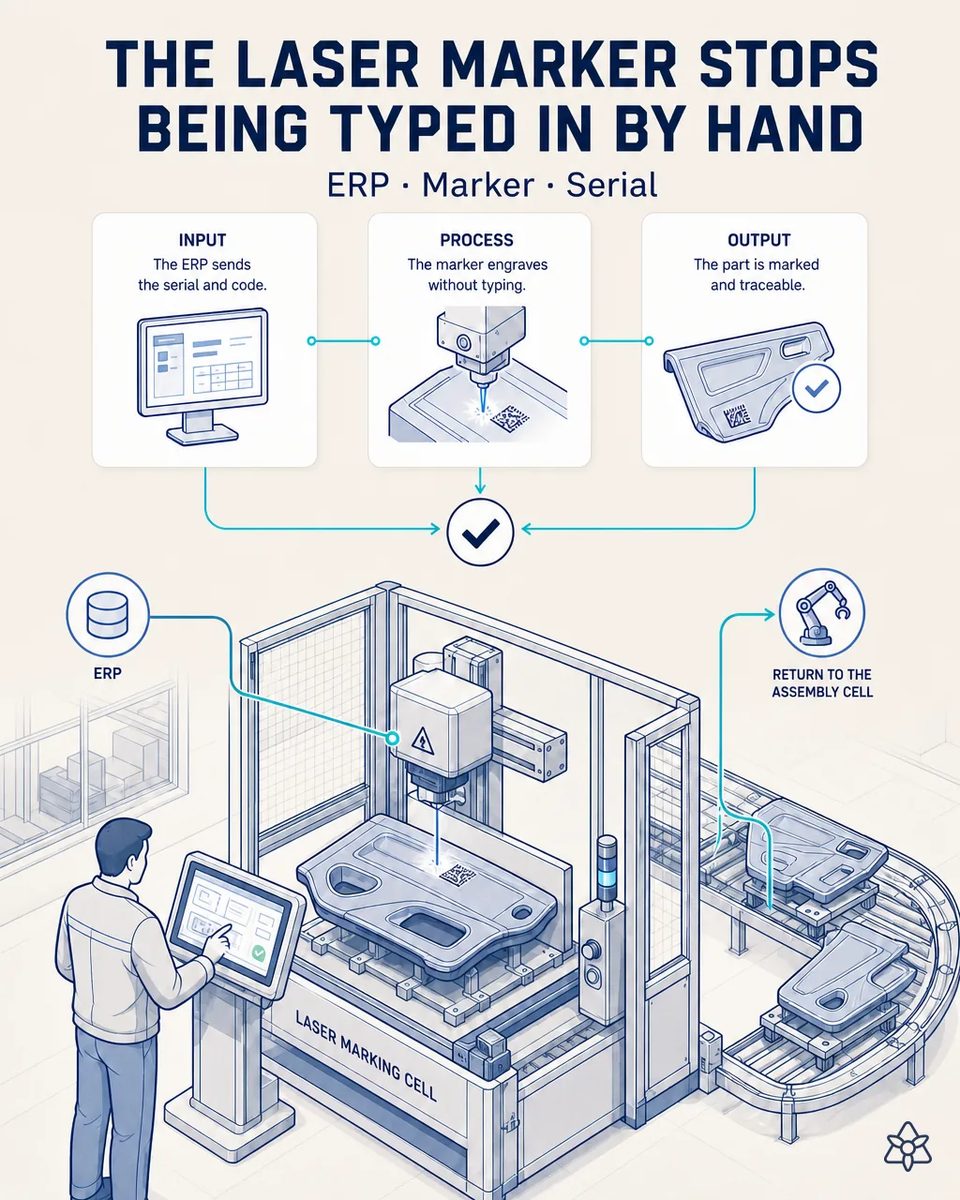
The laser marker that engraves the Data Matrix on every part is ten years old and has a perfectly usable interface. The vibration welding cell publishes its curves over OPC UA. And yet somebody types the revision at every changeover and the curves stay inside the cell. iLEAN Connect stitches both through their own interfaces, without replacing either machine.
One wrong revision digit turns a full shift into misidentified parts.
This is not a technical problem: integrating it properly has simply never climbed high enough up the priority list. The price of not having done it shows up in two different places. The first is marking. The marker is the last physical step before the customer: one wrong revision digit turns a full shift of production into misidentified parts, which at best are caught at the vehicle maker's goods-in and at worst are fitted into vehicles. The second is evidence. On parts with special characteristics — an instrument panel with an airbag tear seam, a structural weld — the process curve is the evidence of conformity. If it only lives inside the cell, as far as the auditor is concerned it does not exist, and conformity has to be demonstrated by other, usually more expensive, means.
- The marker that engraves the Data Matrix on every part is ten years old and has a perfectly usable interface. And yet somebody types part number and revision on its panel at every changeover, with the same data already in the ERP.
- The marker is the last physical step before the OEM: a wrong revision is caught at the vehicle maker's goods-in at best, and fitted into vehicles at worst.
- The vibration welding cell publishes its curves over OPC UA — melt-down depth, pressure, time — and they stay inside the cell.
- On a part with a special characteristic, such as an instrument panel with an airbag tear seam or a welded airbag chute, that curve is the evidence of conformity. If it only lives in the cell, for the auditor it does not exist.
Connect stitches two modern systems through their own interfaces, replacing neither.
Connect stitches two modern systems through their own interfaces. When the ERP declares an order start, it automatically publishes part number, revision and traceability data to the marker: changing part number becomes a change in the ERP, not a keystroke on the panel. In the other direction, Connect reads each weld curve over OPC UA and ties it to the serial number engraved on the part, so every unit leaves with its evidence attached and searchable. Neither machine is replaced or modified.
Changing part number becomes a change in the ERP, not a keystroke on the marker. And what the weld cell says it did comes back attached to the serial number it did it to, so every unit leaves with its evidence searchable. Neither machine is replaced, modified or taken out of production to do it.
The isolated cells versus the stitched cells
| Aspect | Today | With iLEAN Connect |
|---|---|---|
| Part number and revision on the marker | Typed at every changeover | Published by the ERP at order start |
| Keying errors in marking | Two or three a month | Zero of human origin |
| Vibration weld curve | Inside the cell | Tied to the engraved serial number |
| Evidence on the airbag tear seam | Demonstrated by other means | Per serial number, on demand |
| Changeover on the marker | Minutes on the panel | A change in the ERP |
| Either machine | — | Neither replaced nor modified |
from two or three keying errors a month, some reaching the customer, to zero human-origin errors in marking · from weld curves that only exist inside the cell to evidence per serial number available to quality and to the auditor.
Impact estimate — to be validated with your numbers.
The block below is an estimate to be validated against your plant's actual data. We put it forward so the committee has an order of magnitude; we refine it during the assessment.
- Estimated payback 3-6 months, the fastest of the twelve.
- A sharp reduction in the risk of a misidentified lot reaching the OEM, which is the failure that turns a full shift of instrument panels into a containment.
- Weld curves that become evidence per serial number, available to quality and to the auditor without a second, more expensive demonstration.
- And it enables the traceability ring that the zero line-stop flagship depends on.
fast payback, estimated at 3-6 months; a sharp reduction in the risk of a misidentified lot reaching the customer, and it enables the traceability ring that case 12 depends on. *Estimate to be validated.*
And the fair question from the production manager
"Isn't a classic integration cleaner?" — it is, the day the project reaches the top of the list; the problem is that it never does. This stitching uses the interfaces both machines already have, asks for no shutdown window and replaces nothing. Where a value is read rather than published — a label, a panel — it is an anchored task where the best models drop below 1.5% error [1], and the marker confirms what it actually engraved.
[1] OpenAI paper "Why Language Models Hallucinate", 2025 — on the reliability of AI in anchored tasks.
What people ask about stitching the marker and the weld cell
Do we have to replace the marker or the welding cell?
Neither. Connect leans on the marker's existing interface and on the OPC UA server the weld cell already exposes. Nothing is installed on either machine, and neither needs a shutdown window.
What if the marker fails to engrave?
It is detected, because what comes back is the marker's confirmation of what it engraved, not what was requested. Today that failure raises no signal at all: the system assumes what was requested was engraved.
Does it cover ultrasonic welding as well?
Yes, the same way: any cell that exposes its process data — ultrasonic welding on a center console, hot-plate welding on a door panel — can have its curve tied to the serial number. Vibration welding on the instrument panel is where it is usually started, because that is where the special characteristic sits.
What does the auditor get?
The weld curve of a given serial number, on demand. On a special characteristic such as the airbag tear seam, that is conformity evidence that today has to be demonstrated by other means.
How fast is the return?
The case analysis estimates 3-6 months: the integration is cheap because both interfaces exist, and the error it removes is the one that reaches the vehicle maker: two or three keying errors a month today, some of them shipped.
More cases from this series
- Audit evidence, generated at the moment it is producedPhotos, curves, test results and signatures tied to the serial number and organized by standard. From…
- Four verification rings against the customer line stopFour verification rings between the delivery schedule and the dock. If they do not match, the shipment…
- Receiving resin, skins and components, solved with a photoDelivery notes and container labels read by vision, cross-checked against the order and pushed to the…
- Shift knowledge stops dying at handoverA headset and voice capture for whoever walks the shift with both hands busy. The issue structures…
- Lab data stops being retyped by handCMM, color, adhesion and test reports entering the ERP quality module after sign-off. Up to 80% fewer…
- The mold changeover start-up sheet, captured with a photoThe real changeover parameters and the approved first-off part in the central system at second zero.…
Tell us how many machines in your plant have an API you still do not use.
We work on your plant's real data, not ours. Assessment with no commitment.
Request estimated ROI within 48h ‹ See all cases of plastic interiors See automotive