Lab data stops being retyped by hand
In an interiors plant the lab produces data all day: the coordinate measuring machine, the spectrophotometer, the test bench, paint adhesion, resin moisture and melt flow index. All of it lands in a shared folder and stays there. iLEAN Connect reads the file when it is saved, structures it, ties it to the lot and — after the lead's sign-off — inserts it into the ERP quality module.
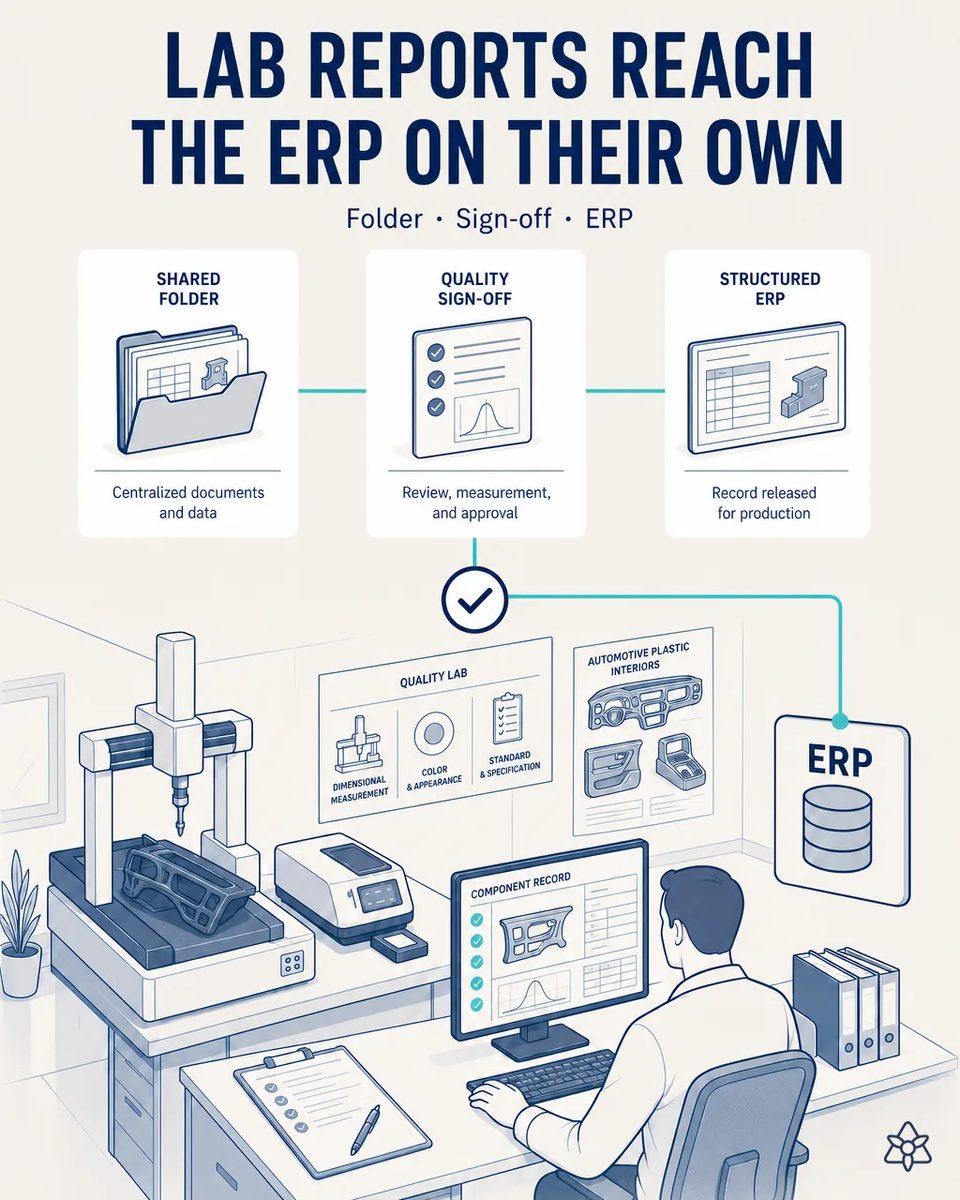
Two parallel worlds, and a person copying cells between them.
Two parallel worlds exist. The real one, the lab folder, where the live data sits and where anybody who genuinely needs to know goes to look. And the official one, the ERP, with transcribed, incomplete data lagging by however long the person doing the transcription lags. When a customer complaint arrives, the two have to be reconciled and they almost never match. Half a day a month copying and pasting is the least of it: the serious part is that auditable evidence is being retyped by hand, with the error rate that implies. And there is a hidden operational cost: an out-of-tolerance value is only discovered when somebody gets around to transcribing it, with the press having produced for hours against that condition.
- The lab produces data all day: CMM reports on the instrument panel carrier, color readings against the OEM master plaque, gloss, paint cross-hatch adhesion, resin moisture before drying, melt flow index of each incoming lot.
- All of it lands in a shared folder, which is where anyone who genuinely needs to know goes to look. The ERP holds a transcribed, incomplete version lagging by however long the person transcribing lags.
- When a customer complaint arrives, the two have to be reconciled and they almost never match. Auditable evidence is being retyped by hand, with the error rate that implies.
- And an out-of-tolerance value is only discovered when somebody gets around to transcribing it, with the press having molded for hours against that condition.
Connect listening inwards — the folder, not the people.
Connect listening inwards. The system observes the shared folder — not the people — reads the delta when the file is saved, parses it with a grounded model including the PDFs each instrument formats its own way, normalizes against the control plan, shows the result for human sign-off and pushes it into the ERP quality module through its interface. If a value falls out of tolerance it does not wait for transcription: it flags it there and then and alerts the lead.
The alert does not wait for transcription: a color reading outside the OEM tolerance or a moisture value over the drying limit fires while the press is still running, not at the end of the month. The rest of the case is the CFO's: the ERP is licensed per named user, and the people who log in purely to type stop needing to.
Today's lab versus the connected lab
| Aspect | Today | With iLEAN Connect |
|---|---|---|
| Gap between folder and ERP | Days or weeks | Second zero |
| Transcription | Half a day a month, minimum | Zero |
| Color reading out of tolerance | Found at transcription | Flagged while the press is running |
| Link between result and lot | Never cross-referenced | Automatic, lot by lot |
| Instrument PDF formats | Each one retyped | Parsed as they come |
| Quality module licenses | Five | One, the person who validates |
from a lag of days or weeks to second zero · from half a day a month transcribing to zero · from an out-of-tolerance result found at transcription time to one that fires while the press is running · from quality data never cross-referenced with the lot to automatic lot-by-lot linkage.
Impact estimate — to be validated against your actual ERP invoice.
The block below is an estimate to be validated against your plant's actual data. We put it forward so the committee has an order of magnitude; we refine it during the assessment.
- Estimated payback 4-9 months, on top of the license saving.
- 💰 CFO angle: the ERP bills per named user. If five people across lab and quality hold a quality module license purely to key in results, that is five licenses; with Connect only the person who validates needs one. Typical reduction of 50-80% on that module, saved every year.
- Half a day a month of copying and pasting, gone, along with the transcription errors in auditable evidence.
- And the out-of-tolerance color or moisture result fires while the press is running instead of weeks later, when the lot has already been molded and shipped.
CFO angle — the ERP is licensed per named user. If five people across lab and quality hold an active quality module license purely to key in test results, that is five licenses; with Connect only the person who validates needs one. Typical reduction of 50-80% on that module's licenses, saved every year. Estimated payback 4-9 months on top of the license saving. *Estimate to be validated against the actual ERP invoice.*
And the fair question from the production manager
"Every instrument formats its report differently — does it hold up?" — that is the anticipated case: parsing does not depend on fixed positions, it interprets the CMM report, the spectrophotometer export and the adhesion sheet as each instrument writes them, and normalizes them against the control plan. It is an anchored task, where the best models drop below 1.5% error [1], and the quality lead signs before anything is pushed.
[1] OpenAI paper "Why Language Models Hallucinate", 2025 — on the reliability of AI in anchored tasks.
What people ask about connecting the lab folder
Do we have to standardize the lab's files?
No, and it is better not to. Asking the lab to change how it saves results is the fast route to the system going unused. Connect reads the files as they exist today, PDFs included, and tolerates the sheet as it changes over the years.
Which results does it cover?
Whatever lands in the folder: CMM dimensions, color and gloss readings, paint adhesion, resin moisture, melt flow index, test bench results. Each is tied to the lot it belongs to and to the part number in the control plan.
Does it check against the control plan?
Yes. Each value is normalized against the tolerance in the control plan for that part number, and a value out of tolerance alerts the lead immediately rather than waiting for transcription. A color reading drifting toward the OEM limit shows as a trend before it crosses it.
Can licenses really be reduced?
It depends on your contract, which is why it is framed as an estimate to validate against last year's invoice. The logic is that anyone who logs in purely to type stops needing to.
Does it help with a PPAP submission?
It is one of the biggest time savers: the dimensional and material results a PPAP needs are exactly what gets rebuilt by hand against the clock today. With the folder connected, they are already in the ERP the day the submission is due.
More cases from this series
- Audit evidence, generated at the moment it is producedPhotos, curves, test results and signatures tied to the serial number and organized by standard. From…
- Four verification rings against the customer line stopFour verification rings between the delivery schedule and the dock. If they do not match, the shipment…
- Receiving resin, skins and components, solved with a photoDelivery notes and container labels read by vision, cross-checked against the order and pushed to the…
- Shift knowledge stops dying at handoverA headset and voice capture for whoever walks the shift with both hands busy. The issue structures…
- Integrating what you already have: laser marker and weld cellPart number, revision and cavity travel from the ERP to the marker with no keying, and the weld curve is…
- The mold changeover start-up sheet, captured with a photoThe real changeover parameters and the approved first-off part in the central system at second zero.…
Bring your annual ERP invoice and we will count the quality module licenses you no longer need.
We work on your plant's real data, not ours. Assessment with no commitment.
Request estimated ROI within 48h ‹ See all cases of plastic interiors See automotive