Four verification rings against the customer line stop
The capital pain of a sequenced interiors tier-1 is always the same: zero stops on the customer's line and zero ppm. A part that is missing, arrives out of sequence or arrives wrong does not cost what the part costs: it costs billable minutes of vehicle line and a supplier rating downgrade paid for over years. The iLEAN flagship coordinates the previous eleven pieces into four rings that cross-check each other.
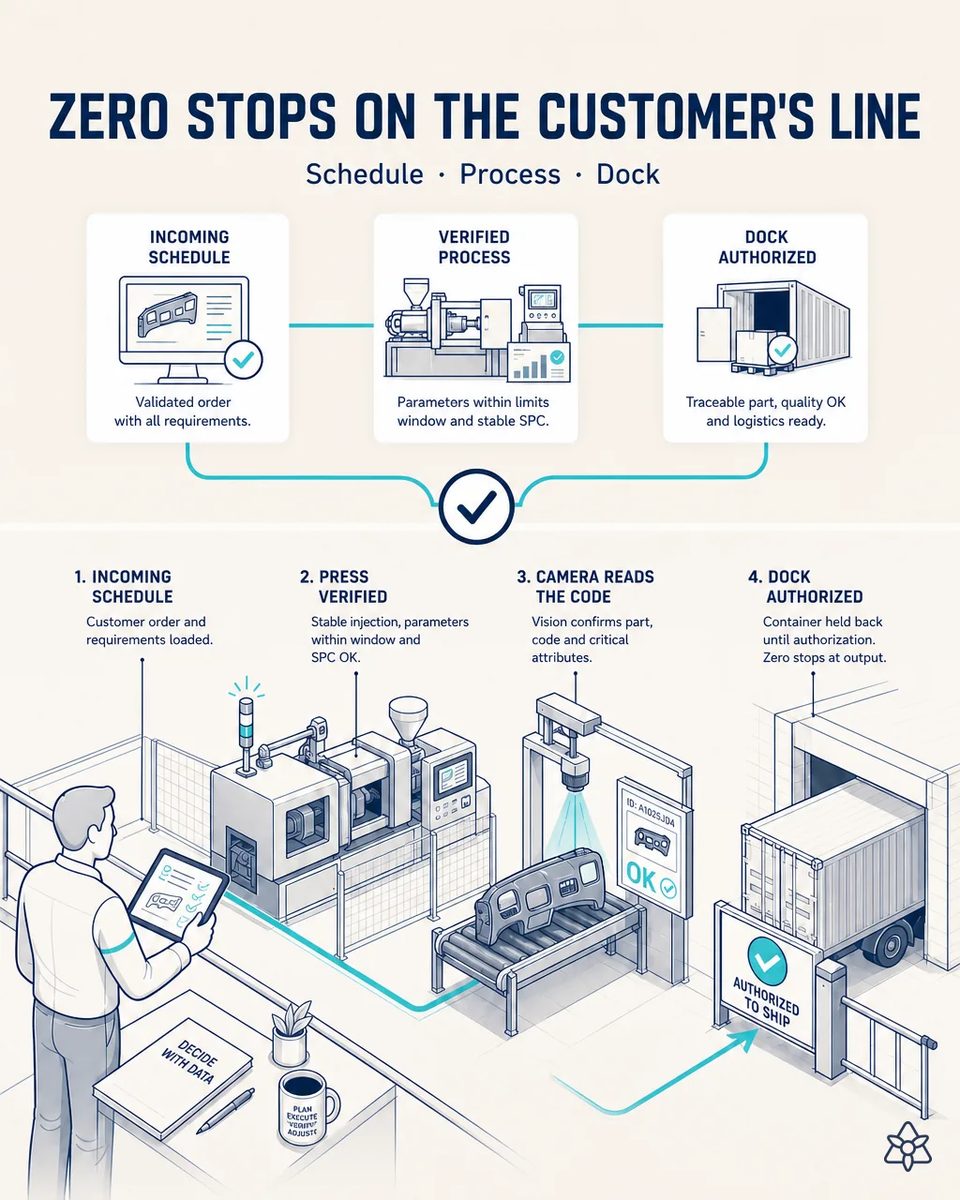
The failure modes are many, and no single control covers them.
In sequenced supply there is no buffer. The failure is not absorbed by stock: it reaches the customer's line within hours. And the failure modes are many and unlike each other — wrong part number, superseded revision, surface defect, container out of sequence, wrong marking, transport delay — so no single control covers them. That is why the flagship is not a new piece: it is the coordination of the previous eleven. The cost is not just the incident. It is the meeting with purchasing, the special freight, and above all the downgrade in the supplier panel, which is paid for over years in programs you do not win.
- Wrong part number, superseded revision, surface defect, container out of sequence, wrong marking, transport delay. Each escapes a different control, and in sequenced supply none of them is absorbed by stock.
- A part that is missing, arrives out of sequence or arrives wrong does not cost what the part costs: it costs billable minutes of vehicle line, written into the contract.
- Then comes the meeting with purchasing, the special freight and, above all, the downgrade in the supplier panel, paid for over years in programs you do not win.
- That is why the flagship is not a new piece: it is the coordination of the previous eleven, so that four independent sources have to agree before a container leaves.
Agents coordinates four rings that cross-check each other — it is all of the above, orchestrated.
No single ring solves the problem: each control already exists in some form and the wrong container still ships. The strength is in the cross-check, because what gives the failure away is the sequence call, the process, the part and the dock ceasing to agree.
- Ring 1 · schedule and alerts. The delivery schedule and the sequence call define what, how much and when; Connect in chaotic-sources mode (case 3) adds what does not travel through the formal channel and cross-checks it against the live plan before anyone stages the wrong container.
- Ring 2 · process. Start-up only happens with the changeover verified by cameras and signed off (case 10), with the actual parameters captured (cases 1 and 2) and the material traced from goods-in (case 7). If the changeover is not conforming, JIDOKA AI does not let the line start.
- Ring 3 · part. The Edge camera inspects appearance on one hundred percent of parts (case 9) and the laser marker engraves each part with its part number, revision and cavity taken straight from the ERP, with no keying (case 8). The weld curve is tied to that serial number.
- Ring 4 · shipping. At the dock, the camera reads the part codes and the container label and cross-checks them against the requested sequence. If part number, revision or order do not match, JIDOKA AI holds the shipment and raises the concrete action. Every container leaves with its evidence pack already assembled (case 11).
SMED AI speeds up and sequences changeovers so the four rings are not paid for in productivity, and Agents coordinates the automatic decisions and escalates to a human whatever requires judgment.
The four rings, and what each one closes
| Ring | Which cases it draws on | What it closes |
|---|---|---|
| 1 · Schedule and alerts | Sequence alert (3) | What, how much and when, including what skipped EDI |
| 2 · Process | Changeover (10) + start sheet (1) + press panel (2) + receiving (7) | No start-up on the wrong setup or material |
| 3 · Part | Surface inspection (9) + laser marker and weld (8) | Every part conforming, marked and with its weld curve |
| 4 · Shipping | Evidence pack (11) + dock camera | Part codes and container label against the requested sequence |
| SMED AI | Changeover (10) | The rings are not paid for in productivity |
| Human verification | Tablet (5) + headset (4) | Judgment stays with a person |
from supply incidents discovered on the customer's line to discrepancies caught on your own dock · from reconstructing after the fact to holding the evidence before anyone asks · from a ppm rate that depends on whoever is on shift to one hundred percent inspection.
Impact estimate — to be validated with plant management, quality and logistics.
The block below is an estimate to be validated against your plant's actual data. We put it forward so the committee has an order of magnitude; we refine it during the assessment.
- Estimated payback 6-12 months against the first incident avoided, measured in the contractual cost of one minute of stoppage on the OEM line plus a containment with external inspection.
- Supply incidents discovered on the customer's line become discrepancies caught on your own dock.
- A ppm rate that depends on whoever is on shift becomes one hundred percent inspection.
- And the multi-year value of holding your standing in the purchasing panel, which is not counted in the payback.
the economic reference is the cost of one minute of stoppage on the customer's line — which is written into the contract — plus the cost of a containment with external inspection. Estimated payback 6-12 months against the first incident avoided, without counting the multi-year value of holding your standing in the purchasing panel. *To be validated with plant management, quality and logistics.*
And the fair question from the production manager
"Do we have to deploy all twelve cases to get this?" — no, and framing it that way would be the way never to start. The rings are built in layers and each case pays on its own. With the sequence alert and the changeover validation you already have ring 1 and most of ring 2. At the dock, reading the part codes and the container label is an anchored task where the best models drop below 1.5% error [1]; JIDOKA AI holds a shipment on a verifiable mismatch, and a person releases it.
[1] OpenAI paper "Why Language Models Hallucinate", 2025 — on the reliability of AI in anchored tasks.
What people ask about the zero line-stop system
Where do you start?
With the case that has the fewest dependencies and the shortest deployment, which in this matrix is the mold start-up sheet or the laser marker. What matters is that each layer pays on its own before the next is added.
What does the cross-check give that each control does not?
The failure that passes every control separately: a superseded revision that is molded, painted, inspected and marked correctly, and is still the wrong part for that sequence. Ring 4 catches it because the dock disagrees with the call.
What happens at the dock when something does not match?
JIDOKA AI holds the shipment inside the plant and raises the concrete action: which container, which part number or revision, which position in the sequence. A person decides; nothing leaves on its own.
Does it replace the ERP or the EDI link?
No. Ring 1 rests precisely on the sequence call being the truth. iLEAN cross-checks the systems against each other and against what actually happens on the presses and at the dock.
Can the return be estimated before committing?
Yes: with the contractual cost of a minute of OEM line stoppage, the cost of your last containment and the number of changeovers per week, the return per layer is estimated before deciding the order.
More cases from this series
- Audit evidence, generated at the moment it is producedPhotos, curves, test results and signatures tied to the serial number and organized by standard. From…
- Receiving resin, skins and components, solved with a photoDelivery notes and container labels read by vision, cross-checked against the order and pushed to the…
- Shift knowledge stops dying at handoverA headset and voice capture for whoever walks the shift with both hands busy. The issue structures…
- Lab data stops being retyped by handCMM, color, adhesion and test reports entering the ERP quality module after sign-off. Up to 80% fewer…
- Integrating what you already have: laser marker and weld cellPart number, revision and cavity travel from the ERP to the marker with no keying, and the weld curve is…
- The mold changeover start-up sheet, captured with a photoThe real changeover parameters and the approved first-off part in the central system at second zero.…
Tell us what a minute of stoppage on your customer's line costs and we will hand you back the full business case.
We work on your plant's real data, not ours. Assessment with no commitment.
Request estimated ROI within 48h ‹ See all cases of plastic interiors See automotive