Receiving resin, skins and components, solved with a photo
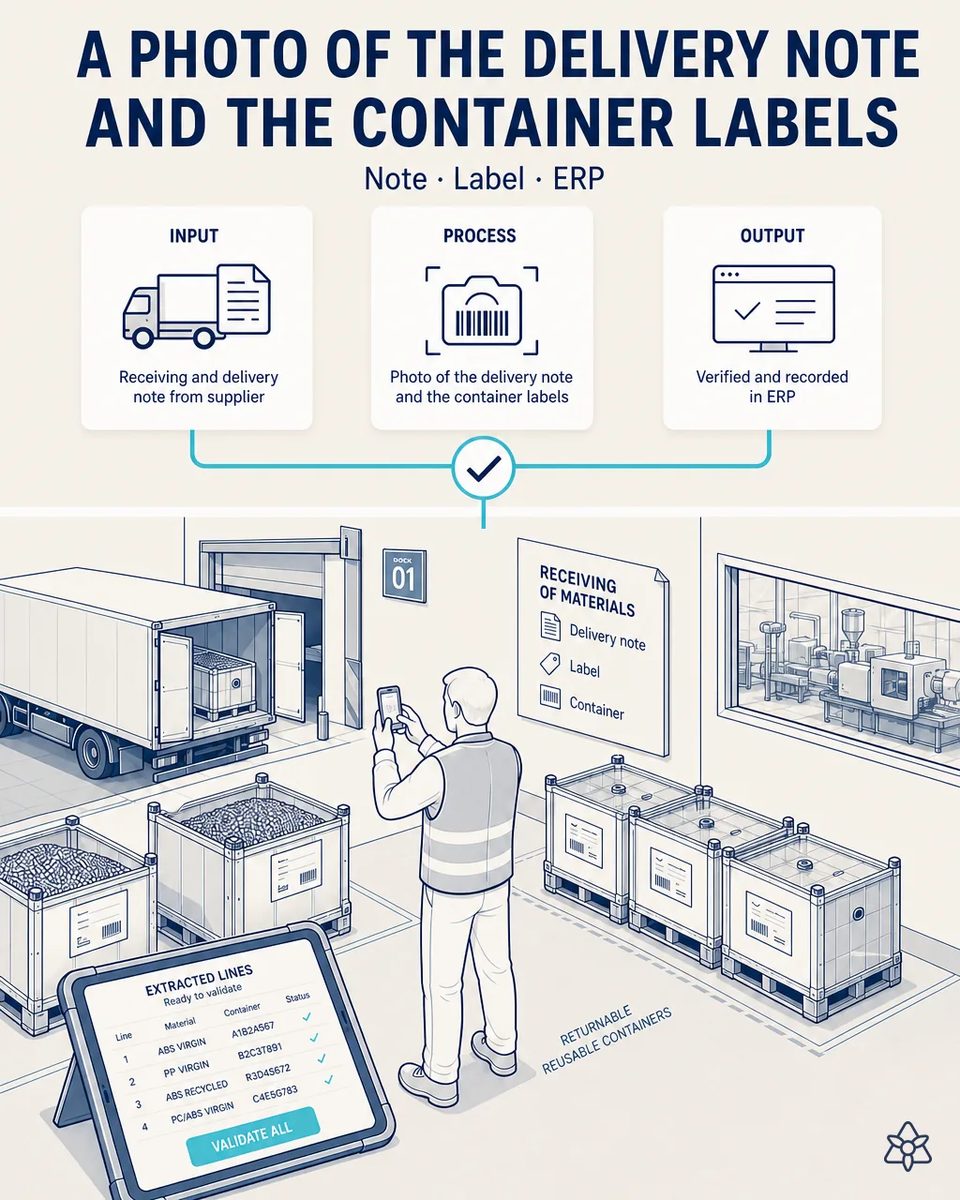
The truck arrives with resin, masterbatch, skins, inserts and bought-out components. The receiving lead holds a delivery note with fifteen or twenty lines and faces a stack of labeled containers, and has to sign and then key it into the ERP. With iLEAN Connect one photo of the note and one of the labels is enough: the system extracts everything, cross-checks the order, the lead validates with one tap and it enters the ERP.
Traceability down to the cavity starts with someone typing under pressure.
Receiving is a bottleneck against the clock. Every supplier has its own delivery note format and none of them will change it. Container labels are standardized, but the ERP still requires goods to be booked in line by line. There are only two ways out and both are bad. Either the carrier waits forty-five minutes charging demurrage, or the data is keyed in fast and the lots end up wrongly linked. The second error is the expensive one, and it is invisible on the day it happens. It surfaces months later, when the customer asks for full traceability of a batch of parts — a standard automotive requirement, where traceability reaches down to the cavity — and nobody can reconstruct which resin they were made from.
- The truck arrives with resin pellets in octabins, masterbatch, laminated skins, inserts and bought-out components. The receiving lead holds a delivery note with fifteen or twenty lines and faces a stack of labeled containers.
- Every supplier has its own delivery note format and none of them will change it. Container labels are standardized, but the ERP still requires booking in line by line.
- Two ways out, both bad: either the carrier waits forty-five minutes charging demurrage, or the data is keyed in fast and the lots end up wrongly linked.
- The wrong link is invisible on the day. It surfaces months later, when the OEM asks which resin lot a batch of center consoles was molded from and nobody can reconstruct it.
Connect in photo mode — the note, the labels, no supplier changes.
Connect in photo mode. Vision recognizes the tabular structure of the delivery note whatever format the supplier uses, and reads the container labels, whether barcode, Data Matrix, QR or plain text by optical recognition. The system extracts supplier, material, lot, quantity and container, cross-checks against the open ERP order and flags quantity or part number discrepancies before the note is signed. The lead validates with one tap on the dock tablet and only then does everything enter the ERP.
The discrepancy between the note and the labels is highlighted before the note is signed, not after the truck has left. Today nobody makes that cross-check with a carrier waiting at the dock. And the resin lot that goes into the container is linked to it from minute one, which is the first link of the chain that ends at the cavity.
Today's receiving versus captured receiving
| Aspect | Today | With iLEAN Connect |
|---|---|---|
| Truck at the dock | 45 minutes | Under 10 |
| Delivery note formats | One per supplier, all typed | Read whatever the layout |
| Container labels | Scanned or typed line by line | Read from one photo |
| Wrongly linked lots | Surface months later | Do not occur |
| Resin lot to cavity traceability | Broken at the dock | Complete, container to part |
| Receiving and warehouse licenses | Two or three | One, the lead who validates |
from 45 minutes of truck waiting to under 10 · from lot errors invisible until a complaint to zero · from broken material traceability to full traceability from the supplier's container down to the part.
Impact estimate — to be validated with your numbers.
The block below is an estimate to be validated against your plant's actual data. We put it forward so the committee has an order of magnitude; we refine it during the assessment.
- Estimated payback 3-8 months.
- 💰 CFO angle: the receiving and warehouse module typically needs two or three active licenses purely to book goods in; with Connect only the lead validates. Typical reduction of 50-70% on that module, plus the removal of bulk-capture add-ons.
- Carrier demurrage, which is usually the first number that surprises people when the annual total is added up, eliminated.
- And full material traceability from the supplier's container down to the part and its cavity, which is the standard automotive requirement that receiving breaks today.
CFO angle — the receiving and warehouse module typically requires two or three active licenses (receiving lead, support, shift supervisor) that exist purely to book goods in. With Connect only the lead validates, with one tap and without entering the ERP: typical reduction of 50-70% on that module's licenses, plus the removal of bulk-capture add-ons and of carrier demurrage. Estimated payback 3-8 months. *Estimate to be validated.*
And the fair question from the production manager
"Does it recognize every supplier's delivery note?" — yes, without asking any of them to change it: the model extracts the tabular structure of the note with no per-supplier template. Labels are read by barcode, Data Matrix or QR where present and by optical recognition where not. It is an anchored task, where the best models drop below 1.5% error [1], and the lead validates on the dock tablet before anything enters the ERP.
[1] OpenAI paper "Why Language Models Hallucinate", 2025 — on the reliability of AI in anchored tasks.
What people ask about receiving with a photo
Does it work for materials as different as resin, skins and inserts?
Yes. What changes between them is the format of the note and the label, and the model reads the structure without a template. An octabin label and a skin roll label are handled the same way, and inserts or bought-out components with a supplier Data Matrix are read from the same photo.
What if the note and the labels disagree?
The discrepancy in quantity or part number is highlighted in the summary before the note is signed. That is exactly the check that never gets made today with a truck waiting.
Do we need barcode scanners?
Not necessarily: a photo from the phone or the dock tablet is enough. If the plant already has scanners that work well, they integrate just the same; what disappears is the line-by-line booking in the ERP.
Does it close traceability down to the cavity?
It closes the first link: which resin and masterbatch lot went into which container. Combined with the start-up sheet, that is what lets you reach the cavity when the OEM asks for the full traceability of a batch of parts months later.
Can we start with receiving alone?
Yes, and it is a good starting point: the result is visible from the first truck and does not depend on the other pieces being deployed. The dock tablet and the phone are the only hardware involved.
More cases from this series
- Audit evidence, generated at the moment it is producedPhotos, curves, test results and signatures tied to the serial number and organized by standard. From…
- Four verification rings against the customer line stopFour verification rings between the delivery schedule and the dock. If they do not match, the shipment…
- Shift knowledge stops dying at handoverA headset and voice capture for whoever walks the shift with both hands busy. The issue structures…
- Lab data stops being retyped by handCMM, color, adhesion and test reports entering the ERP quality module after sign-off. Up to 80% fewer…
- Integrating what you already have: laser marker and weld cellPart number, revision and cavity travel from the ERP to the marker with no keying, and the weld curve is…
- The mold changeover start-up sheet, captured with a photoThe real changeover parameters and the approved first-off part in the central system at second zero.…
Tell us how much your plant pays a year in carrier demurrage.
We work on your plant's real data, not ours. Assessment with no commitment.
Request estimated ROI within 48h ‹ See all cases of plastic interiors See automotive