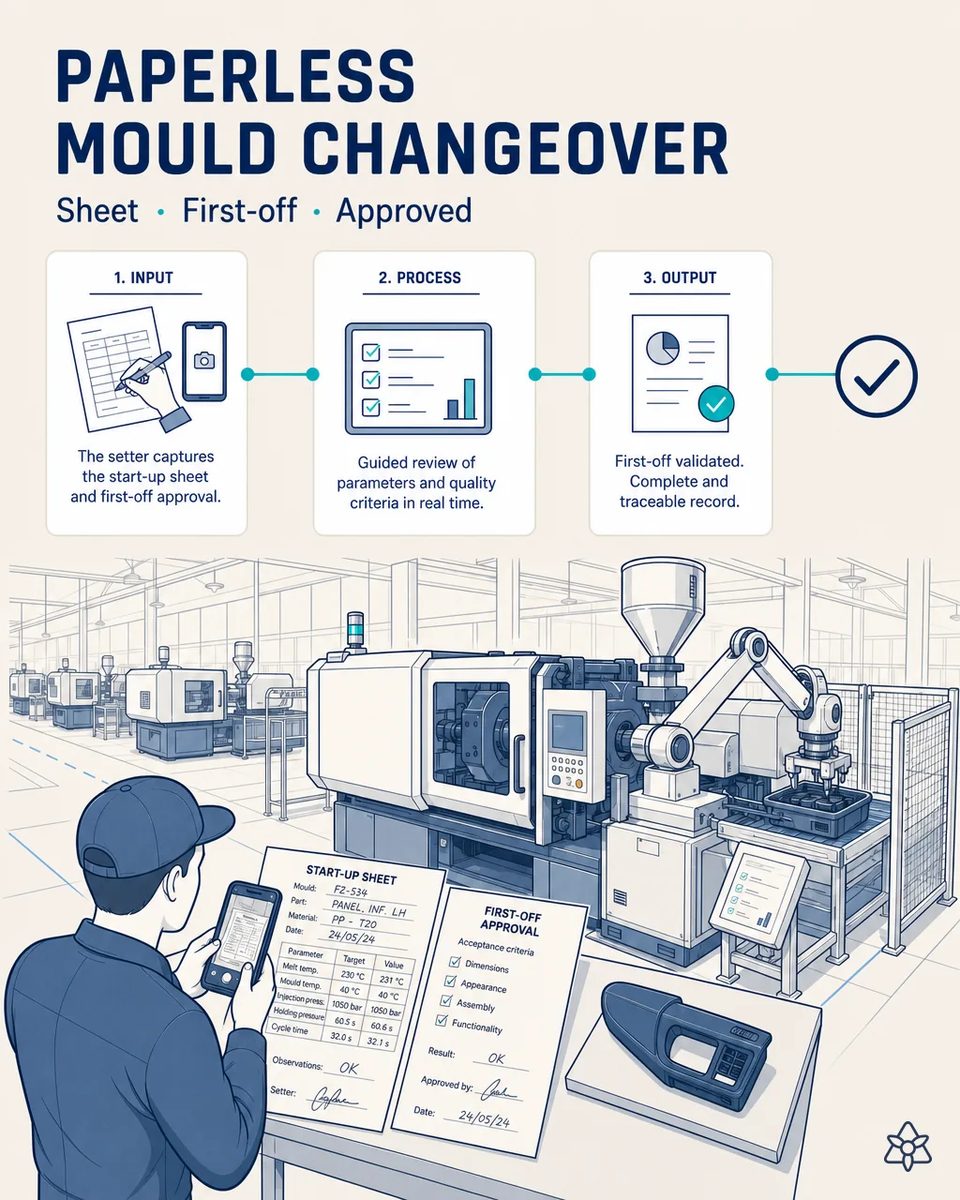
The mold changeover start-up sheet, captured with a photo
In a plastic interiors plant every mold changeover starts on paper: a sheet with the molding parameters and a first-off record signed by quality. Those two documents define everything that will happen over the following hours, and today they end up in a folder in the production office. With iLEAN Connect the operator takes two photos at start-up and the changeover already exists in the central system at second zero, with no change to the routine.
The parameters that actually made a good part never leave the paper.
The start-up sheet prints with the textbook parameters, but on top of them the setter writes down what actually had to be changed to get a good part that day: ten degrees more in zone three, an extra second of holding time, one cavity blocked off because the ejector is marginal. That is precisely the knowledge that prevents the next bad part, and it never reaches the system. The first-off approval record, in turn, is mandatory evidence in a certified automotive environment. If a complaint arrives three weeks later, somebody has to physically go and find it in a folder to prove the check was done. Between the moment it is written and the moment somebody collects it, four to eight hours pass. If the changeover happens on nights, a full day. And in a plant that changes mold, color and part number several times a week, that is a permanent hole in the process history.
- The sheet prints from the ERP with the nominal molding parameters, and the setter writes on top what really made the door panel come out right that day: ten degrees more in barrel zone three, an extra second of holding time, a cavity blocked off because the ejector is marginal.
- The first-off record is handwritten by standard, with the dimensions checked against the control plan, the appearance check and the quality signature. In a plant certified to IATF 16949 it is mandatory evidence.
- Between the signature and the moment somebody collects the sheets, four to eight hours pass — and a full day if the changeover falls on nights.
- In a shop that changes mold, color and part number several times a week, that latency is a permanent hole in the process history of every large-tonnage press.
Connect in photo mode — two photos at start-up, the routine untouched.
Connect in photo mode. The operator photographs the annotated sheet and the first-off record with a phone or an industrial tablet. A grounded language model extracts the structured fields — part number, revision, mold number, active cavities, resin and masterbatch lot, actual versus nominal parameters, signature and approval time — and ties them to the live ERP production order. The summary appears on the tablet at the press so a human can validate it in two taps (see case 5) and only then does it cross into the central system. Zero change of habit: people keep writing on the same paper.
It is the simplest case of the twelve and the one with the least friction on the shop floor, because it asks nothing of the setter: they keep writing on the same sheet and add two photos. The mold's real recipe stops living in the heads of two people and becomes something the next shift can look up.
Today's mold start-up versus the captured start-up
| Aspect | Today, on paper | With iLEAN Connect |
|---|---|---|
| Latency of the start-up sheet | 4-8 h, a full day on nights | Second zero |
| Real parameters per mold | In the heads of two setters | Searchable history per mold and press |
| First-off approval record | Hunted for in a folder | Tied to the lot and the serial number |
| Resin and masterbatch lot | On the sheet, if anyone wrote it | Extracted and linked to the ERP order |
| Start-up on a difficult mold | Rebuilt from memory | Last known-good parameters reused |
| Setter's habit | — | Unchanged: two photos |
from 4-8 hours of latency (or a full shift) to second zero · from "the real parameters live in the heads of two setters" to a searchable history per mold · from hunting for the first-off record in a folder to having it tied to the lot and the serial number.
Impact estimate — to be validated with your numbers.
The block below is an estimate to be validated against your plant's actual data. We put it forward so the committee has an order of magnitude; we refine it during the assessment.
- Estimated payback 4-9 months, depending on the number of mold changeovers per week.
- Transcription time of the production technician recovered, every changeover, every week.
- Shorter start-up on difficult molds by reusing the parameters that already worked instead of rediscovering them.
- And the first-off record stops being something you go and find: it is tied to the lot when a complaint lands three weeks later.
estimated payback 4-9 months depending on changeovers per week; recovery of the production technician's transcription time and shorter start-up on difficult molds by reusing the parameters that already worked. *Estimate to be validated.*
And the fair question from the production manager
"What if it misreads a holding pressure the setter scrawled in the margin?" — reading fields from a document with a known structure is an anchored task, where the best models drop below 1.5% error [1]. And there is a second net: the summary goes to the tablet at the press and the setter confirms or corrects it before anything crosses into the central system; a value outside the physical range of that press is flagged, not accepted.
[1] OpenAI paper "Why Language Models Hallucinate", 2025 — on the reliability of AI in anchored tasks.
What people ask about capturing the mold start-up sheet
Do we have to change the start-up sheet or the first-off form?
No. Both keep their current layout, including the handwritten annotations. Vision reads the structure as it is, whether the sheet comes from the ERP or from a template the tooling team designed years ago.
Does it read the setter's handwriting on top of the printed values?
That is the part with the most value, because it is where the real recipe is written: the actual barrel profile, the holding time, the blocked cavity. Handwritten values are extracted like any other field, and a low-confidence one is flagged for the setter to confirm.
Does it link the sheet to the resin and masterbatch lot?
Yes, if the lot is written on the sheet or already exists in the ERP order. That link is what lets you answer, months later, which resin lot a batch of instrument panels was molded from.
What happens with a changeover on the night shift?
That is where it shows most: today the sheet waits until the morning, and with capture the changeover exists in the system from the first minute, exactly as it would on a Tuesday morning.
Can we reuse the parameters from the last good start-up?
Yes, and that is the second saving. When the mold comes back to the press, the setter sees the parameters that actually produced a good part last time, not the nominal ones from the sheet.
More cases from this series
- Audit evidence, generated at the moment it is producedPhotos, curves, test results and signatures tied to the serial number and organized by standard. From…
- Four verification rings against the customer line stopFour verification rings between the delivery schedule and the dock. If they do not match, the shipment…
- Receiving resin, skins and components, solved with a photoDelivery notes and container labels read by vision, cross-checked against the order and pushed to the…
- Shift knowledge stops dying at handoverA headset and voice capture for whoever walks the shift with both hands busy. The issue structures…
- Lab data stops being retyped by handCMM, color, adhesion and test reports entering the ERP quality module after sign-off. Up to 80% fewer…
- Integrating what you already have: laser marker and weld cellPart number, revision and cavity travel from the ERP to the marker with no keying, and the weld curve is…
Tell us how many mold changeovers you run per week and we will size the return with your numbers.
We work on your plant's real data, not ours. Assessment with no commitment.
Request estimated ROI within 48h ‹ See all cases of plastic interiors See automotive