Shift knowledge stops dying at handover
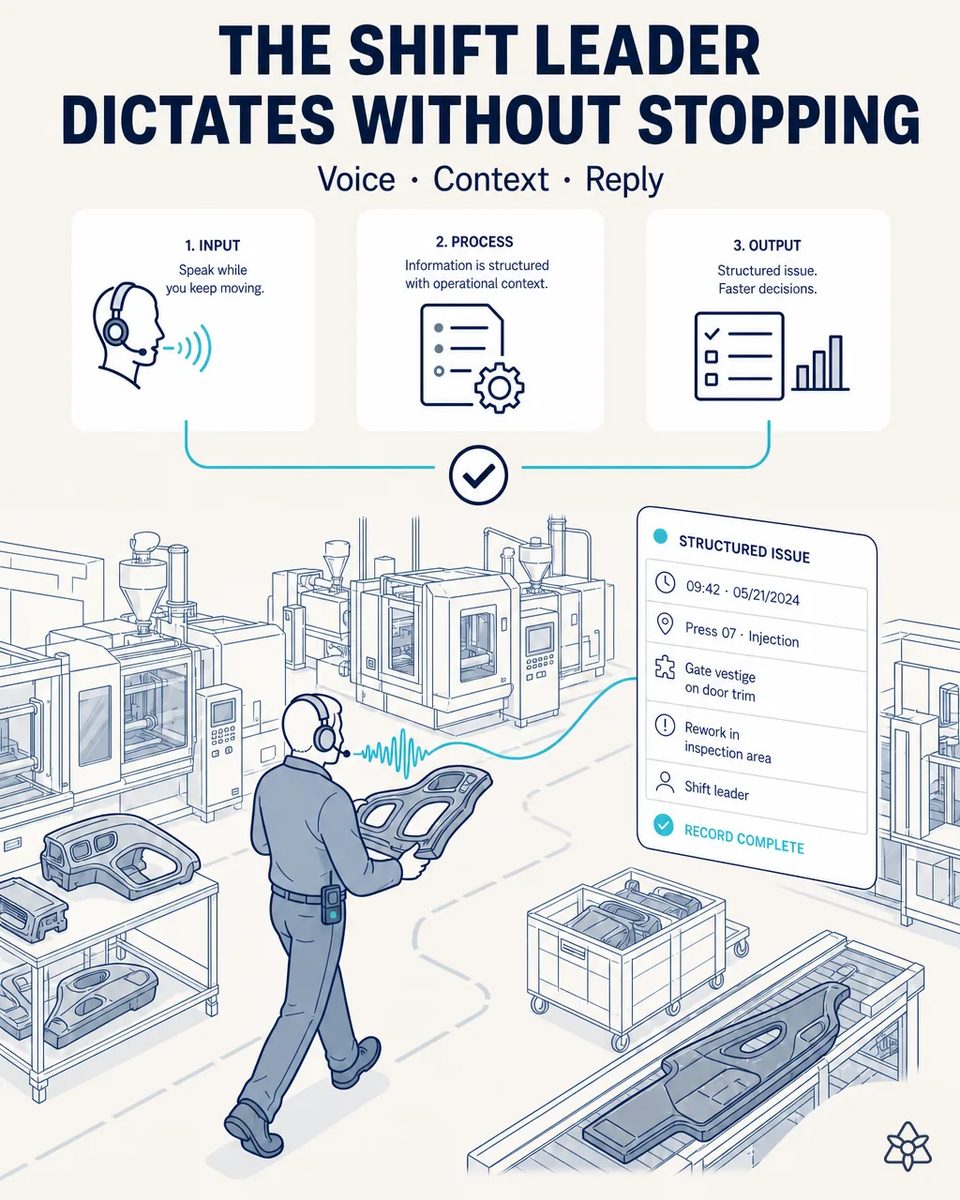
The shift leader of an interiors plant spends the whole shift walking between molding, foaming, paint, assembly and the dock, wearing hearing protection with both hands busy. Everything they know dies at the end of the shift or fits in three lines of the shift report. With iLEAN Connect in voice mode they dictate on the move, the system structures it against the live machine and part number, and returns context within seconds.
What the night shift saw never reaches the morning shift.
The critical operational knowledge of a molding plant lives in the heads of the shift leader and the veteran setter. That press twelve has been running a second long on cycle for two shifts. That the new assembly operator will need support on Friday. That the part from cavity four comes out with a heavier ejector mark. Nobody asks them anything because they cannot type: they are wearing gloves and hearing protection and holding a part up to the light. And across three shifts, what nights sees never reaches mornings beyond two sentences at handover. The underlying risk is not the lost information: it is the dependency. When the setter who knows how to start three difficult molds retires, the only known way of starting them retires too.
- The shift leader knows that press twelve has been running a second long on cycle for two shifts, that cavity four leaves a heavier ejector mark on the door panel, that the new assembly operator on the airbag station will need support on Friday.
- Nobody asks them anything because they cannot type: they wear gloves and hearing protection and hold a part up to the light between the presses, the PUR foaming line, paint, welding, assembly and the dock.
- What survives is two sentences at handover and three lines in the shift report.
- The real risk is dependency: when the setter who knows how to start three difficult molds retires, the only known way of starting them retires too.
Connect in voice mode — iLEAN listens to the shift leader, not to the operators.
Connect in voice mode. A Bluetooth earpiece compatible with the hearing protection the shop floor requires, and a custom wake word. The shift leader dictates while walking; a language model structures the dictation as an issue linked to the live machine, mold, part number and shift, and replies by voice or by push to the station tablet. The reply is not an echo: it cross-checks the history and returns the context the person cannot hold in their head — for instance, that the same symptom appeared with the previous lot from the same resin supplier.
The reply is not an echo. The system cross-checks what was dictated against the history of that press, mold and part number and returns the context nobody can hold in their head — that the same symptom appeared with the previous lot from the same resin supplier, for instance. The shift leader keeps walking; the plant keeps what they saw.
Today's shift versus the captured shift
| Aspect | Today | With iLEAN Connect |
|---|---|---|
| Shift knowledge | Dies at handover | Enters the system in real time |
| Shift report | Three lines | A history per press and per mold |
| Recurring symptom on a cavity | Solved again each shift | Detected as recurring, with a date |
| Shift leader's effort | Walk back to the office | Speak while walking |
| Key-person dependency | Total | Shared, searchable knowledge |
| Ordinary floor conversation | — | Not recorded |
from knowledge that dies at handover to knowledge that enters the system in real time · from three-line shift reports to a history per machine and per mold · from key-person dependency to shared, searchable knowledge.
Impact estimate — to be validated with your numbers.
The block below is an estimate to be validated against your plant's actual data. We put it forward so the committee has an order of magnitude; we refine it during the assessment.
- No standalone payback, and the case analysis says so plainly: this is an enabling piece, the hardest of the twelve to monetize on its own.
- Its value is in enabling every continuous improvement plan with a history that exists, and in reducing key-person dependency on the setters who know how to start the difficult molds.
- The handover goes from two verbal sentences to a written summary, per press and per mold, that exists when the next shift walks in.
- To be validated with the continuous improvement and training leads, not with a payback figure.
this is the hardest piece to monetize on its own, and it is worth saying so plainly. Its value lies in enabling every continuous improvement plan and in reducing key-person dependency. *To be validated with the continuous improvement and training leads.*
And the fair question from the production manager
"Is this for monitoring my team?" — no: iLEAN listens to the shift leader, not to the operators, and only to what they choose to dictate through a wake word. There is no continuous listening and no tracking of where anyone is. Structuring a dictated issue against a live press, mold and part number is an anchored task where the best models drop below 1.5% error [1], and the shift leader sees the structured card before it is saved.
[1] OpenAI paper "Why Language Models Hallucinate", 2025 — on the reliability of AI in anchored tasks.
What people ask about capturing the shift by voice
Does it work with the noise of a molding shop?
That is the design condition. The earpiece is compatible with the hearing protection the shop floor requires, and recognition is prepared for press noise and for the trade vocabulary of injection, foaming and paint. A custom wake word means nothing is captured unless the shift leader calls it.
Does the shift leader have to speak in a particular way?
No. They speak the way they would tell a colleague. iLEAN structures it afterwards: press, mold, part number, symptom, criticality and shift, and shows the card for a second before it is saved.
What does the reply contain?
Context, not an echo: the history of that press or mold, the last time the same symptom appeared, the resin lot in use. It comes back by voice or as a push to the station tablet, so the shift leader does not have to stop at a terminal to see it.
Why does the case analysis give it no payback?
Because it is honest: the return of shared knowledge is real but hard to isolate. It shows up in faster onboarding, in start-ups that no longer depend on one person, and in improvement plans that finally have data.
Does it help when the veteran setter retires?
It is the use with the longest range: the fine-tuning history of the difficult molds is exactly what is not passed on today and has to be relearned by the next person. With the history in the system, the next setter starts from what worked, not from zero.
More cases from this series
- Audit evidence, generated at the moment it is producedPhotos, curves, test results and signatures tied to the serial number and organized by standard. From…
- Four verification rings against the customer line stopFour verification rings between the delivery schedule and the dock. If they do not match, the shipment…
- Receiving resin, skins and components, solved with a photoDelivery notes and container labels read by vision, cross-checked against the order and pushed to the…
- Lab data stops being retyped by handCMM, color, adhesion and test reports entering the ERP quality module after sign-off. Up to 80% fewer…
- Integrating what you already have: laser marker and weld cellPart number, revision and cavity travel from the ERP to the marker with no keying, and the weld curve is…
- The mold changeover start-up sheet, captured with a photoThe real changeover parameters and the approved first-off part in the central system at second zero.…
Tell us what would leave with your best setter if they retired tomorrow.
We work on your plant's real data, not ours. Assessment with no commitment.
Request estimated ROI within 48h ‹ See all cases of plastic interiors See automotive