Audit evidence, generated at the moment it is produced
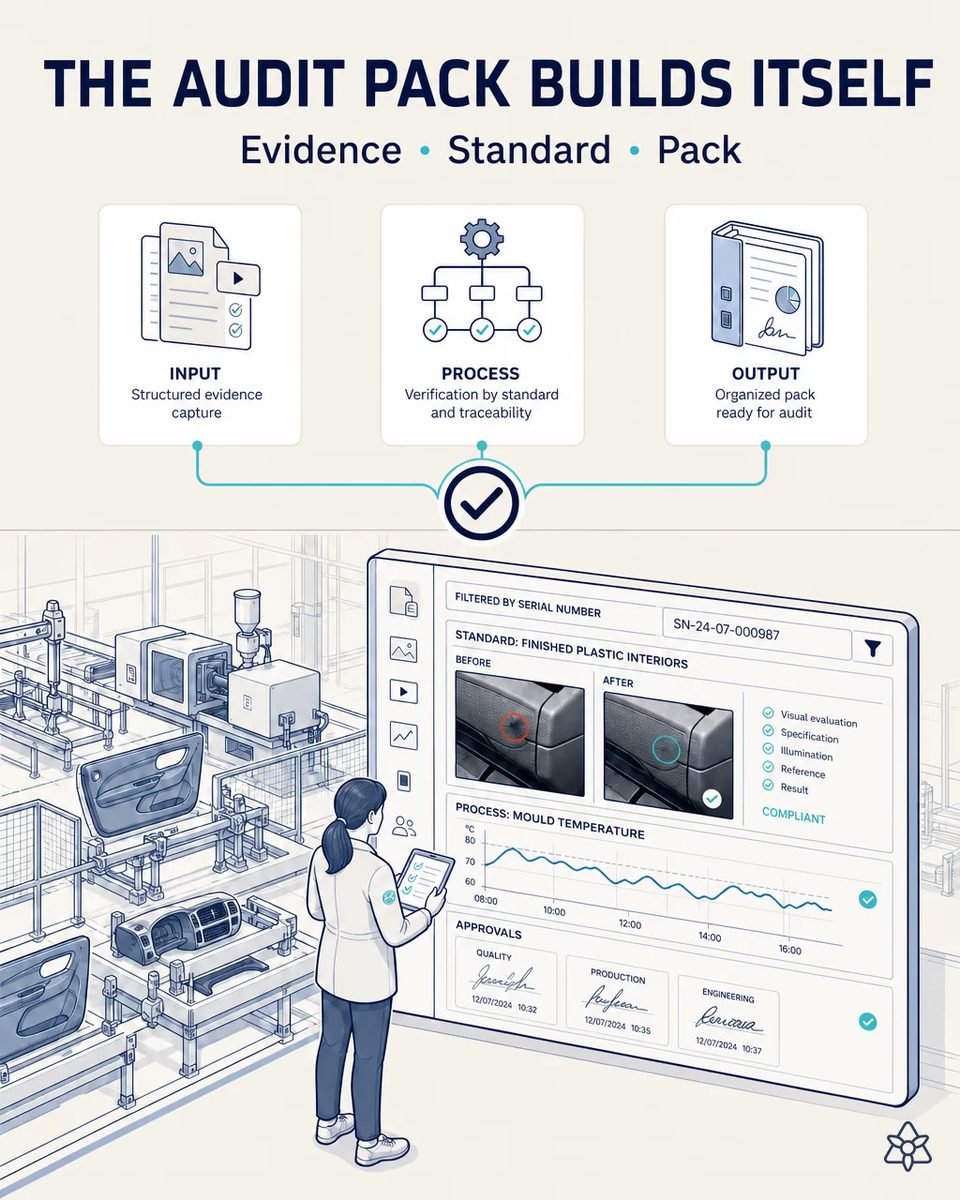
The day the automotive standard recertification arrives, or a customer process audit, the plant spends person-days reconstructing evidence. The auditor asks for proof, the plant produces paper, and the non-conformity is raised on the documentation gap, not on the process. With iLEAN Edge and Agents, every changeover and every lot automatically generate their pack, organized by the relevant standard.
The non-conformity is raised on what you cannot prove, not on what went wrong.
In automotive, evidence is not an extra: it is part of what you sell to the auditor. Sector standards and customer audits require you to demonstrate control over special characteristics, over changes and over deviations. The problem is that every standard wants the same information in a different shape. Today that restructuring is human work, done after the fact and under pressure — hunting for first-off records in folders, printing lab reports and explaining why the record from a night shift four months ago is missing. And that is exactly the scenario where gaps appear. The non-conformity is almost never raised because the process was wrong: it is raised because you cannot prove it was right.
- IATF 16949 and the customer-specific requirements ask you to demonstrate control over special characteristics, over changes and over deviations. Evidence is part of what you sell to the auditor.
- Every standard and every OEM wants the same information in a different shape, and that restructuring is human work done after the fact and under pressure.
- Hunting for first-off records in folders, printing lab reports, explaining why the record from a night shift four months ago is missing: that is audit preparation today.
- And that is exactly where the gaps appear. The non-conformity is almost never raised because the process was wrong; it is raised because you cannot prove it was right.
Edge and Connect capture at the moment it happens; Agents organizes by standard.
Edge captures visual evidence at the moment it is produced — before and after photos of the critical points at every changeover, the press process curve, the weld curve and the engraved serial number, lab results, rejects with their images — each with signature and timestamp, all tied to the part's serial number. Agents maps every piece of evidence to the requirements of each standard and builds the pack by period, by part number or by serial number. And it proactively flags gaps — "that mold's night shift is missing the validation of one point" — while they can still be closed, not in audit week. The pack is signed by quality, not by the AI.
The gap is flagged the day it happens — that mold's night shift is missing the validation of one changeover point — while it can still be closed, not in audit week. And the pack is signed by quality, not by the AI. The same evidence, re-indexed, serves the certification body and every OEM with its own requirements.
Today's audit preparation versus the permanent pack
| Aspect | Today | With iLEAN Agents |
|---|---|---|
| Preparation before an audit | Person-days of reconstruction | Zero |
| Changeover evidence | A signed checklist, if found | Before and after photos per point, timestamped |
| Weld curve on the airbag tear seam | Inside the cell | In the pack, per serial number |
| Documentation gap | Found in front of the auditor | Flagged the same day |
| Answering an OEM complaint | A week | Hours, with serial-number evidence |
| Same evidence, another OEM | Rebuilt in full | Re-indexed to that customer's requirements |
from person-days of document reconstruction before every audit to zero · from finding the gap in front of the auditor to seeing it the same day it happens · from a customer complaint that takes a week to answer to an answer with serial-number evidence in hours.
Impact estimate — to be validated with your numbers.
The block below is an estimate to be validated against your plant's actual data. We put it forward so the committee has an order of magnitude; we refine it during the assessment.
- Estimated payback 6-12 months, depending on audit frequency and the number of OEMs with their own requirements.
- The person-days spent preparing each audit — hunting first-off records, printing lab reports, reconstructing a night shift — saved directly.
- Protection of the IATF 16949 certification and of standing in customer supplier panels — a loss measured not in euros but in programs you do not win.
- And a customer complaint answered in hours with serial-number evidence instead of in a week.
protection of the certification and of standing in customer supplier panels — the loss of which is not measured in euros but in programs you do not win — plus the direct saving of the person-days spent preparing audits. Estimated payback 6-12 months depending on audit frequency and the number of customers with their own standard. *Estimate to be validated.*
And the fair question from the production manager
"Isn't this just another document manager?" — the difference is direction. A document manager stores what somebody decides to upload, after the fact, and inherits the same gaps. Here the evidence is captured at the moment it is produced, each item with its signature and timestamp, and Agents maps it to the requirement of each standard. Where it reads a record rather than a sensor, that is an anchored task where the best models drop below 1.5% error [1], and quality signs the pack.
[1] OpenAI paper "Why Language Models Hallucinate", 2025 — on the reliability of AI in anchored tasks.
What people ask about the automatic evidence pack
What goes into the pack?
Before and after photos of the critical points at every changeover, the press process curve, the weld curve, the engraved serial number, lab results and rejects with their images, each with signature and timestamp and all tied to the part's serial number. It can be built by period, by part number or by serial number.
Does it serve IATF 16949 and the OEM audits at once?
Yes, and that is the point: the evidence is the same, what changes is the requirement it is indexed against. That re-indexing is exactly the work repeated in full for each auditor today.
How does it flag a gap?
By comparing what should have been generated with what was: a changeover without the validation of one point, a lot without its first-off, a serial number without its weld curve. It flags it the same day, not in audit week, while the shift that produced it is still there to close it.
Does the auditor get into our systems?
No. They access a view scoped to the period, part number or serial number of their audit, filter and download. Nothing else, and the plant's other programs and customers stay out of view.
Who signs the pack?
Quality. The AI assembles and organizes; the signature that goes to the auditor is a person's, with their name and timestamp, exactly as the standard expects.
More cases from this series
- Four verification rings against the customer line stopFour verification rings between the delivery schedule and the dock. If they do not match, the shipment…
- Receiving resin, skins and components, solved with a photoDelivery notes and container labels read by vision, cross-checked against the order and pushed to the…
- Shift knowledge stops dying at handoverA headset and voice capture for whoever walks the shift with both hands busy. The issue structures…
- Lab data stops being retyped by handCMM, color, adhesion and test reports entering the ERP quality module after sign-off. Up to 80% fewer…
- Integrating what you already have: laser marker and weld cellPart number, revision and cavity travel from the ERP to the marker with no keying, and the weld curve is…
- The mold changeover start-up sheet, captured with a photoThe real changeover parameters and the approved first-off part in the central system at second zero.…
Tell us how many people and how many days go into preparing your next audit.
We work on your plant's real data, not ours. Assessment with no commitment.
Request estimated ROI within 48h ‹ See all cases of plastic interiors See automotive