REACH SCIP — the Candidate List changes twice a year, your SCIP cannot lag behind it.
REACH requires notifying ECHA of any SVHC present in a concentration >0.1 % in any article placed on the EU market. iLEAN Tracer anchors the real composition of the SKU, an agent cross-references it with the updated ECHA Candidate List and prepares the SCIP notification per article. The person signs — with no undeclared SKU slipping through.
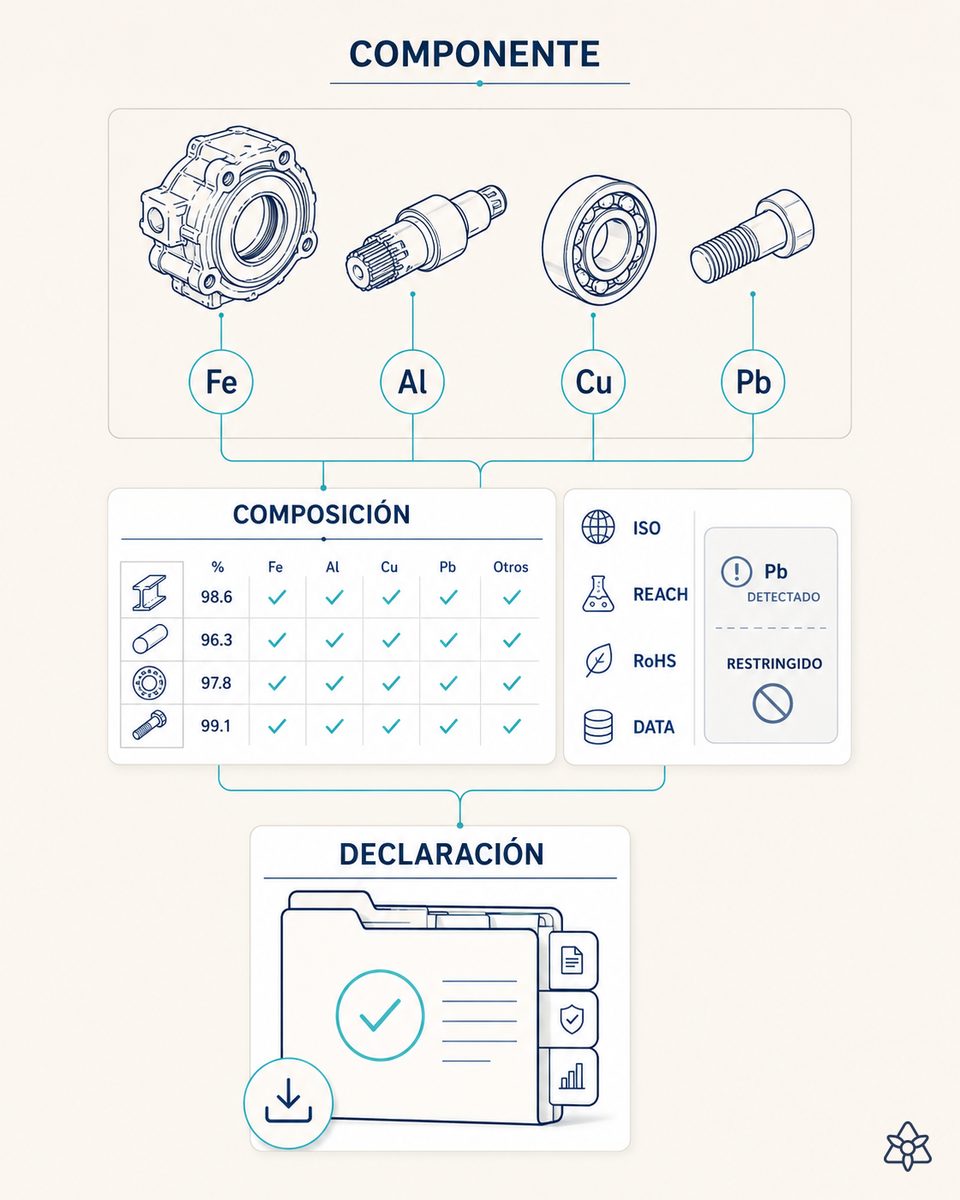
“The Candidate List has just added three substances and I don't know which SKU they are in.”
REACH is a system that works, but the daily job of keeping SCIP up to date is where almost every industrial manufacturer breaks. The regulatory manager knows the mechanics:
- ECHA updates the SVHC Candidate List twice a year (typically January and June). Every update adds substances.
- You have to check whether those substances are present in any of your articles — and the answer lives in the SDS and technical datasheets the supplier sent months ago.
- If an SVHC is present at a concentration >0.1 % by weight per article, you must notify SCIP, and also inform the B2B customer under article 33 of REACH.
- The deadline for SCIP runs from the moment the article is placed on the market, not “whenever you have time”.
The problem is not the logic — it is that the real composition lives scattered: SDS as PDF per component, the supplier datasheet in the quality folder, the BOM in the PLM with generic material, shop-floor additives that the quality technician writes down in a notebook. When the Candidate List adds a substance, re-reading two hundred SDS by hand is not viable, and SCIP is left with articles that were never notified.
iLEAN does not replace the regulatory function — it re-reads the SDS for you when ECHA updates the list.
SCIP does not fail for lack of tools — the IUCLID/ECHA portal does its part. It fails because the real composition of each article and the updated Candidate List never meet in time. iLEAN acts as the filler that keeps that cross-check alive, without the regulatory manager having to re-read two hundred SDS every six months.
Tracer anchors the exact composition to the SKU. Connect captures SDS and certificates through whatever channel they arrive. The agent re-reads and cross-references with the Candidate List when ECHA updates. The person signs.
The three iLEAN pieces applied to REACH SCIP:
- Tracer — anchors to each SKU its real composition: additives, coatings, engineering plastics, alloys, inks. The concentration per substance is recorded with its source (SDS, certificate, supplier declaration) and the date — so you know which source backs which declaration.
- Connect — captures the SDS and technical datasheets through whatever channel they arrive: supplier email with a PDF, chemical distributor portal, scanned certificate, a call with the technical manager. Every document is anchored to the corresponding article and stays searchable.
- Agent — keeps the ECHA Candidate List live with its CAS and EC numbers. When ECHA publishes the twice-yearly update, the agent automatically re-reads the archived SDS and the PDF certificates to detect whether the new SVHC was already present — and therefore whether there are overdue SCIP notifications. It prepares the notification in IUCLID format, and the customer communication under article 33. The regulatory manager signs.
And all of it under the three safety rings: capture and re-reading happen in ring 3, the cross-validation (is the concentration declared by the supplier consistent with the use of that additive?) in ring 2, and the signed notification lives in ring 1. What is submitted to ECHA is what the person approved. Never the other way round.
SCIP by hand vs. SCIP cross-referenced with iLEAN
| Aspect | SCIP with a spreadsheet + SDS in a folder | With iLEAN Tracer + Connect + Agent |
|---|---|---|
| Composition per article | Scattered SDS, BOM with generic material | Real composition anchored to the SKU, with its source |
| Candidate List update | Email alert, re-read the SDS by hand | Automatic cross-check against every archived SDS |
| New SVHC in an existing BOM | Late detection — days or weeks | Detected as soon as ECHA publishes |
| SCIP notification | IUCLID template filled in by hand | Dossier ready for signature with evidence |
| Article 33 to the customer | Generic email whenever someone remembers | Communication per SKU in the B2B customer format |
| National authority audit | Rebuild the history of declarations | Traceability per article with its source SDS |
Impact estimate for your plant — to be validated with your numbers.
The block below is an estimate to be validated with the concrete data of your operation. We put it forward so the committee has an order of magnitude; we refine it during the diagnostic.
- Mid-sized manufacturer (chemicals, metalworking, electronics, furniture, construction) with 50-500 active SKUs on the EU market, tens to hundreds of archived SDS.
- Tracer + Connect + Agent pilot on one product family and the latest Candidate List update. First expected value within a few weeks: detection of overdue SCIP notifications and preparation of notifications for signature.
- Indicative payback between 4 and 9 months, depending on the number of exposed SKUs and the current cost of maintaining SCIP by hand (regulatory FTE + quality hours + delays).
- Reduction of manual hours spent re-reading SDS after each ECHA update: ≥ 30 %, with room for more as more articles enter the loop.
- The hard lever is avoiding a fine from ECHA or the national authority for a SCIP notification that was never filed, and shielding yourself from a B2B customer claim for breaching article 33.
And the regulatory manager's reasonable doubt
“What if the agent misreads an SDS and lets an SVHC through without notifying it?” — hallucination is a problem of free generation, not of anchored tasks. In tasks where the AI is limited to recontextualising a data point (read the SDS, extract the composition, look up the CAS in the Candidate List), the best models brought the error below 1.5 % [1]. And even so, the notification does not go out on its own: the agent prepares it, the responsible person reviews and signs it. The three rings are there for exactly this.
[1] OpenAI paper “Why Language Models Hallucinate”, 2025 — on the reliability of AI in anchored tasks.
What people ask about REACH SCIP with AI
What is the SCIP notification and what does REACH require?
The SCIP notification (Substances of Concern In articles, as such or in complex objects, Products) is the ECHA database where every supplier of an article placed on the EU market must notify the presence of any SVHC (Substance of Very High Concern) in a concentration above 0.1 % by weight. SCIP is based on article 9 of the Waste Framework Directive (WFD) and is complemented by article 33 of REACH, which also requires informing the customer when an SVHC crosses that threshold in an article.
Why is it so hard to keep SCIP up to date?
Because the ECHA SVHC Candidate List changes twice a year (typically January and June), and each update adds substances that may sit in additives, coatings, engineering plastics or alloys inside your articles. Checking whether the new substance is present in your BOM means cross-referencing: (1) the supplier technical datasheet, which is rarely updated; (2) the SDS per component, which arrive as PDF; (3) your own BOM in the PLM; (4) the updated Candidate List. Without automation the regulatory manager finds out late and SCIP is left with articles that were never notified.
How does iLEAN cross-reference real composition with the ECHA Candidate List?
The agent keeps the ECHA Candidate List live (with its CAS and EC numbers and official names) and cross-references it with the compositions declared by each supplier for every article in your BOM. When a new SVHC is published, the agent re-reads the archived SDS and the PDF certificates to detect whether that substance was already present — and whether the corresponding SCIP notification was never filed. If there is any doubt, it holds the SKU release and alerts the regulatory manager. The person signs.
What about the customer communication required by article 33 of REACH?
The same SVHC × article cross-check prepares the mandatory customer communication (downstream user / distributor / consumer) when an SVHC crosses the 0.1 % threshold. iLEAN prepares the information sheet in the format the B2B customer asks for (some OEMs have their own template), links it to the SKU and to the batch, and delivers it through the customer channel. The person approves the delivery before it is sent.
What concrete risk does iLEAN remove in REACH SCIP?
Three hard risks: (1) a fine from ECHA or the national authority for a SCIP notification that is missing or out of date — the authority cross-checks the SCIP database against what is actually on the market; (2) a B2B customer claim for breaching article 33 when the SVHC present was never communicated (a classic industrial risk with automotive and electronics OEMs); (3) a surprise in the twice-yearly Candidate List update, where a substance you had been using for years becomes an SVHC and you were not ready to notify on time.
Keep reading: Conflict minerals 3TG · CBAM carbon border · CSDDD due diligence
More cases in industrial traceability
- Multi-tier traceability — the disruption that stops your line is almost never where you are looking.iLEAN traces tier-1, tier-2 and tier-3 suppliers and warns of supply risk days or weeks before it…
- Product carbon footprint — PCF built on your plant's data, not on a sector factor.iLEAN calculates the product carbon footprint (PCF) per SKU from real plant data — cradle-to-gate, ISO…
- Product hologram with AI — the seal properly applied on every unit, at eight in the evening too.How iLEAN Edge verifies the security hologram on every unit in line — presence, position, integrity —…
- A B2B return gets lost in emails. And by the time it resurfaces, the batch has already been sold three times over.iLEAN closes the B2B returns loop: categorized cause, affected batch, documented decision (rework /…
- RFID in the warehouse with AI — when the reader misses, the inventory lies.How iLEAN reconciles RFID reads, WMS and ERP with vision and agents so real stock adds up and…
- Traceability softwarethat answers in secondswhen something goes wrong.Industrial traceability software with AI: forward and backward, inventory control, GS1 labeling, ERP…
Tell us your case and within 48h we will send you the estimated ROI of your SCIP with AI.
We work on the real data of your operation, not on ours. Diagnostic with no commitment.
Request demo See all traceability solutions