Multi-tier traceability — the disruption that stops your line is almost never where you are looking.
An invisible disruption at tier-3 reaches your line when it is already too late — tier-1 calls you the day they can no longer deliver. iLEAN traces down to tier-N by crossing supplier data, ERP data and public signals, and gives early warning with days or weeks of margin. The person decides plan B.
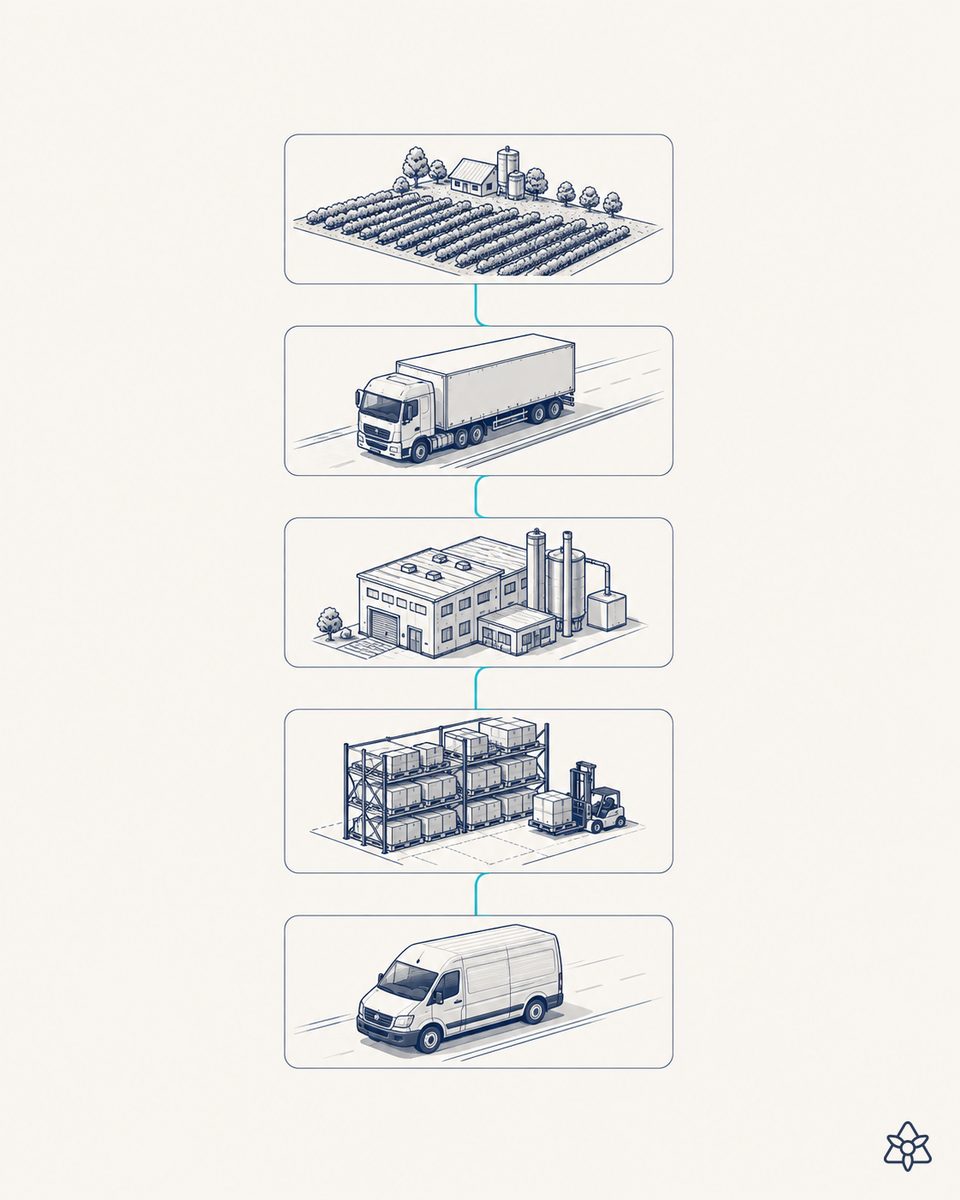
Tier-1 is the part you manage. What stops you is what you cannot see.
The chain you control in the ERP ends at tier-1: the supplier who invoices you. Beyond that, the chain exists but is dark. Your tier-1 buys from their tier-2, who buys from their tier-3, who depends on a material extracted in one specific country — and that depth is almost never in any system of yours. Classic procurement stops at tier-1 because that is what the ERP models; the rest is a blind spot.
And here is the problem: expensive supply disruptions almost never come from tier-1. They come from a tier-2 that shut down without warning tier-1 until the last moment. From a tier-3 that switched to a cheaper alternative whose quality nobody validated. From a tier-N material hit by a regulatory restriction on another continent. Tier-1 calls you when they can no longer deliver — the damage is already done.
Procurement platforms (source-to-pay suites) do the tier-1 job very well, but they were not designed for tier-N. And annual spreadsheets with declared tier-2 data are a still photo of reality — out of date the day they are signed off.
iLEAN does not replace procurement — it sees what procurement cannot see.
The multi-tier problem is not a lack of purchasing software: it is that tier-2 and beyond lives outside your systems (in tier-1's email, in press releases, in another country's customs office, in a spreadsheet the strategic buyer last updated eight months ago). iLEAN acts as the filler that closes those gaps — without replacing your procurement suite or your purchasing ERP.
Tracer reconstructs the tier-N chain. Connect captures supplier email, messaging and portals. The agent tracks public signals. When they line up, it raises an alert. The person decides plan B.
The iLEAN pieces applied to multi-tier:
- Tracer + Connect — Tracer keeps the chain graph alive (component → tier-1 → tier-2 → tier-3 → material → country of origin). Connect captures what tier-1 already sends through their usual channels (email, messaging app, portal, form) and extracts the tier-2 data without asking the supplier to log into a new portal. The rule is: never force tier-1 to learn another tool.
- Agent — watchtower for external signals — the agent continuously reads company registries, customs alerts, press releases, logistics stoppages, regulatory restrictions, port congestion and geopolitical shifts affecting the regions, companies and materials in the graph. It crosses that with tier-1 operational data (average delay, quality, communication frequency) and triggers an alert when several signals line up on a critical component.
- Integration with your procurement suite / ERP — bidirectional: it reads the supplier master, orders and deliveries; it writes back flagging suppliers at risk, component-level risks and active contingency plans. The strategic buyer opens the same procurement screen as always and sees the multi-tier dimension already enriched.
Classic tier-1 traceability vs. multi-tier with iLEAN
| Aspect | Classic procurement | With iLEAN Tracer + Connect + Agent |
|---|---|---|
| Chain depth | Tier-1 only — beyond that, the strategic buyer's annual spreadsheet | Live graph tier-1 → tier-2 → tier-3 → material → country |
| Collaboration with tier-1 | A new portal the supplier never uses | Capture through the channel the supplier already uses |
| External public signals | Whatever reaches the purchasing manager's phone | Customs, press, registries, logistics — tracked continuously |
| Disruption warning | A call from tier-1 when they can no longer deliver | Alert with days or weeks of margin — time for plan B |
| Integration with procurement suite / ERP | Only what the platform ships with (tier-1) | Multi-tier layer on top, bidirectional |
| Chain map | The strategic buyer's annual PDF — out of date the day it is signed | Live graph, updated with every capture |
Impact estimate for your plant — to be validated with your numbers.
The block below is an estimate to be validated with the concrete data of your chain. We set it out so the committee has an order of magnitude; we refine it during the diagnostic.
- Tier-1 company in automotive, electronics, pharma or defence with 15-50 critical components in a multi-tier chain (semiconductors, rare earths, battery cells, specific materials).
- Pilot on 3-5 critical components. First value expected within a few weeks — the live tier-2/3 map over those components usually reveals previously undocumented risks.
- Indicative payback between 4 and 9 months, dominated by the cost of a single avoided disruption on a critical component.
- Hard lever: one tier-2/3 disruption anticipated with enough margin to activate plan B (alternative supplier, safety stock, minor redesign) pays for the whole system several times over.
And the fair objection from the supply chain manager
«What if the AI fires false alarms and burns out the purchasing team with noise?» — an alert is never triggered by a single signal. The agent waits for several to line up on the same component (one tier-1 operational, one external public, one from declared tier-2). And even then, the alert does not open plan B on its own: the agent proposes it with the evidence in front of you; the person validates and decides. In anchored tasks such as crossing the graph with verifiable public signals, the best models brought error below 1.5 % [1]. The three safety rings exist for exactly this: plan B decisions are human, the agent prepares the file.
And the context reinforces the urgency: ocean freight cost went from ~1,500 USD/container to >20,000 USD at the 2021 peak, spiked again in 2024 because of the Red Sea situation, and fell sharply again on overcapacity — the volatility of long chains is here to stay [2]. Anticipating is competitive advantage, not luxury.
[1] OpenAI paper «Why Language Models Hallucinate», 2025 — on the reliability of AI in anchored tasks.
[2] Ocean freight volatility data (Drewry / Freightos / sector reports) — order of magnitude used to argue the fragility of long chains.
What people ask about multi-tier traceability with AI
How deep does multi-tier traceability actually go?
As deep as supplier collaboration and public signals allow you to verify. Tier-1 (your direct supplier) is trivial: it is already in your ERP. Tier-2 (your supplier's supplier) requires tier-1 collaboration — and this is where most projects stall, because asking for it in an annual spreadsheet does not work. Tier-3 and beyond can only be reconstructed by cross-checking what tier-1 declares against public data (company registries, press releases, customs alerts, logistics stoppages). iLEAN automates that reconstruction and keeps the map alive instead of freezing it in an annual PDF. Real depth depends on the component — for a critical material (semiconductor, rare earths, battery cells) you get further, because tier-1 has a stronger incentive to collaborate.
How do you get tier-2 data out of your direct supplier?
Through the channel the supplier already uses, not a new one. iLEAN Connect captures the supplier's email, messaging app, corporate portal or the form they already fill in for you — and the agent reads tier-2 data from there without asking the supplier to learn yet another tool. The rule is: never force tier-1 into a portal of ours (they will not log in), but capture what they already send through their own channels. For critical components a bilateral agreement is signed in which tier-1 accepts to declare tier-2 — but day-to-day operations run through channels that already exist, not an invented one.
How does tier-N disruption early warning work?
The agent tracks three families of signals continuously: tier-1 operational signals (rising average delay, batches with quality outside band, communication losing frequency), declared tier-2 operational signals (when tier-1 reports them) and external public signals about the network — a shutdown in a producing region, a customs alert, strike coverage in the press, port congestion, a regulatory change in a tier-3 country. When several of those signals line up on the same critical component, the agent raises an alert with days or weeks of margin — the time needed to activate plan B (alternative supplier, safety stock, minor redesign).
Does it integrate with our procurement platform and ERP?
Yes. iLEAN connects as a layer on top of your source-to-pay procurement suite or the purchasing module of whatever ERP you run, without asking you to change platform. It reads the supplier master, open purchase orders and delivery history — and enriches that base with the multi-tier dimension those platforms do not have on their own (because they were designed for tier-1, not for tier-3). The integration is bidirectional: the agent can write back to the ERP flagging suppliers at risk, component-level risks and active contingency plans. Autonomy is configured plant by plant.
How much does it really reduce supply disruption?
Expensive supply disruptions almost never come from tier-1 (tier-1 is the part you already manage) — they come from the invisible tier-2 or tier-3: a supplier your supplier switched without telling you, a tier-2 plant stopped by a fire in another country, a regulatory restriction on a tier-3 material. Having days or weeks of margin on those events changes the cost — there can be an order of magnitude between activating plan B calmly and stopping the line with no warning. Disruption cost reductions in the order of 30-60 % are a conservative target, estimate to be validated, depending on chain maturity and sector.
More cases in industrial traceability
- iLEAN Writer: encrypted traceabilityat the level of the big players,free for small food makers.iLEAN Writer is free. Generates encrypted .ILE traceability files per batch for SMB food manufacturers.…
- Industrial inventory control with AI and traceabilityiLEAN unifies inventory control with AI: real-time inbound/outbound, stock by location, automated…
- A label is just the beginning.iLEAN Writer turns it intoreal traceability.iLEAN Writer: industrial labeling and printing software. GS1, DataMatrix, QR, RFID. Connects to…
- Product carbon footprint — PCF built on your plant's data, not on a sector factor.iLEAN calculates the product carbon footprint (PCF) per SKU from real plant data — cradle-to-gate, ISO…
- Product hologram with AI — the seal properly applied on every unit, at eight in the evening too.How iLEAN Edge verifies the security hologram on every unit in line — presence, position, integrity —…
- REACH SCIP — the Candidate List changes twice a year, your SCIP cannot lag behind it.iLEAN identifies SVHC in every article and automates the SCIP notification to ECHA — real composition…
Tell us about your case and in 48h we will send you the estimated ROI of multi-tier traceability for your chain.
We work on your chain's real data, not ours. Diagnostic with no commitment.
Request demo ‹ See all traceability solutions