RFID in the warehouse with AI — when the reader misses, the inventory lies.
Warehouse RFID promises continuous real-time inventory — and in practice leaves between 5% and 15% of reads in the air because of interference, angle and dead tags. iLEAN cross-checks the portal read, the image above the door and the WMS to reconcile what comes in and goes out at second zero. A person signs off the difference.
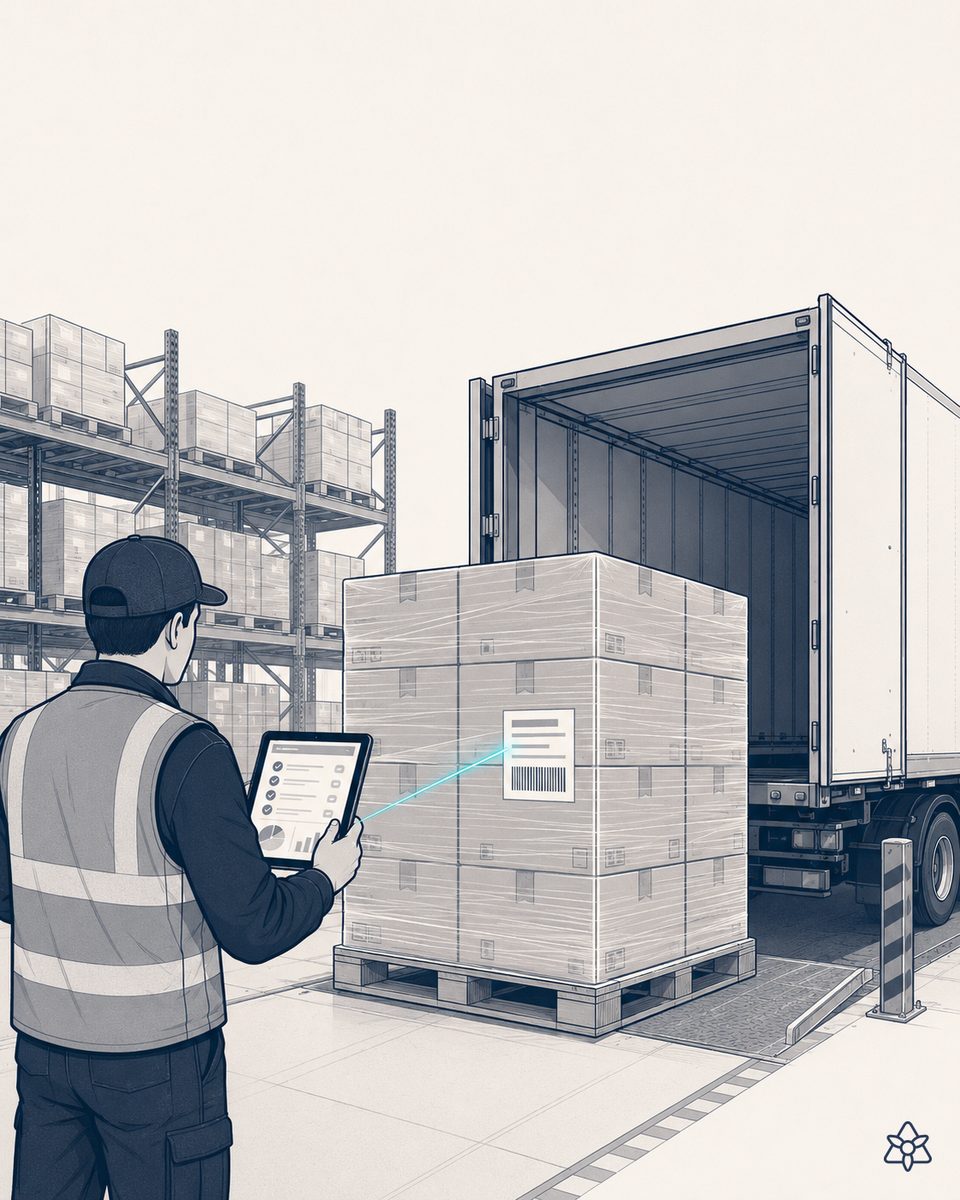
The RFID reader catches 90% — and nobody knows what to do with the missing 10%.
When an RFID solution for the warehouse is sold to you, it is sold as perpetual inventory, eyes on every box. On the plant floor, on day 30, this is what you get:
- Phantom reads and missed reads — the portal reads half the tags on the pallet, or reads the same one twice, or reads tags that were sitting on the other side of the wall.
- Unexplained shrinkage — the monthly gap grows and nobody knows whether it is theft, a picking error, a missed read or a badly closed delivery note.
- Manual rescue counts — to reconcile with the customer, somebody spends Saturday counting with a scanner gun, and "perpetual" stops being perpetual.
- A customer claiming units we never shipped — plus a carrier email sent at 22:47 that nobody read until Monday.
The reader is not broken: physics says radio waves behave like that around metal, liquids and angles. The problem is not the read: it is assuming the read is the truth. If your WMS trusts a single channel, the gap is structural — and it grows.
iLEAN does not replace the reader — it puts three eyes where there was one.
The warehouse gap is the textbook example of data islands: the RFID read inside the reader middleware, the WMS on its own server, the carrier notification in somebody's inbox, the operator's incident on a Post-it note. iLEAN acts as the filler that seals those cracks, without throwing away the RFID hardware you already paid for.
Connect listens to the reader, the WMS and the carrier's email at the same time. Edge watches the door. An agent cross-checks the three channels and closes the gap at second zero. A person signs off.
The three iLEAN pieces applied to RFID reconciliation in the warehouse:
- Edge — a terminal with machine vision (CNN) above the dock door. It detects how many pallets go in or out, the wrapping type and the code visible on the side, and stores the clip in milliseconds. It works without a network. If the warehouse Wi-Fi drops, Edge keeps counting what passes through the door.
- Connect — connects to the existing RFID middleware and captures the read stream as it is; in parallel it listens to the WMS and to external carrier notifications by email, EDI or messaging app. It also captures the forgotten safety-stock spreadsheet the warehouse manager maintains on the side.
- Agent — cross-checks RFID read + Edge count + WMS + delivery note by SKU, batch and time window. It flags three states: matched, minor discrepancy (rule-based auto-approval), critical discrepancy (hold and alert to the warehouse manager). The operator sees reality already closed, not a list of incidents pending review.
RFID on its own vs. RFID reconciled with iLEAN
| Aspect | Classic RFID + WMS | With iLEAN Edge + Connect + Agent |
|---|---|---|
| Useful read rate | 85-95% depending on aisle and load | Cross-reconciliation → most of the gap closed |
| Monthly gap | Grows silently, shows up in the P&L | Closed at second zero, with root cause |
| Dead tags | Detected months later | Pattern detected, automatic replacement alert |
| Carrier notification | Email read on Monday | Enters the system at second zero |
| Manual rescue count | Saturday with a scanner gun | Only on critical discrepancy signed off by a person |
| Evidence file for the auditor | Rebuilt by hand | Dossier per inbound/outbound with Edge clip + read |
Impact estimate for your plant — to be validated with your numbers.
The block below is an estimate to be validated with the specific data of your installation. We put it forward so the committee has an order of magnitude; we refine it during the diagnostic.
- Warehouse of 5,000-10,000 m², 2-6 passive UHF RFID portals already installed, standard WMS (SAP EWM, Manhattan, Mecalux Easy or similar).
- Pilot with Connect plus one Edge above the highest-flow portal. First expected value in a few weeks: outbound shipments reconciled for one key customer.
- Indicative payback between 4 and 9 months, depending on annual unexplained shrinkage and manual counting hours.
- Hard lever: ≥ 30% reduction in unexplained gap and a noticeable drop in month-end overtime spent reconciling.
And the IT director's reasonable doubt
"What if the agent decides to close a discrepancy that was actually theft?" — the three rings exist precisely for this. The agent lives in ring 3 (maximum capability), but any action touching the WMS goes through ring 2 (validation) and only ring 1 executes what has been signed off. On reliability: hallucination is a problem of free generation, not of anchored tasks such as cross-checking two reads; the best models brought the error below 1.5% [1]. You decide how much autonomy the agent gets, plant by plant.
[1] OpenAI paper "Why Language Models Hallucinate", 2025 — on the reliability of AI in anchored tasks.
What people ask about warehouse RFID with AI
Why does warehouse RFID lose reads, and what do you do about it?
A typical passive UHF RFID installation leaves between 5% and 15% of reads in the air because of metal interference, liquids, tag angle, anti-collision and dead tags. It is not a vendor defect: it is physics. The problem is not that reads are lost, it is that the WMS assumes the read is the truth. iLEAN treats the RFID read as one source among several — and when a box comes through the door without a read, it cross-checks against the Edge camera above the portal and against the delivery note that already arrived by email, and reconciles. The gap closes before it ever reaches the monthly count.
How does iLEAN make the RFID read match the WMS?
Connect listens to three channels in parallel: the reads from the RFID portal (the reader), the inbound/outbound flow in the WMS, and the carrier's delivery notes and notifications arriving by email, EDI or messaging app. On top of that, an agent cross-checks by SKU, batch and time window, and flags three states: matched (all three agree), minor discrepancy (one is missing but the other two agree → rule-based auto-approval), critical discrepancy (two do not agree → hold and alert to the warehouse manager). The classic system dumps everything into an incident spreadsheet nobody reads; iLEAN closes the gap at second zero.
Does it work with the passive UHF RFID and fixed portals we already have?
Yes. iLEAN does not require changing the reader, the middleware or the tags. Connect plugs into the existing middleware and captures the read stream as it is. Edge is installed as one extra camera above the dock door to add the vision layer (which boxes and which pallets are physically going through). What iLEAN contributes is the brain that cross-checks — it does not replace the RFID hardware, it finally makes it useful to the WMS.
What do I do about dead tags, badly placed tags or anti-collision problems?
The agents accumulate patterns: if one specific SKU always fails at portal 3, they raise it as a case for reviewing tag placement or reader power; if a pallet carrying liquids does not read, they suggest a specific tag or an assisted manual read; if dead tags are detected above the vendor threshold, they generate the replacement request. The operator does not chase the problem — the system brings it to the supervisor with the diagnosis already done. And nothing is decided on its own: a person approves the changes.
How long does an RFID + AI reconciliation pilot take to pay for itself?
As an estimate to be validated with your warehouse data: a typical pilot on one inbound/outbound portal with vision + WMS reconciliation starts delivering value in a few weeks, and indicative payback sits between 4 and 9 months. The hard levers are the reduction of unexplained shrinkage (≥30% conservative), the drop in manual counting hours and closing customer discrepancies that today arrive too late. Send us your warehouse numbers and we return the estimated ROI in 48h with your figures, not ours.
See also: all traceability solutions → · What is iLEAN traceability →
More cases in industrial traceability
- Product hologram with AI — the seal properly applied on every unit, at eight in the evening too.How iLEAN Edge verifies the security hologram on every unit in line — presence, position, integrity —…
- REACH SCIP — the Candidate List changes twice a year, your SCIP cannot lag behind it.iLEAN identifies SVHC in every article and automates the SCIP notification to ECHA — real composition…
- A B2B return gets lost in emails. And by the time it resurfaces, the batch has already been sold three times over.iLEAN closes the B2B returns loop: categorized cause, affected batch, documented decision (rework /…
- Traceability softwarethat answers in secondswhen something goes wrong.Industrial traceability software with AI: forward and backward, inventory control, GS1 labeling, ERP…
- Tobacco serialization under the TPD with AI — aggregation decides whether the truck leaves.How iLEAN verifies pack-carton-case-pallet aggregation by vision, reconciles exceptions and reports…
- AI export track & trace — five regulatory languages, one single case.How iLEAN orchestrates serialization, aggregation and reporting to DSCSA, FMD, Chestny Znak and other…
Tell us your case and in 48h we'll send you the estimated ROI of this AI project for your warehouse.
We work on the real data of your installation, not ours. Diagnostic with no commitment.
Request estimated ROI in 48h See traceability