What is industrial traceability: definition and examples
Industrial traceability is the ability to know, at any moment, where every component of your product came from and where every batch leaving your plant has gone — in two directions: backward (origin) and forward (destination).
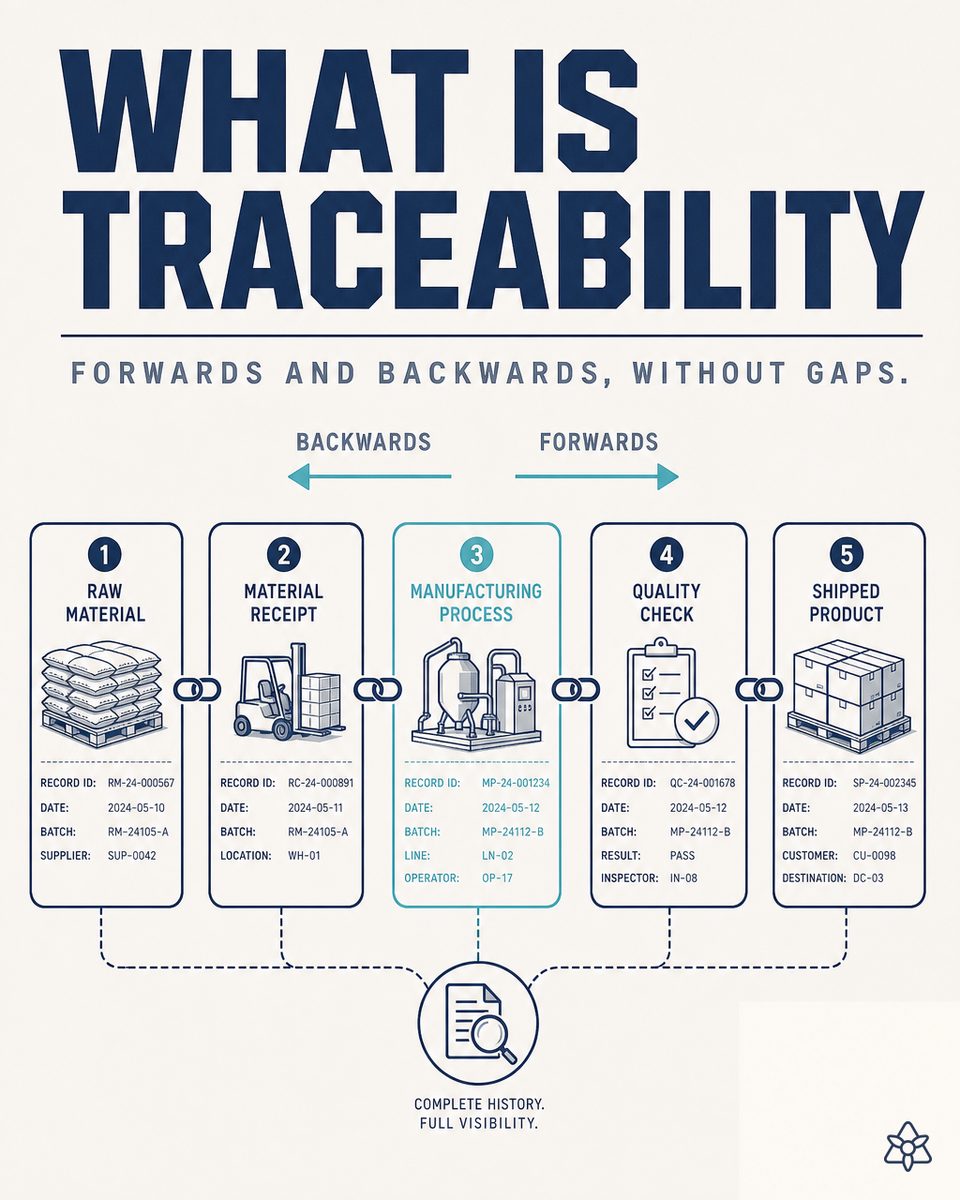
The two directions of traceability
Industrial traceability is based on a simple idea: each batch of product can reconstruct its history. There are three classical types:
- Upstream traceability (backward): where did each component come from? Activates when there's a quality issue and you need to find the origin.
- Downstream traceability (forward): where did each batch go? Activates when you need to recall product from market.
- Internal traceability: what happened to this batch inside my plant? Per-order costs, yields, non-conformities.
Industrial traceability — the three types
| Type | Question it answers | When it activates |
|---|---|---|
| Backward (upstream) | Where did this component come from? | Quality investigation, return, audit |
| Forward (downstream) | Where did this batch go? | Product recall, customer alert, health alert |
| Internal | What happened inside my plant? | Yield analysis, costs, non-conformity |
What people ask about industrial traceability
What is industrial traceability?
Ability to follow a product across its entire value chain — from raw material to end customer — recording who handled it, when, with which machine, and under what conditions.
What's the difference between upstream and downstream traceability?
Upstream: where each component came from (origin search). Downstream: where each batch went (destination search). A good system answers both in seconds.
Is traceability the same as serialization?
Not exactly. Traceability is the complete tracking system. Serialization is assigning a unique number to each unit. Serialization is a tool for traceability, but you can also do batch traceability without serializing.
Which regulations require traceability?
Main ones: EU Regulation 178/2002 (food), FSMA (US food), IMDS (automotive), cGMP (pharma), AS9100 (aerospace), GS1 (global retail standard).
How do you apply traceability without rewriting everything?
iLEAN Tracer integrates with your current ERP/MES without replacing it. Adds GS1 labeling, capture via scan or vision, and connects to supplier systems. Phased rollout, no big bang.
More cases in industrial traceability
- Tobacco serialization under the TPD with AI — aggregation decides whether the truck leaves.How iLEAN verifies pack-carton-case-pallet aggregation by vision, reconciles exceptions and reports…
- AI export track & trace — five regulatory languages, one single case.How iLEAN orchestrates serialization, aggregation and reporting to DSCSA, FMD, Chestny Znak and other…
- UDI on medical devices with AI — a miscoded PI is a recall notice, not an incident.How iLEAN composes the UDI (DI+PI) read on the line, cross-checks it against GUDID/EUDAMED and keeps the…
- Product QR code with AI — the door to the batch digital record, not to a static page.iLEAN Edge reads and verifies the product QR on the line; Connect links it to recipe, batch and MES; the…
- Anti-counterfeit with AI vision — the veteran's eye, on every box.How iLEAN Edge reads the visual signature of your product in line and catches counterfeits or grey…
- Carmen — the managementsoftware that is stillstanding, and has been modernized.Carmen is the long-standing factory management program of the iLEAN ecosystem. Still active, modernized…
Tell us what you manufacture. We'll tell you what traceability you need.
25 years with documented cases. Free diagnostic conversation.
Request demo See full traceability