Anti-counterfeit with AI vision — the veteran's eye, on every box.
A good counterfeit passes the human visual check; a professional one passes the serial OCR. iLEAN Edge trains a CNN on your authentic product and compares every unit against that visual signature — typography, print screen, embossing, alignment, security ink. It also catches the parallel market: your own product in an unauthorised channel. The agent assembles the dossier; legal and brand sign off the withdrawal.
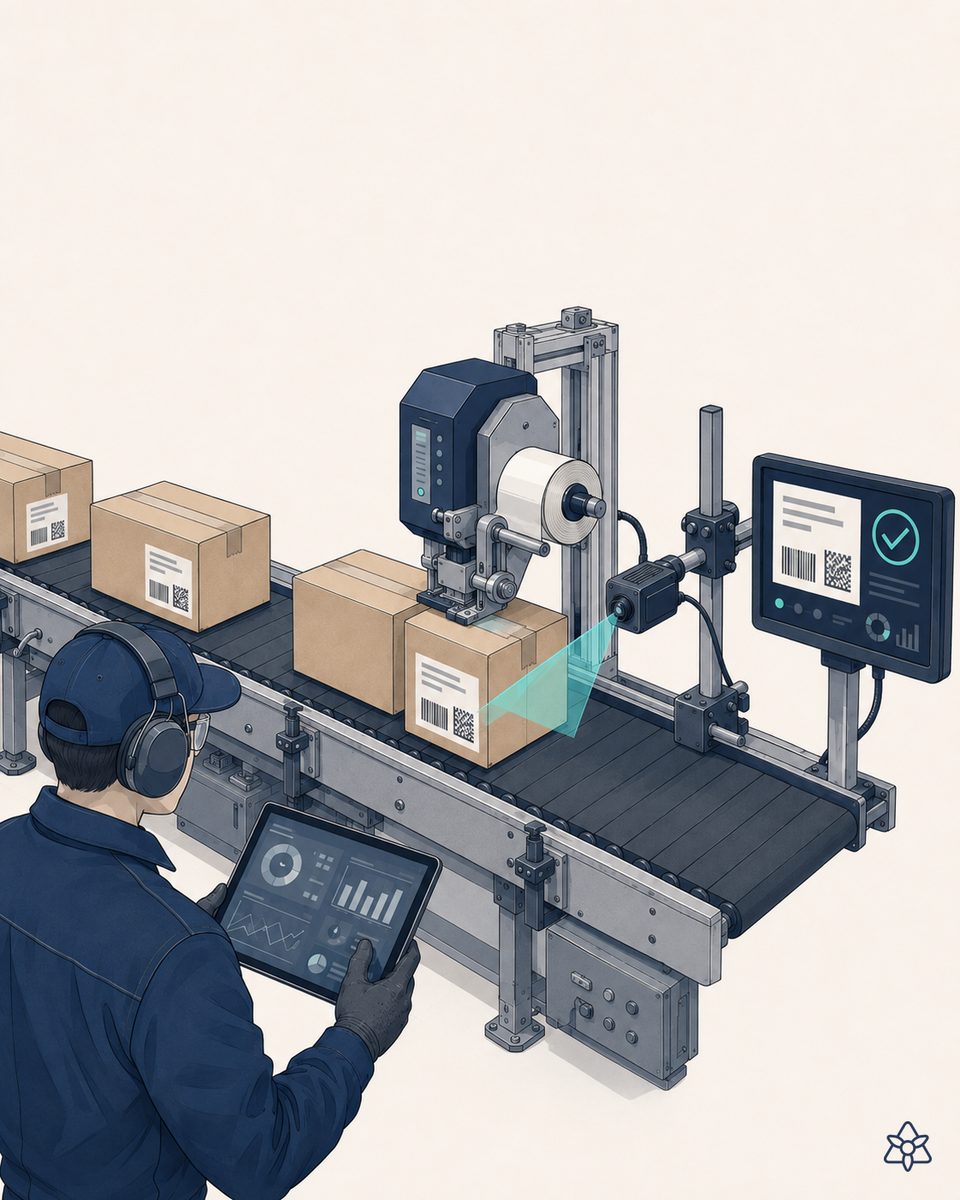
Human checking gets tired; the counterfeiter does not.
Professional counterfeiting is no longer street-stall knock-offs. Professional counterfeiting:
- Replicates the packaging with unsettling precision — the seal, the neck, the tab, the generic hologram. It fools the untrained eye, and it fools the trained eye after eight hours of looking at boxes.
- Reuses authentic serial codes — bought on the parallel market, reprinted, cloned in blocks. The serial OCR says "it exists in my ERP", and it still is not yours.
- Comes in through reverse logistics — grey return, repacked, redistributed. The least watched vector and, in premium brands, the most expensive one: your own channel puts back on the shelf product you never made.
Classic checking (operator + magnifier + checklist) works 99% of the time. That 1% is the one that reaches the shelf or the end customer — and each unit is brand cost, not just hard cost. A margin eroded by parallel market does not show up in the P&L until it has already happened.
iLEAN does not add a fourth system — it gives eyes and memory to the line you already have.
The problem with anti-counterfeiting is not missing data: it is that the human eye does not scale, and the serial information lives on an island separate from the product image. iLEAN acts as the filler that closes that gap, without asking you to change your packaging line, your distribution centre or your logistics provider.
Edge reads the product's visual signature. Connect reads the serial code and the expected destination. The agent cross-checks against the ERP and assembles the dossier. Legal and brand sign off the withdrawal — never the other way round.
The three iLEAN pieces applied to anti-counterfeiting:
- Edge — a terminal with machine vision (CNN) on the packaging line, at the reverse logistics intake and in the regional hub. It reads the product's visual signature — neck embossing, print screen, alignment, ink — and fires the actuator (ejector, stack light, hold) in milliseconds. It works with no network. If the centre loses WiFi, Edge keeps reading and holding boxes.
- Connect — captures the serial code, the delivery note and the return manifest, whether they come from a modern ERP, a vertical WMS, the importer's email or the distributor's messaging app. When a brand exports to several countries and each one reports differently, Connect normalises from second zero.
- Anti-counterfeit agent — lives in Central, inside the three safety rings. It cross-checks Edge's visual signature against the serial read by Connect, against the issuance recorded in the ERP, against the authorised channel and against the expected destination. If something does not add up, it assembles the dossier — before/after photos, serial number, batch history, chain of custody, applicable regulation — and hands it to the legal and brand owner. The person signs off — the withdrawal never executes on its own.
Manual checking + isolated OCR vs. cross-checked vision with iLEAN
| Aspect | Operator + serial OCR | With iLEAN Edge + Connect + Agent |
|---|---|---|
| Detection of professional counterfeits | Depends on a trained, well-rested eye | Visual signature against your own pattern, on every unit |
| Cloned serial | "It exists in my ERP" = it passes | Serial + visual signature + channel, cross-checked |
| Parallel market / grey return | Invisible until it reaches the shelf | Caught at the reverse logistics intake |
| Time from detection to legal dossier | Days, with manual searching | Minutes, with the file closed |
| Coverage per shift | Drops at the end of the day | Constant 24/7 |
| Operation with no network | n/a | Edge keeps running on cabinet power |
Impact estimate for your plant — to be validated with your numbers.
The block below is an estimate to be validated with the specific data of your brand. We put it forward so the committee has an order of magnitude; we refine it during the diagnostic.
- Premium brand (cosmetics, spirits, OEM spare parts, consumer electronics) with documented counterfeit product on marketplaces and growing grey returns in reverse logistics.
- Edge pilot on the packaging line + reverse logistics intake. First expected value in a few weeks: the first counterfeit or parallel unit held with a closed dossier.
- Indicative payback between 4 and 9 months, depending on affected volume and % of share lost to the parallel channel. A reduction of counterfeit/parallel product getting past the check of ≥ 30% is expected, against your current baseline.
- The hard lever is not only the cost of the withdrawn product: it is the market share recovered in the authorised channel and the minimum price defended.
And the brand director's fair objection
"What if the AI flags an authentic unit as a counterfeit and we block a legitimate shipment?" — hallucination is a problem of free generation, not of anchored tasks. In tasks where the AI only compares an image against your own pattern and cross-checks a serial against an ERP, the best models pushed the error below 1.5% [1]. And even so, no withdrawal executes on its own: the dossier goes to the owner and the person signs it off. The three safety rings are there precisely for this.
[1] OpenAI paper "Why Language Models Hallucinate", 2025 — on the reliability of AI in anchored tasks.
What people ask about anti-counterfeit with AI vision
How does an AI vision system tell a professional counterfeit apart?
A good counterfeit fools the untrained eye, but it leaves traces in what the industrial camera does see: micro-variations in the batch code typography, direction of the print screen, exact geometry of the embossing on the neck, alignment of the inner tab, colour of the security ink under different spectra. iLEAN Edge trains a CNN on thousands of images of authentic product from your own plant — your brand's visual signature, not a generic library — and compares every unit against that pattern. What the veteran's eye spots in one box, the camera spots in every single one.
What kind of fraud is detected — only counterfeiting, or parallel market too?
Both. A counterfeit is product manufactured by a third party imitating your brand. The parallel market is your own authentic product circulating outside the authorised channel — returned, repacked, exported to a country other than the one on the packaging, sold below the minimum price. Edge vision detects the counterfeit by reading the product signature, and detects the parallel diversion by cross-checking the image against the serial code and the expected destination. If authentic product shows up where it should not, the agent flags it and prepares the file for legal.
Where is Edge vision installed — only in your own factory?
On the line itself, in the distribution centre and at the reverse logistics intake. The first station catches the counterfeit batch that slips in as a return in order to re-enter the channel — that is one of the least watched and most expensive vectors. The second station verifies reconditioned product before it goes back on the shelf. The third one, at customs or at the regional hub intake, detects your own authentic product arriving through an unauthorised channel. It works with no network: if the centre loses WiFi, Edge keeps reading and holding boxes, because what is critical cannot depend on connectivity.
How is the visual decision cross-checked with the legal system and the serial code?
Connect captures the printed or engraved serial code, the agent cross-checks it against the ERP/MES (was this number issued? which customer did it go to? was it active or already withdrawn?) and against the expected destination. If the visual signature does not add up, or the destination does but the channel does not, the agent assembles the dossier — before/after photos, serial number, batch history, chain of custody, applicable regulation — and leaves it ready for the legal and brand owner. The person decides whether proceedings are opened; iLEAN does not decide that on its own, the three safety rings are there precisely for this.
How much does anti-counterfeit vision cost for a mid-size brand?
The order of magnitude of an Edge anti-counterfeit pilot in a mid-size brand (cosmetics, premium goods, beverages, automotive spare parts) is close to that of a vision pilot on any line: an initial investment covering terminals + cameras + actuator + training the CNN on your authentic references + ERP integration, plus an annual licence. A reasonable payback is a few months — the hard lever is the market share recovered, not just the counterfeits blocked. Send us the data for your case and we will send you the estimated ROI within 48h, with your numbers, not ours.
More cases in industrial traceability
- UDI on medical devices with AI — a miscoded PI is a recall notice, not an incident.How iLEAN composes the UDI (DI+PI) read on the line, cross-checks it against GUDID/EUDAMED and keeps the…
- What is industrial traceability: definition and examplesIndustrial traceability is the ability to know, at any moment, where every component came from and where…
- Product QR code with AI — the door to the batch digital record, not to a static page.iLEAN Edge reads and verifies the product QR on the line; Connect links it to recipe, batch and MES; the…
- Carmen — the managementsoftware that is stillstanding, and has been modernized.Carmen is the long-standing factory management program of the iLEAN ecosystem. Still active, modernized…
- Cepicafé — coffee tracedfrom the Peruvian farmto the European container.iLEAN Tracer real case: Cepicafé coffee traceability from Peruvian farms to the European container, with…
- McDonald's — the chainnobody wants to break.iLEAN real case: McDonald's food supply chain integration. Documented conference, GS1 traceability…
Tell us about your case and within 48h we'll send you the estimated ROI of your AI anti-counterfeit project.
We work on the real data of your brand and your chain, not on ours. Diagnostic with no commitment.
Request estimated ROI in 48h See traceability