Product QR code with AI — the door to the batch digital record, not to a static page.
The product QR code is the gateway to the digital record — but only if it is linked to the reality of the batch. iLEAN Edge reads and verifies the QR on the line, Connect cross-checks it with the ERP recipe and MES data, and the agent builds the Digital Product Passport at second zero. Your end customer scans it and sees the truth of your plant — not a marketing PDF.
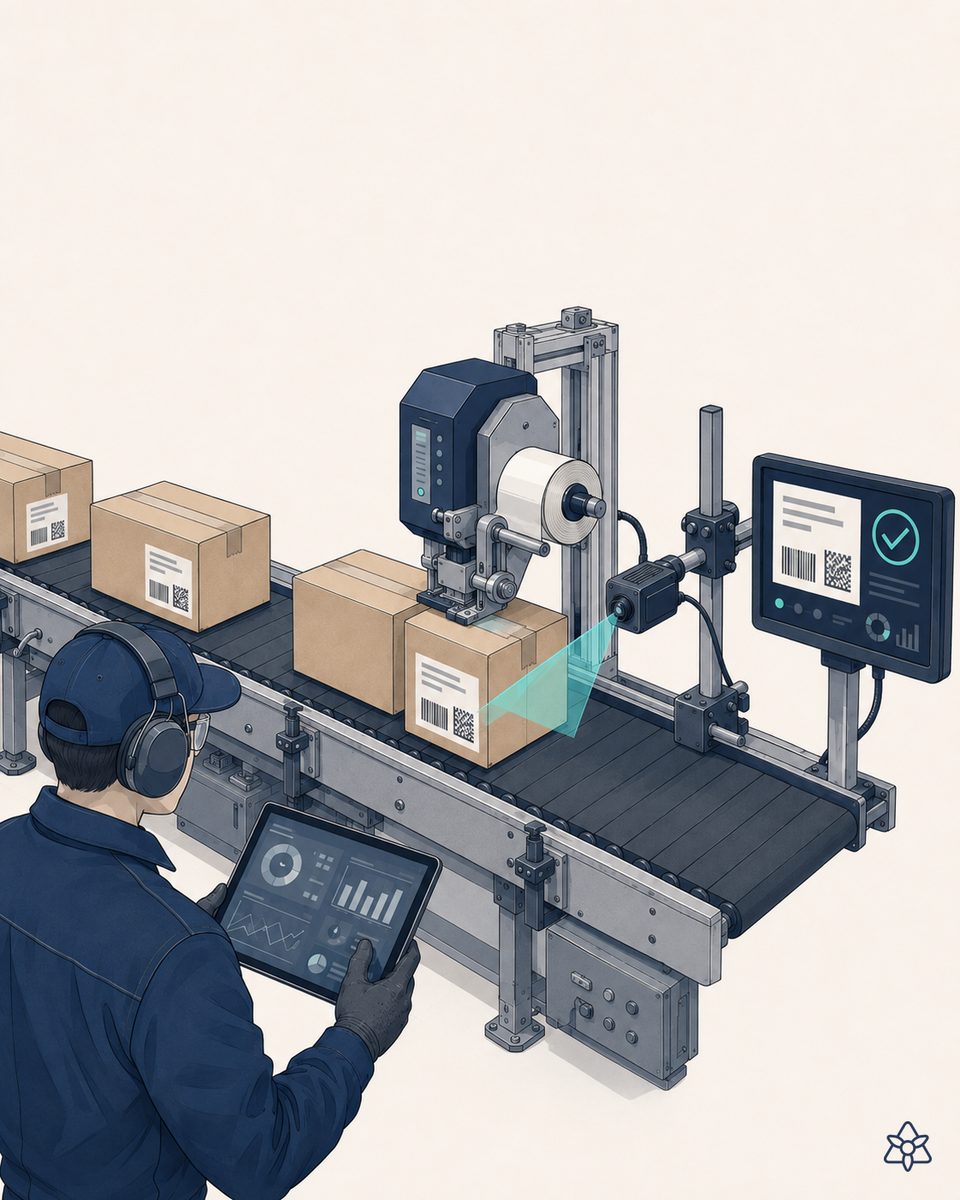
A QR with no batch behind it is a marketing trick — and the regulator has noticed.
Anyone can stick a QR code on their product and link it to a page of static PDFs. The problem starts when the QR has to mean something:
- The end customer scans and wants to see their batch, not the generic datasheet. That batch data lives in the MES, in the ERP, in a spreadsheet on the R&D manager's laptop, on a LIMS control sheet — scattered.
- The regulator requires the DPP by product family. Home appliances, batteries, textiles, construction materials — the Digital Product Passport is arriving, and the QR (or Data Matrix) is its carrier. It is not a differentiation option: in some sectors it is already compliance.
- The printer is still carrying the previous batch QR. It is the most common and most expensive incident: SKU changeover, the printer was not updated, the whole pallet ships with the wrong QR. When someone scans and sees a product that is not theirs, it reaches quality and the retailer — and sometimes a recall.
The classic setup (a QR linked to a static web page) keeps working — until the customer, the retailer or the auditor demand the truth of the batch behind it. And the truth of the batch lives scattered.
iLEAN links the QR to reality — without you throwing away your MES or your ERP.
The challenge of the product QR is not printing it: it is linking it to the truth of your plant in real time. iLEAN does not ask you to change the printer or the ERP; it acts as the filler that seals the crack between the scattered data (MES, ERP, LIMS, spreadsheets) and the endpoint that serves the QR to the customer.
Edge reads the printed QR. Connect joins recipe, batch and certificates. The agent builds the DPP. The person signs what goes to market.
The three iLEAN pieces applied to the product QR:
- Edge — a terminal with machine vision (CNN) over the marking or packaging line. It reads and decodes the printed QR, cross-checks it against the active MES order and verifies that it points to the correct batch. If there is a deviation, it holds the item before packaging and fires the actuator. It works without a network.
- Connect — captures the batch data wherever it lives: recipe from the ERP, parameters from the SCADA, controls from the LIMS, the batch photo taken by the shift supervisor, the supplier certificate that arrived by email. That is the precondition for the QR to mean something real.
- Agent — lives in Central. It recontextualises that data into the Digital Product Passport or GS1 Digital Link format, publishes it to the endpoint that serves the QR, manages differentiated permissions (what the end customer sees vs. what the B2B retailer sees vs. what the auditor sees), and assembles the compliance dossier (EUDR, CBAM, REACH/SCIP where applicable). The person validates the publication — nothing reaches the market without a human signature.
Static QR vs. QR linked to the batch with iLEAN
| Aspect | QR to a generic web page | With iLEAN Edge + Connect + Agent |
|---|---|---|
| Link to the real batch | Generic, by SKU | Specific to the batch and serial produced |
| Verification at print time | None | Edge reads the QR and verifies against MES on the line |
| Origin of the content | Static PDFs someone updates | ERP/MES/LIMS/Connect cross-checked by the agent |
| DPP / GS1 Digital Link compliance | Partial or absent | Native, compatible structure |
| Differentiated permissions | n/a — all or nothing | End customer / B2B retailer / auditor |
| Detection of the previous batch QR | Arrives as a complaint | Held on the line before packaging |
Impact estimate for your plant — to be validated with your numbers.
The block below is an estimate to be validated with the specific data of your plant. We lay it out so that management and compliance have an order of magnitude; we refine it during the diagnostic.
- Manufacturer with 1–3 marking/packaging lines, exporting to the EU/UK/USA, in a sector with the DPP on a close regulatory horizon (home appliances, batteries, textiles, construction materials).
- Edge pilot on one line + Connect for batch capture + DPP agent. First value expected within a few weeks: product leaves the pilot with a QR linked to the batch and an endpoint the customer and the retailer can scan.
- Indicative payback between 4 and 9 months, conservative. Levers: reduction of incidents from a wrong QR ≥30% (estimate), access to retailers that already demand a real-batch QR, savings in compliance audit preparation, and reduction of counterfeiting.
- The hard lever: a single recall avoided because of a wrong label or QR pays for the pilot. A single blocked listing at a major retailer over a non-compliant QR is avoided with the same system.
And the reasonable doubt from the CAIO / compliance
“What if the agent publishes wrong data in the DPP?” — hallucination is a problem of free generation, not of tasks anchored to the source. Recontextualising ERP/MES data into the DPP format is exactly that: reformatting, not inventing. On anchored tasks the best models brought the error rate below 1.5% [1]. And even so: nothing reaches the market without a human signature — the three safety rings require it by design. It fits the manufacturer's liability and the direction the AI Act is taking.
[1] OpenAI paper “Why Language Models Hallucinate”, 2025 — on the reliability of AI in anchored tasks.
What people ask about the product QR code with AI
What is a QR code on an industrial product for?
The QR code on an industrial product stops being a retail code and becomes the gateway to the batch digital record: the end customer scans it and sees the origin, the components, the manufacturing date and line, the quality certificate, the carbon footprint, the usage instructions and the repair manual. It is the technical foundation of the European Digital Product Passport (DPP), which comes into force product family by product family, and the main tool to fight counterfeiting, justify EUDR/CBAM and give access to the repairability passport. And it only works if it is linked to the truth of the batch — a QR wired to a static page is worthless.
How does iLEAN verify that the printed QR is the one for the real batch?
iLEAN Edge is a terminal with machine vision (CNN) over the packaging or marking line. It reads the printed QR in milliseconds, decodes it, cross-checks it against the manufacturing order in the MES/ERP and verifies that it points to the batch being produced at that moment. If the printer is still carrying the previous batch QR (a classic cause of RASFF incidents and recalls), Edge holds the item before packaging and raises the alert. It works without a network: if the plant loses WiFi, it keeps reading and holding. The person validates and signs.
Who builds the content behind the QR code?
The agent does, on top of the sources your plant already has: the ERP (raw material, suppliers, batch), the MES (line, shift, parameters), the SCADA (process curves), the LIMS (quality controls), Connect (batch photo, shift supervisor voice note, supplier certificate that arrived by email). The agent recontextualises that data into the format required by the DPP or the GS1 Digital Link standard, without writing anything new — and publishes it to the endpoint that serves the QR. Your traceability is only as good as your capture: that is why the Connect piece is the precondition.
Does it comply with the European Digital Product Passport and with GS1?
Yes. The system supports the GS1 Digital Link standard (the QR contains a resolvable HTTPS URL) and the DPP (Digital Product Passport) data structure following the ESPR technical specifications for the products where it already applies. Sensitive data (B2B, certificates, repairability) and public data (for the end consumer) are served with differentiated permissions. The schema is aligned with the direction European regulation is taking on digital labelling, not a patch you will have to redo.
What does it cost to link the QR to the truth of the batch?
The typical pilot covers one marking/packaging line with an Edge terminal for reading and verification + Connect for batch data capture + an agent that builds the DPP. First value within a few weeks: every product manufactured after the pilot leaves with a QR linked to the real batch. Indicative payback between 4 and 9 months, with hard levers in counterfeiting reduction, fewer incidents from label mix-ups, savings in audit preparation, and market access where the DPP is already mandatory. We ask for your plant data and send you the estimated ROI within 48h.
More cases in industrial traceability
- AI export track & trace — five regulatory languages, one single case.How iLEAN orchestrates serialization, aggregation and reporting to DSCSA, FMD, Chestny Znak and other…
- UDI on medical devices with AI — a miscoded PI is a recall notice, not an incident.How iLEAN composes the UDI (DI+PI) read on the line, cross-checks it against GUDID/EUDAMED and keeps the…
- What is industrial traceability: definition and examplesIndustrial traceability is the ability to know, at any moment, where every component came from and where…
- Anti-counterfeit with AI vision — the veteran's eye, on every box.How iLEAN Edge reads the visual signature of your product in line and catches counterfeits or grey…
- Carmen — the managementsoftware that is stillstanding, and has been modernized.Carmen is the long-standing factory management program of the iLEAN ecosystem. Still active, modernized…
- Cepicafé — coffee tracedfrom the Peruvian farmto the European container.iLEAN Tracer real case: Cepicafé coffee traceability from Peruvian farms to the European container, with…
Tell us about your case and within 48h we will send you the estimated ROI of this AI project for your product QR.
We work on the real data of your plant, not on ours. Diagnostic with no commitment.
Request estimated ROI in 48h See traceability