Tobacco serialization under the TPD with AI — aggregation decides whether the truck leaves.
The TPD requires a unique identifier per unit, declared aggregation at every level (pack → carton → case → pallet) and reporting of every movement to the EU repository within strict deadlines. An aggregation failure or a late report blocks the shipment. iLEAN verifies inline, by vision, that what was scanned is what was packed, Agents reconciles the exceptions and leaves only the doubtful cases for the person, and Connect delivers the report to the repository with traceable evidence.
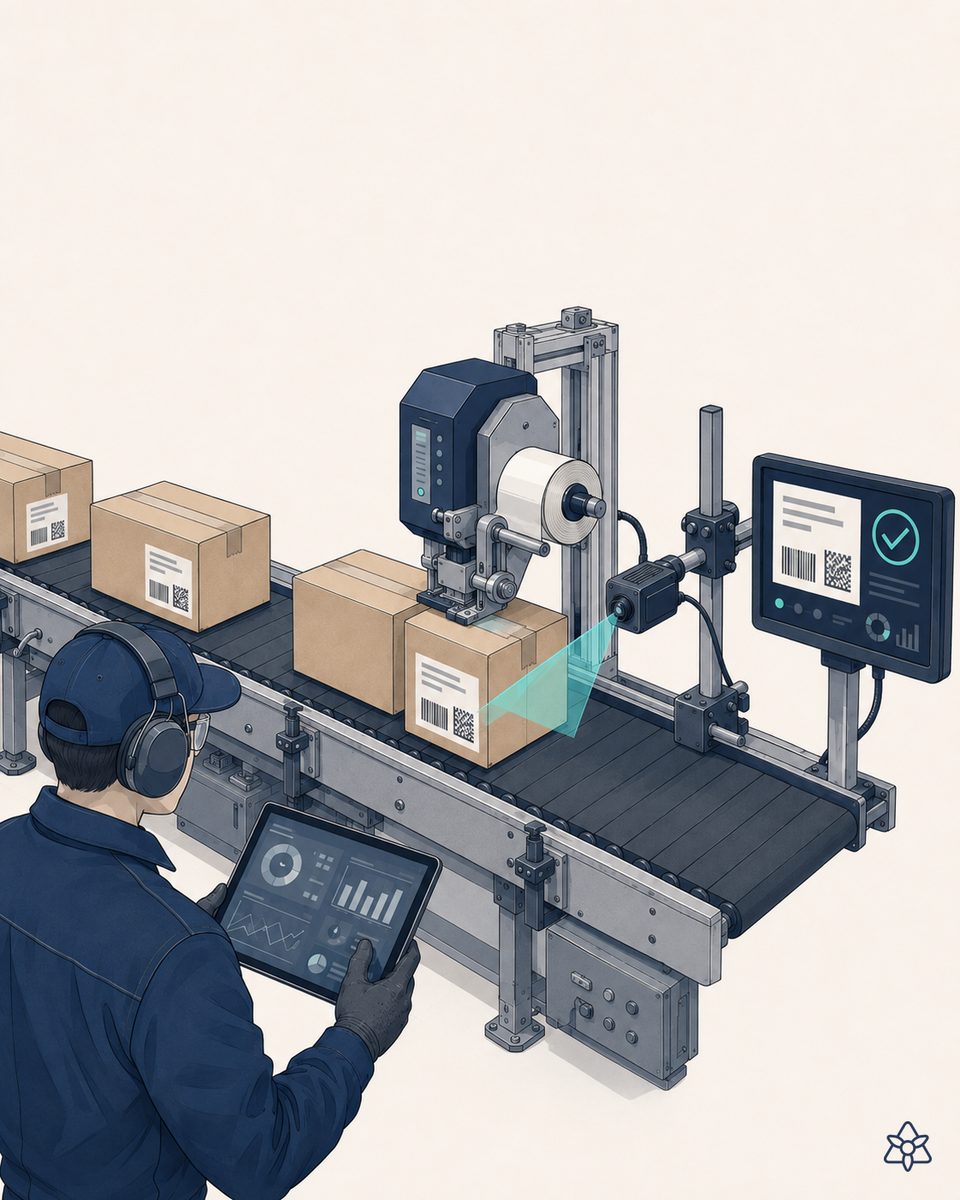
The identifier prints fine. What breaks is the aggregation.
In a tobacco packing plant, serialization is already solved at the printing level: the pack carries its unique identifier and the reader confirms it. The problem shows up one meter later, when that unit enters — or fails to enter — the container the system has just declared:
- Removals after scanning — a pack is pulled for quality after being read. The carton closes with 9 units and the system declared 10. Nobody undoes the aggregation.
- Rework coming back to the line — a carton opened and rebuilt drags along identifiers already declared as children of another parent. The repository sees an impossibility.
- Format changes and manual completion — the case is finished by hand at shift change; the real aggregation and the declared one diverge without a trace.
- Reporting against the clock — movements go out in a nightly batch. When the repository rejects one, the pallet is already loaded and the shipment is blocked at the dock.
The cost is not the fine: it is the stopped truck and the team spending its day reconciling aggregations by hand, container by container, unable to prove afterwards why it decided what it decided. The evidence is rebuilt from memory, and that does not survive an audit.
iLEAN does not replace your serialization system — it closes the gap between what was scanned and what was packed.
TPD serialization is a textbook case of the problem iLEAN solves: the data exists, but nobody checks at second zero that it matches physical reality. iLEAN acts as the putty that stitches together your printer, your readers, your serialization system, your MES and the EU repository — without throwing away anything you already have.
Edge checks by vision what enters the container. The agent reconciles the mechanical exceptions. Connect reports to the repository on time. The person resolves only the doubtful cases and signs.
The three iLEAN pieces applied to tobacco serialization under the TPD:
- Edge — a terminal with computer vision (CNN) at the closing point of carton, case and pallet. It counts the units that actually go in, detects unreadable codes or units foreign to the batch, and holds the container before it closes if the aggregation event does not match what it sees. It runs with no network and without touching the PLC.
- Connect — a two-way channel with the EU repository and with the ID issuer: it sends the movements within their deadline, picks up acknowledgments and rejections at second zero and returns them to the line before the pallet leaves the warehouse.
- Agent — automatically reconciles the single-resolution exceptions (unit pulled for quality, reopened container, batch rework), rebuilds the correct parent and closes the case with its trail. It escalates only the doubtful cases to the person, and any external submission goes out with a human signature.
Manual TPD serialization vs. TPD serialization verified with iLEAN
| Aspect | Classic TPD serialization | With iLEAN Edge + Connect + Agents |
|---|---|---|
| Aggregation verification | Blind trust in the scan | Computer vision at the closing point |
| Mis-aggregated container | Discovered on repository rejection | Held before it closes |
| Aggregation exceptions | Manual queue, resolved the next day | Reconciled by the agent; the person sees only the doubtful ones |
| Movement reporting | Nightly batch, no evidence attached | On time, with evidence linked to the event |
| Shipping | Dock blockages from broken aggregation | Pallet released with its aggregation verified |
| Auditing an old pallet | A week of document archaeology | A query with traces, images and signatures |
| Repetitive tasks | Manual, human error | Done inside the rings, without touching OT |
Impact estimate for your plant — to be validated with your own numbers.
The block below is an estimate to be validated with the concrete data of your factory. We put it forward so the committee has an order of magnitude; we refine it during the diagnostic.
- A packing plant with TPD serialization already in place, aggregation to carton and case, and a team dedicated to reconciling exceptions every shift.
- Pilot: one line with vision verification at carton closing plus automatic exception reconciliation on that line. First value expected within a few weeks.
- Indicative payback between 5 and 10 months, dominated by: shipments without blockages (the truck leaves the day it is supposed to) plus fewer people dedicated to reconciling aggregations by hand plus a drop in repository rejections.
- Hard lever: every shipment blocked at the dock costs transport, customer penalties and hours from two departments. Avoiding a few per year already pays for the system. The European AI Act also requires human oversight in high-risk systems — iLEAN already complies by architecture (rings).
And the CAIO's reasonable doubt
"What if an agent reconciles an aggregation wrong and that ends up reported to the repository?" — the three rings solve this by architecture. The agent lives in ring 3 (power); every reconciliation with regulatory impact passes through ring 2 (validation) and only ring 1 launches the signed action. On reliability: hallucination is a problem of free-form generation, not of anchored tasks like checking a vision count against a declared aggregation event; the best models have pushed the error below 1.5% [1].
[1] OpenAI paper "Why Language Models Hallucinate", 2025 — on the reliability of AI in anchored tasks.
What people ask about tobacco serialization under the TPD with AI
What exactly does the TPD require for tobacco serialization?
The Tobacco Products Directive (TPD) mandates three chained things: a unique identifier per unit packet, generated by an independent ID issuer; declared aggregation at every logistic level (pack → carton → case → pallet), so the system knows what each container really holds; and reporting of every movement — production, aggregation, dispatch, change of ownership — to the EU repository within strict deadlines. If the aggregation does not add up or the report arrives late, the shipment is blocked: it is not a deferred fine, it is a truck stopped at the dock.
Where do aggregations actually fail?
It is almost never the reader that fails: it is what happens between the read and the physical closing of the container. The typical cases: a pack pulled for quality after scanning and nobody undoes the aggregation; a reworked carton returning to the line with its identifier already declared in another pallet; a case completed by hand during a format change; a pallet restacked in the warehouse without registering the new parent. The system believes it correctly declared what was packed, but what was scanned and what was packed stopped being the same thing. It is discovered weeks later, when the repository rejects a movement.
How does computer vision verify that the aggregation is correct?
With a camera at the closing point of each level. The Edge terminal counts and checks by vision (CNN) the units that actually enter the container and contrasts them against the aggregation event the system is about to declare. If the carton declares 10 packs and vision counts 9, or a unit shows up with an unreadable code, the container is held before it closes, not downstream. The terminal runs with no network and without touching the PLC: it reads, compares and returns the verdict right on the line.
What happens when an aggregation exception appears?
Most exceptions are mechanical and have a single reasonable resolution: a unit pulled for quality, a reopened container, a batch rework. The agent reconciles that bulk automatically — it undoes the affected aggregation, rebuilds the correct parent and closes the case with its trail — and escalates to the person only what is doubtful: a duplicate identifier, a container with an incoherent history, a movement past its deadline. The team resolves dozens of cases a day, not thousands, and every resolution is signed by whoever made it.
How is the report to the EU repository audited?
Every message sent to the repository is stored next to its evidence: the aggregation event, the image from the vision check that backed it, the line timestamp, the repository's acknowledgment and, if there was an exception, who resolved it and on what basis. When an auditor or the regulator asks about a pallet shipped eight months ago, the reconstruction is a query, not a week of document archaeology. And no external communication goes out without a person's signature: the agent prepares, the person validates.
See also: export track & trace with AI → · GS1 DataMatrix with AI →
More cases in industrial traceability
- A B2B return gets lost in emails. And by the time it resurfaces, the batch has already been sold three times over.iLEAN closes the B2B returns loop: categorized cause, affected batch, documented decision (rework /…
- RFID in the warehouse with AI — when the reader misses, the inventory lies.How iLEAN reconciles RFID reads, WMS and ERP with vision and agents so real stock adds up and…
- Traceability softwarethat answers in secondswhen something goes wrong.Industrial traceability software with AI: forward and backward, inventory control, GS1 labeling, ERP…
- AI export track & trace — five regulatory languages, one single case.How iLEAN orchestrates serialization, aggregation and reporting to DSCSA, FMD, Chestny Znak and other…
- UDI on medical devices with AI — a miscoded PI is a recall notice, not an incident.How iLEAN composes the UDI (DI+PI) read on the line, cross-checks it against GUDID/EUDAMED and keeps the…
- What is industrial traceability: definition and examplesIndustrial traceability is the ability to know, at any moment, where every component came from and where…
Tell us your case and within 48h we will send you the estimated ROI of this AI project for your packing plant.
We work on your factory's real data, not ours. Diagnostic with no strings attached.
Request estimated ROI in 48h See all traceability solutions