GS1 DataMatrix with AI — one mis-encoded Application Identifier stops the importer, not the printer.
The GS1 DataMatrix compresses GTIN, batch, expiry date and serial into an 8×8 mm square — and a single badly encoded Application Identifier turns 50,000 units into regulatory scrap downstream. iLEAN Edge verifies AI/FNC1 structure, ISO/IEC 15415 print quality and serial inline; if something does not add up, it holds the case before aggregation. A person signs off.
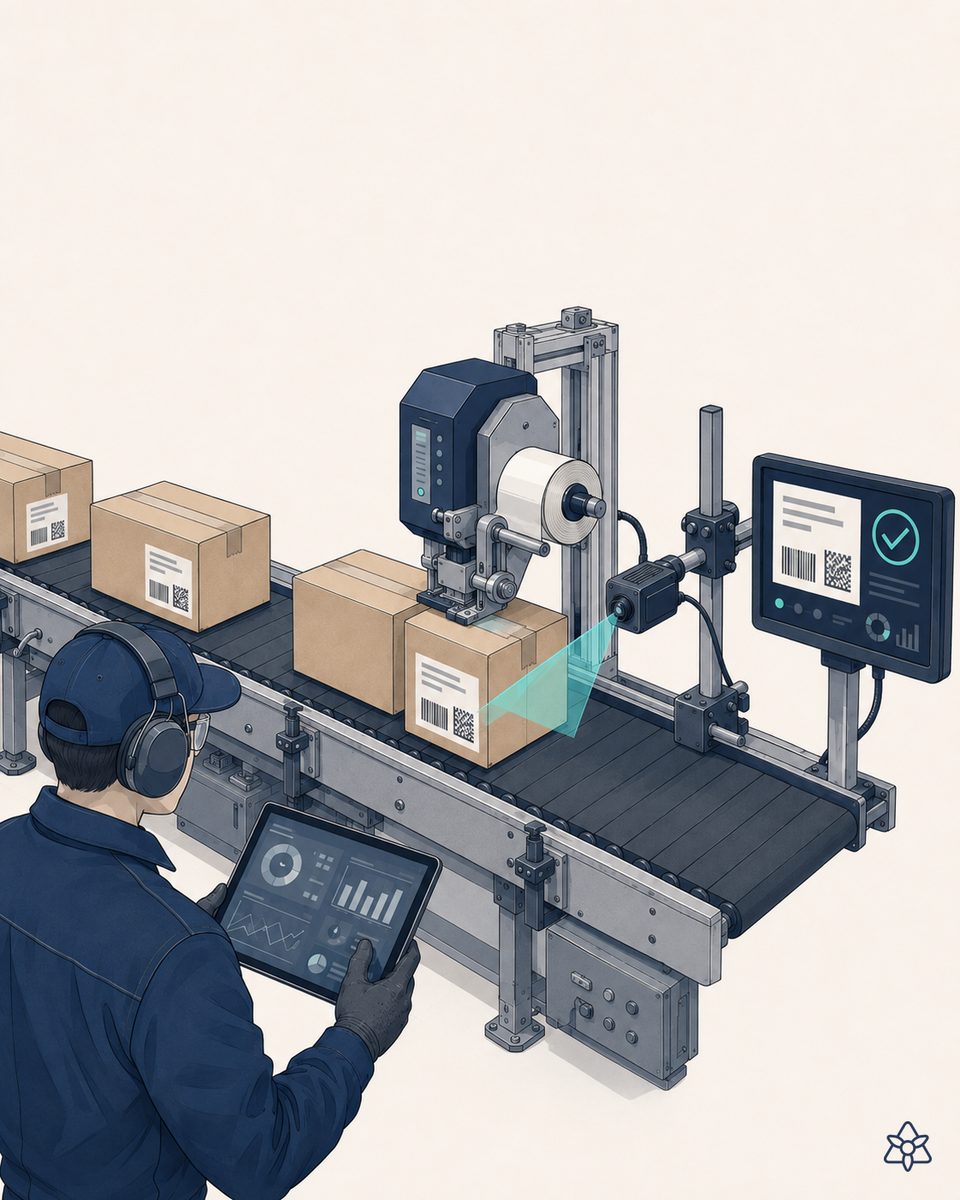
A readable DataMatrix is not a correct DataMatrix.
The verifier on the case packer says "OK". The American customer rejects the shipment two weeks later because their DSCSA system cannot parse AI 17 (expiry date) — the date was right, but the FNC1 separator was missing. The GS1 serialization failure patterns we see over and over:
- Badly built AI/FNC1 structure — the code prints, the code reads, but it does not parse against the GS1 standard; the repository spits it out.
- Borderline ISO 15415 grade — it passes today with the printer's new camera, it fails tomorrow with the scanner on the Rotterdam dock.
- Broken parent-child aggregation — the master case declares 12 packs and holds 11 plus one duplicate; nobody notices until landing.
- EPCIS events reconstructed afterwards — commissioning was uploaded by someone with a spreadsheet yesterday, because the aggregation system never sent it.
The classic verifier checks whether the code can be read. iLEAN checks whether the code makes sense — for the regulator in the destination country, for the wholesaler receiving it, for the EPCIS repository it is about to be published to. The failure either stays in the plant or it stays nowhere.
iLEAN does not add another case packer — it adds the brain the case packer does not have.
The problem is not printing: it is that the verification chain between printer, case packer, palletiser and repository is broken at the joints. iLEAN acts as the sealant that closes those joints, without ripping out your serializer or your aggregation system.
Edge watches every step (print → unit → case → pallet) with GS1 criteria. Connect moves EPCIS to the retailer hub. An agent holds parent-child coherence together and signs the events at the moment they happen. The person validates.
The three iLEAN pieces applied to the GS1 DataMatrix:
- Edge — a terminal with computer vision (CNN) that decodes the DataMatrix, splits the AIs by FNC1, validates the GS1 structure, measures ISO/IEC 15415 quality and checks the GTIN check digit. It blocks the unit if the grade or the structure does not comply. It works with no network, on the light available at the panel.
- Connect — emits and consumes EPCIS 2.0 (JSON/JSON-LD) or EPCIS 1.2 (XML) depending on the retailer, wholesaler or regulator hub. It also captures the importer's email changing a quality threshold, the messaging thread with the adhesive supplier, the spreadsheet kept by the serialization manager.
- Agent — holds parent-child across three levels (pack → case → pallet) in real time; orchestrates the EPCIS events (commissioning, packing, shipping) and proposes corrections when a case comes up short. The person signs; the system does not decide alone.
Classic verification vs. GS1 DataMatrix with iLEAN
| Aspect | Classic verifier | With iLEAN Edge + Connect + Agent |
|---|---|---|
| What gets validated? | That the code is readable | GS1 AI/FNC1 structure + check digit + ISO 15415 grade |
| SKU / regulatory profile change | Manual reconfiguration of the verifier | Profile per family (DSCSA/FMD/cosmetics…) applied automatically, validated by a person |
| Print quality | Pass / fail | A-F grade + print head and laser trend |
| Parent-child aggregation | Counts tags | Vision of the real units + agent reconciliation |
| EPCIS events | Uploaded afterwards, from a spreadsheet | Signed and emitted at the moment of the event |
| Importer rejection | Arrives two weeks later | Impossible — the rejection is avoided at the outbound dock |
Impact estimate for your plant — to be validated with your own numbers.
The block below is an estimate to be validated with the concrete data of your line. We put it forward so the committee has an order of magnitude; we refine it during the diagnostic.
- Packaging line with unit-level plus master-case serialization (pharma, cosmetics, premium food), exporting into 2-3 regulatory regimes.
- Edge pilot on the case packer with a GS1 profile plus EPCIS integration from Connect. First value expected within a few weeks.
- Indicative payback between 4 and 9 months, dominated by: a reduction of ≥ 30% in rejections caused by bad printing or mis-encoded AIs plus a drop in returns caused by broken aggregation.
- Hard lever: the cost of one single return from a US or EU port under DSCSA or FMD pays for the pilot.
The demanding standard
In sectors such as automotive, the quality bar sits around the order of 25 PPM (parts per million). In pharma under DSCSA or FMD the threshold is not measured in PPM at all, it is zero rejections: no invalid serial can enter the chain. What moves the needle is not a better verifier — it is verifying against the standard that actually applies, inline, before aggregation. That is exactly the kind of anchored task where AI is reliable: it checks against a defined structure instead of guessing [1]. The Edge does it with GS1 criteria, not the OEM reader shipped with the printer.
[1] OpenAI paper "Why Language Models Hallucinate", 2025 — on the reliability of AI in anchored tasks.
What people ask about GS1 DataMatrix with AI
What does a GS1 DataMatrix carry, and why does one mis-encoded AI sink the batch?
The GS1 DataMatrix encodes several Application Identifiers (AIs) inside a single symbol, separated by FNC1: AI 01 (GTIN-14), AI 10 (batch), AI 17 (expiry date, YYMMDD), AI 21 (serial) and more, depending on the product family. The structure is not optional: a missing FNC1 or a badly closed variable-length AI turns the code into something unreadable for your customer, for the EPCIS repository and for the retailer. A single mis-encoded AI can strand 50,000 units on the importer dock — and the problem surfaces two weeks later, on the other side of the Atlantic.
How does iLEAN measure print quality (ISO/IEC 15415) inline?
Edge verifies the code at every step of the line (printing, aggregation, pallet), measuring the parameters of the ISO/IEC 15415 standard — symbol contrast, modulation, fixed pattern damage, defects, decode — and assigns an A-F grade. You set the acceptance threshold yourself, according to your retailer or regulator (pharma DSCSA usually demands ≥ B; food depends on the contract). If the grade drops, Edge blocks the unit before it is aggregated into the case. It also tracks print head and laser health as a trend: if contrast degrades shift after shift, the agent raises it as maintenance before the grade falls below threshold.
Does it work for pharma DSCSA/FMD, cosmetics and food?
Yes. GS1 encoding rules are universal — what changes is which AIs are mandatory and what quality threshold each sector demands. iLEAN ships a library of sector profiles (pharma DSCSA US, EU FMD, cosmetics CPNP, EU food 1169/2011, US retailer, Latam) and applies the profile your line is running at that moment. You change SKU and the profile changes with it, without touching plant code. A person validates any new profile before it goes into production.
What happens with pack → case → pallet aggregation?
Parent-child aggregation is where the classic system breaks most often: a master case that should hold 12 packs declares 12 reads, but one of them was a duplicate. iLEAN combines Edge on the case packer (vision of the real units entering the case) with the palletiser tunnel read and agent reconciliation. If the packs read do not match the packs expected, it is held before the case is closed. And the EPCIS event goes out signed, not reconstructed afterwards.
How does it connect to EPCIS and to the retailer hub?
Connect emits and consumes EPCIS 2.0 (JSON/JSON-LD over REST, or XML 1.2 over AS2/SFTP) depending on what your trading partner asks for: retailer hub, wholesaler DSCSA platform, EU Hub for FMD, or a national repository. The agents orchestrate the submissions event by event (commissioning, packing, shipping) without a human having to remember the schedule. What is critical gets signed; what is repetitive runs on its own inside the rings.
See also: UDI medical device with AI → · Export track & trace with AI →
More cases in industrial traceability
- EPR — the right fee per SKU and country, not the generic-factor one.iLEAN calculates EPR fees per SKU and country from real packaging composition and eco-modulation —…
- EUDR — the supplier's geocoordinate is no longer optional.iLEAN automates EUDR due diligence — supplier geocoordinates, cross-check with official deforestation…
- iLEAN Tracer features: modules and architectureiLEAN Tracer covers upstream and downstream traceability, inventory control, GS1 labeling, ERP…
- iLEAN Writer: encrypted traceabilityat the level of the big players,free for small food makers.iLEAN Writer is free. Generates encrypted .ILE traceability files per batch for SMB food manufacturers.…
- Industrial inventory control with AI and traceabilityiLEAN unifies inventory control with AI: real-time inbound/outbound, stock by location, automated…
- A label is just the beginning.iLEAN Writer turns it intoreal traceability.iLEAN Writer: industrial labeling and printing software. GS1, DataMatrix, QR, RFID. Connects to…
Tell us your case and within 48h we will send you the estimated ROI of this AI project for your line.
We work on your factory's real data, not ours. Diagnostic with no strings attached.
Request estimated ROI in 48h See all traceability solutions