EUDR — the supplier's geocoordinate is no longer optional.
The EUDR (EU Regulation 2023/1115) requires a Due Diligence Statement per batch with the exact geocoordinates of the plot of origin. iLEAN Connect captures the coordinate through whichever channel the supplier uses (email, WhatsApp, PDF), an agent cross-checks it against the official deforestation maps and prepares the DDS. A person signs — and the batch does not reach customs without that signature.
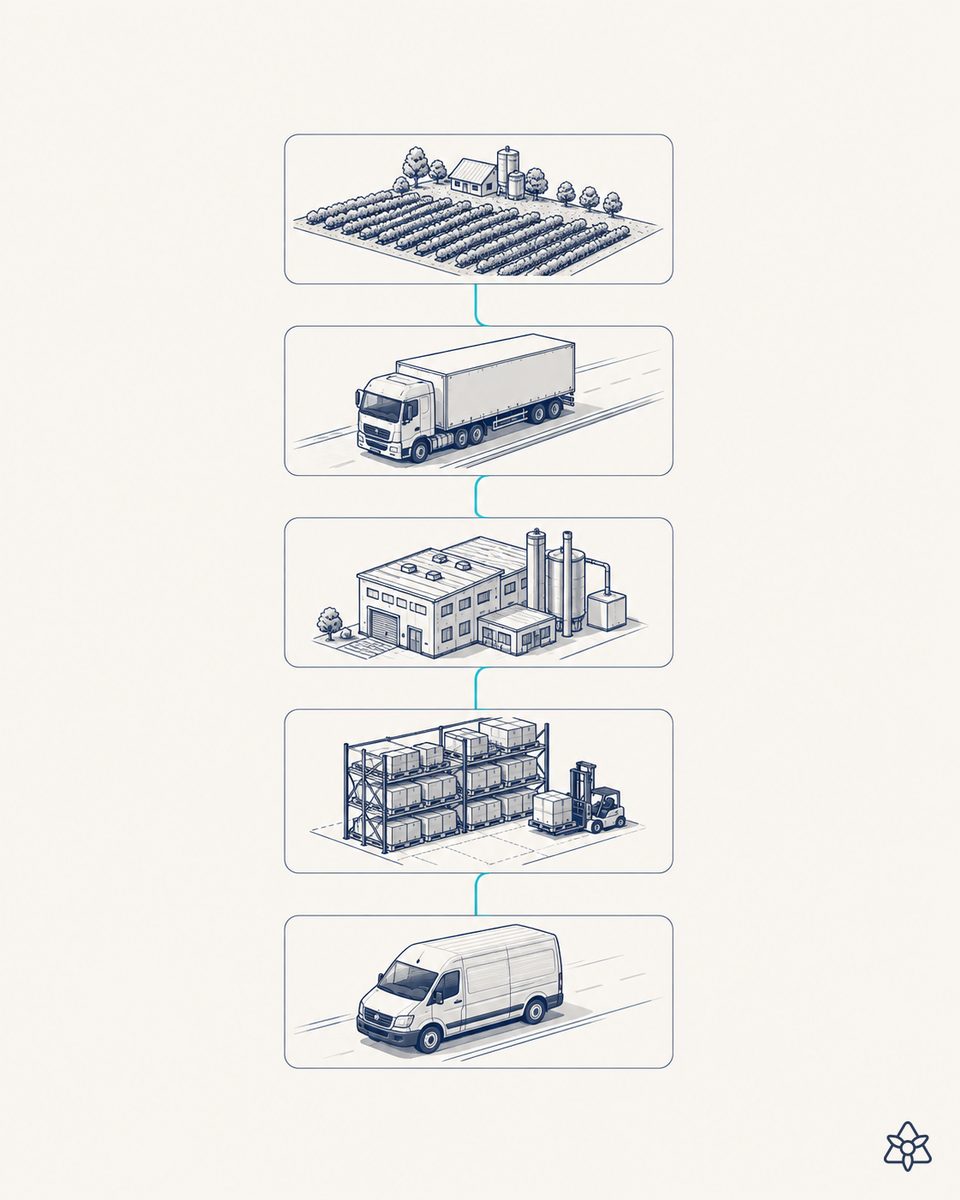
“The chain is multi-tier and the coordinate arrives over the middleman's WhatsApp.”
The EUDR is honest about what it asks for: for every batch of soy, coffee, cocoa, rubber, palm, timber or cattle crossing the EU border, the operator must file a Due Diligence Statement with the exact geocoordinate of the plot of origin, evidence that it was not deforested after the cut-off date, and a signed declaration of legality. Without that, there is no customs clearance.
The problem is not knowing what has to be done — it is that the information lives in a multi-tier chain where:
- The plot is known by the smallholder, who often has no email at all; they have WhatsApp.
- The local middleman aggregates volume from a hundred plots and delivers a single batch with a summary declaration.
- The third-country exporter sends the certificate by email as a scanned PDF.
- The EU importer receives scattered information and, at the moment of clearance, has to hand TRACES a signed DDS per batch.
In between: three lost emails, an out-of-date spreadsheet, and a coordinate copied by hand with one decimal wrong. The procurement manager knows it. The classic system works until one batch is stopped at customs and drags the rest of the season down with it.
iLEAN acts as the sealant between your multi-tier supply chain and the EUDR.
The problem is not that one more tool for managing DDS is missing. It is that the information already exists — it lives in the coordinate the smallholder sent over WhatsApp, in the exporter's PDF certificate, in the middleman's email — but it does not reach the person who signs, complete and on time. iLEAN seals that crack, without asking the third-country supplier to change how they work.
Connect listens to whichever channel the supplier uses — email, WhatsApp, PDF, web form. The agent cross-checks the coordinate against the official maps. The procurement manager signs. The DDS is filed to TRACES.
The two iLEAN pieces applied to EUDR:
- Connect — captures outward whatever arrives through channels no ERP ever integrated: the exporter's email with a scanned certificate PDF, the smallholder's WhatsApp with the coordinate, the middleman's web form, a transcribed call. It all enters at second zero, anchored to the batch of origin. Connect is bidirectional: it also replies to the supplier through the same channel to ask for whatever data is missing — a person approves the reply before it goes out.
- Agent — queries the geospatial layers (JRC Global Forest Cover Change, Global Forest Watch, local sources in the country of origin), overlays the supplier's polygon, computes the area deforested after the cut-off date and issues a verdict. If there is doubt, it holds the batch and alerts the procurement manager through whichever channel they use. If everything adds up, it prepares the DDS ready for signature and files it in the format TRACES asks for.
And all of it under the three safety rings: external data enters ring 3 (power, capture), is validated in ring 2 (could this supplier deliver today? does the coordinate match the historical polygon?), and the signed DDS is deposited in ring 1 — the data that goes to TRACES is the data the person approved. Never the other way around.
EUDR by hand vs. EUDR coordinated with iLEAN
| Aspect | EUDR by hand (spreadsheet + email) | With iLEAN Connect + Agent |
|---|---|---|
| Coordinate capture | Smallholder's WhatsApp copied by hand | Connect reads the channel, anchors it to the batch, no re-keying |
| Cross-check with official maps | Screenshot of Global Forest Watch | Automated cross-check, JRC + GFW + local sources |
| Multi-tier chain | Three emails, one PDF, one spreadsheet — and a prayer | Agent chases the missing data through the supplier's channel |
| DDS generation | Word template + data pasted by hand | Per-batch dossier ready for signature in TRACES |
| Non-compliance detection | At customs, with the batch already in transit | Before clearance, with time to reassign the batch |
| Later audit | Reconstructing conversations from months ago | History anchored per batch with the original capture |
Impact estimate for your plant — to be validated against your numbers.
The block below is an estimate to be validated with the concrete data of your operation. We put it forward so the committee has an order of magnitude; we refine it during the diagnostic.
- Typical operator with a multi-tier chain in one or more EUDR commodities, tens to hundreds of batches a month, third-country suppliers delivering data through heterogeneous channels.
- Connect + DDS Agent pilot on one commodity and one country of origin. First value expected within a few weeks.
- Indicative payback between 4 and 9 months, depending on the monthly DDS volume and the current cost of manual handling (compliance FTE + sales team hours spent chasing certificates).
- Reduction in manual hours preparing DDS and chasing certificates: ≥ 30%, with room for more as capture covers more suppliers.
- The hard lever is not losing a batch at customs: a single detention pays for the pilot, before counting brand damage or season reassignment.
And the procurement manager's reasonable doubt
“What if the agent gets a coordinate wrong and I let a non-compliant batch through?” — hallucination is a problem of free generation, not of anchored tasks. In tasks where the AI is limited to recontextualising a piece of data (extracting the coordinate from the PDF, overlaying it on a map, computing the deforested area), the best models brought the error below 1.5% [1]. And even so, the DDS is not filed on its own: the agent prepares it, the responsible person reviews and signs it. The three rings are there for exactly this.
[1] OpenAI paper “Why Language Models Hallucinate”, 2025 — on the reliability of AI in anchored tasks.
What people ask about EUDR with AI
What exactly does the EUDR require from an EU operator or trader?
EU Regulation 2023/1115 (EUDR) bans placing soy, coffee, cocoa, rubber, palm, timber or cattle — and their derivatives — on the EU market if they come from deforested or degraded land. Every operator must file a Due Diligence Statement per batch in the European Commission's TRACES system, with the exact geocoordinates of the plot of origin, evidence that the plot was not deforested after the cut-off date, and a signed declaration of legality. No DDS, no customs clearance.
How do you manage traceability when the supplier is in a third country and the chain is multi-tier?
That is exactly the worst case — and where the classic system breaks first. The information travels in spreadsheets, the sales rep's WhatsApp, the smallholder's PDFs, the middleman's certificates… and something always gets lost on the way. iLEAN Connect captures the channels the multi-tier supplier actually uses to hand over the data (email, WhatsApp, web form, PDF) and puts it into the system at second zero. An agent cross-checks the coordinates against the official maps (Global Forest Watch, JRC, local sources in the country of origin) and prepares the DDS — a person signs it.
How does iLEAN cross-check the coordinates against official deforestation maps?
The agent queries the applicable geospatial layers: JRC Global Forest Cover Change (the Commission's official reference), Global Forest Watch, local maps of the country of origin where they exist, and the Commission's TRACES. For each plot it computes the area deforested after the cut-off date, overlays it on the supplier's polygon and issues a verdict: compliant, non-compliant or requires human verification. If there is any doubt, the batch is held and the procurement manager decides — the agent does not act alone where the decision is critical.
Does it apply to every operator or only to large companies?
It applies to any operator or trader placing on the EU market — or exporting from the EU — any of the seven commodities and their derivatives (cardboard, paper, tyres, chocolate, coffee, leather, furniture, biodiesel, and so on). There is a simplified exemption for SMEs, but the DDS is still mandatory. And even if the EUDR deadlines are relaxed, the B2B buyer — the large brands above all — is already demanding geocoordinate-level traceability as a condition of sale, well before the rule bites.
What concrete risk does iLEAN avoid under EUDR?
Three hard risks: (1) fines of up to 4% of the operator's annual turnover in the member state; (2) seizure of the batch at customs and a ban on selling it; (3) inclusion in the public non-compliance list, with the brand and commercial damage that follows. The classic system (spreadsheet + email + checklist) works when you handle five batches a month. When you handle five hundred, the first mistyped coordinate ends up in the alert system of the day — the Commission's, in this case.
Keep reading: Digital Product Passport · EPR extended producer responsibility · CSDDD due diligence
More cases in industrial traceability
- Digital Product Passport — a living dossier per SKU, not a label.How iLEAN builds the Digital Product Passport per SKU from real plant data — ESPR-ready and exportable…
- Static safety stock is either over-stock or a stockout. Almost never the right one.iLEAN calculates safety stock per SKU from real demand and supply variability. Same coverage or better,…
- EPR — the right fee per SKU and country, not the generic-factor one.iLEAN calculates EPR fees per SKU and country from real packaging composition and eco-modulation —…
- iLEAN Tracer features: modules and architectureiLEAN Tracer covers upstream and downstream traceability, inventory control, GS1 labeling, ERP…
- GS1 DataMatrix with AI — one mis-encoded Application Identifier stops the importer, not the printer.How iLEAN verifies every GS1 DataMatrix inline — GTIN, batch, expiry, serial — with AI vision, and holds…
- iLEAN Writer: encrypted traceabilityat the level of the big players,free for small food makers.iLEAN Writer is free. Generates encrypted .ILE traceability files per batch for SMB food manufacturers.…
Tell us about your case and we'll send you the estimated ROI of your EUDR traceability with AI in 48h.
We work on the real data of your operation, not on ours. Diagnostic with no commitment.
Request demo See traceability