Static safety stock is either over-stock or a stockout. Almost never the right one.
A fixed buffer per SKU is decided once a year and lives off the stock manager's intuition. The result: stable SKUs carrying over-stock that weighs on working capital, and critical SKUs running out at the worst possible moment. iLEAN calculates safety stock per SKU and dynamically, from real demand and supply variability. Same coverage or better; working capital released.
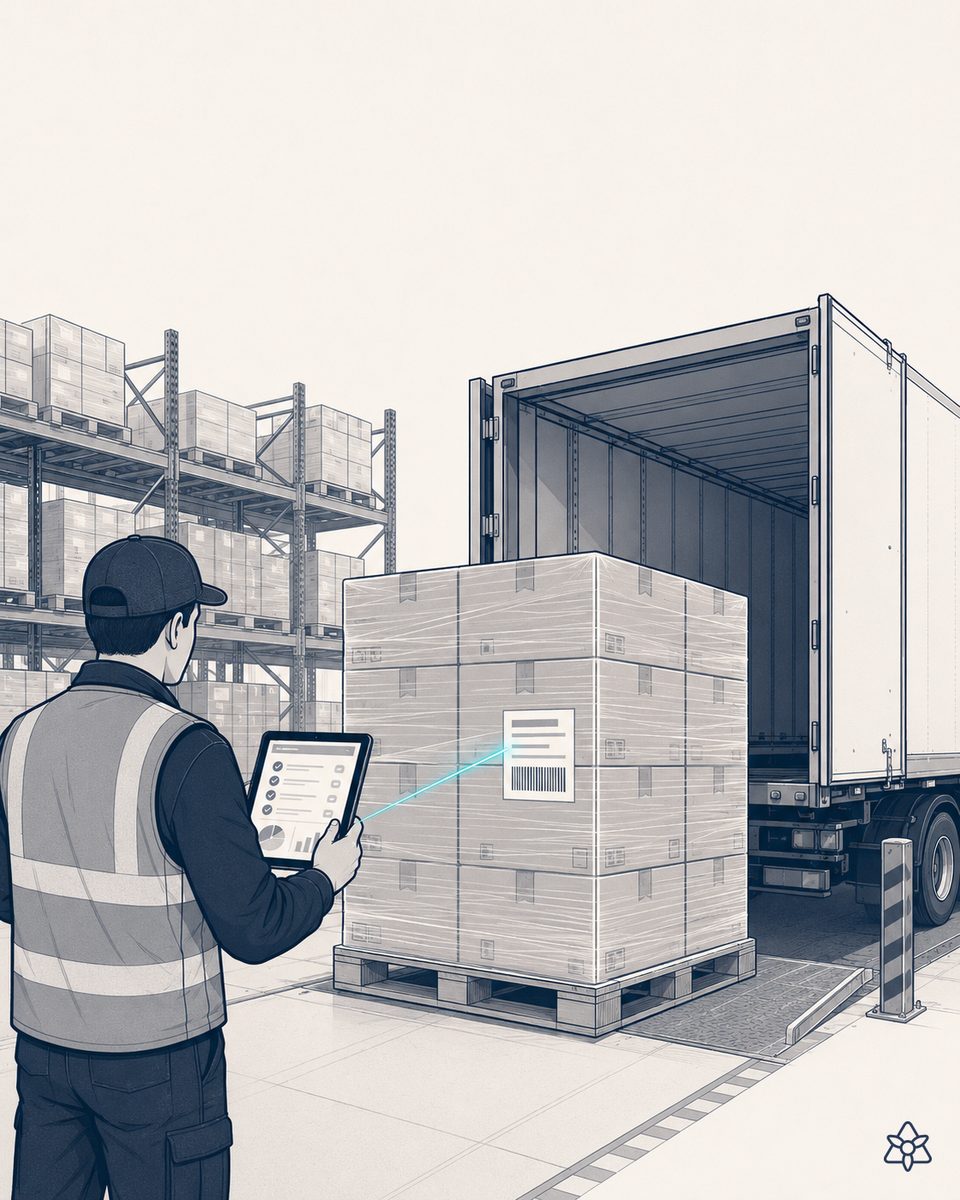
The fixed buffer per SKU is decided once a year and lives off intuition.
Classic safety stock is calculated like this in most mid-sized plants: once a year, in a spreadsheet, with a simple formula (lead time × average demand × safety coefficient) and a manual adjustment from whoever runs the warehouse. What happens next is predictable:
- SKUs with stable demand and reliable supply — the buffer stays in place out of inertia. It weighs on working capital without contributing anything. Nobody lowers it because there is no incident either.
- Critical SKUs with high variability — the buffer falls short when an unexpected campaign, a supplier delay or a change in customer behaviour arrives. The stockout hits and everyone fights the fire.
- Seasonal SKUs — the buffer is inflated all year just in case and deflates exactly when the campaign starts, because nobody had time to touch it.
- New SKUs — they are launched by eye with indefinite over-stock until a year goes by and the manager remembers to adjust.
The problem is not the formula — it is that nobody can keep that formula alive per SKU, in a plant with hundreds or thousands of references, when demand and supply move every week. The stock manager would have to spend the entire working day on the calculation, and does not, because there is another job to do.
iLEAN does not replace the stock manager — it gives them an agent that recalculates on their behalf.
IRIS (Industrial Reality Intelligence Systems) is the category; iLEAN is the system. Dynamic safety stock calculation is one of the cleanest examples of the iLEAN principle: the data exists (ERP movements, real measured lead time, historical demand, seasonality), but nobody has time to operate it. The stock manager's agent is the librarian that was missing from a library full of data with no reader.
Static stock is thought through once a year. Dynamic stock is thought through every time demand or supply changes. The person signs off; the agent sustains it.
The iLEAN pieces applied to dynamic safety stock:
- iLEAN Brain (Central) — the multi-agent brain where the coverage calculation logic per SKU lives. Here historical demand, commercial leading indicators, real lead time per supplier, SKU criticality (margin, substitutability, impact of a stockout) and retailer constraints all come together.
- iLEAN Agent (for the stock manager) — an assistant that keeps coverage alive per SKU, proposes parameter readjustments when reality moves, flags critical SKUs with growing variability, and prepares the dashboard the manager reviews each morning. It proposes; the person signs off.
- iLEAN Connect — captures the signals the ERP cannot see: the supplier email warning about a delay, the sales rep's message about a campaign starting earlier, the shift in a key account's behaviour. Those signals are exactly the ones that break the static buffer — and the ones dynamic calculation has to see at second zero in order to anticipate.
Static safety stock vs. dynamic stock with iLEAN
| Aspect | Static safety stock | With iLEAN Brain + Agent |
|---|---|---|
| Recalculation frequency | Annual (sometimes half-yearly) | Continuous, on any relevant change |
| Granularity | By family or ABC category | Per individual SKU |
| Variables considered | Average demand + promised lead time | + real lead time + variability + seasonality + leading indicators |
| New SKUs | By eye, indefinite over-stock | Proxy from analogous SKUs, progressive adjustment |
| Seasonal SKUs | Fixed buffer all year round | Curve anticipated per campaign, orderly release afterwards |
| Total stock | Inflated by psychological safety | Optimised per SKU, same coverage or better |
Impact estimate for your plant — to be validated with your numbers.
This block is an estimate to be validated with the specific data of your plant. It works as an order of magnitude for the steering committee; we refine it during the diagnostic.
- Multi-SKU plant (from 100 to several thousand active references) with safety stock calculated in a spreadsheet or in a basic ERP module, reviewed annually or half-yearly.
- Immersion of 3-5 days, Pareto identified in the inventory (the SKUs that concentrate 80% of the cost and of the stockouts).
- First dynamic calculation agent operating within a few weeks; first recalculation cycle per SKU validated by the stock manager.
- Total stock reduction between 15% and 35% in the first measurable cycle, with the same service level or better (conservative goal: hold or improve the service level, never worsen it).
- Reduction of stockouts on critical SKUs ≥ 30% through better anticipation of real variability.
- Indicative payback between 4 and 9 months. The hard lever is releasing the working capital tied up in inventory.
The underlying fact — volatility is here to stay
Ocean freight went from ~1,500 USD/container to >20,000 at the 2021 peak, rebounded in 2024 (Red Sea) and then fell sharply on overcapacity. The honest argument is not that transport is expensive today — it is that long chains became fragile and volatile, and safety stock calculated when everything was stable no longer protects. Dynamic calculation is not an optional improvement; it is how inventory reacts to volatility without inflating the buffer blindly.
And the CAIO's doubt — does the AI invent the coverage?
What if the agent lowers a critical buffer because of a hallucination and we run out during the campaign? — hallucination is a problem of free generation, not of anchored tasks. Dynamic stock calculation is pure statistics over ERP data — there is no free generation, there is optimisation anchored to time series. On anchored tasks the best models pushed the error below 1.5% [1]. And even so, the agent proposes; the stock manager signs off before anything enters the ERP. The three safety rings are there precisely for this.
[1] OpenAI paper "Why Language Models Hallucinate", 2025 — on the reliability of AI in anchored tasks.
What people ask about dynamic safety stock with AI
How do you measure demand and supply variability?
The useful measure is always history + leading indicators. Demand: historical order series per SKU, seasonality, trend, and early signals (commercial campaigns, launches, key-account behaviour). Supply: real lead time measured per supplier (not the promised lead time), incident frequency, delays with a documented cause. The agent cross-references them with SKU criticality (margin, substitutability, impact of a stockout) and calculates the minimum viable safety stock. And it recalculates every time reality moves — not once a quarter.
What about new SKUs with no history?
For new SKUs with no demand history of their own, the agent uses intelligent proxies: analogous SKUs from the same segment, the typical behaviour of previous launches in your portfolio, retailer constraints and the commercial forecast. While real history builds up (the first 4-8 order cycles), safety stock stays conservative and is adjusted progressively. The initial error is absorbed by controlled over-stock; the sooner it starts moving, the sooner it is tuned. You avoid the launch done by eye with indefinite over-stock.
Does it integrate with the existing ERP?
Yes — iLEAN sits on top of the ERP (SAP, Oracle, Dynamics, IFS, vertical systems) and does not replace it. Connect reads the master data and the stock movements; the agent calculates the optimal safety stock per SKU; the result goes back to the ERP as a proposed updated parameter, which the stock manager validates and signs off before it goes live. We never touch master data without a human signature — the three safety rings prevent it by design.
Does it reduce the plant total stock?
Yes — the mechanism is that static stock is usually inflated by psychological safety: the stock manager sets a generous buffer to avoid stockouts and nobody minds until it weighs on working capital. With dynamic calculation per SKU, SKUs with stable demand and reliable supply lower their buffer; critical SKUs with high variability raise it. The net effect is normally a total stock reduction of between 15% and 35% in the first measurable cycle, with the same coverage or better. We run the calculation with your numbers — not ours — within 48h.
What about seasonal or campaign SKUs?
The seasonal SKU is where the difference shows most. The typical static stock inflates the buffer all year just in case — and deflates exactly when the campaign starts. Dynamic calculation anticipates the curve: months before the campaign it raises the buffer based on the history of previous campaigns, commercial signals and the critical supplier lead time; after the campaign it releases it in an orderly way so you are not left with obsolete product. The agent keeps it alive; the manager signs off every step.
More cases in industrial traceability
- Conflict minerals 3TG — the CMRT is not a spreadsheet, it is a living dossier.iLEAN automates CMRT and 3TG due diligence (tantalum, tin, tungsten, gold): it checks smelters against…
- CSDDD with AI — living due diligence, not a PDF only the auditor reads.How iLEAN cross-checks your multi-tier supply chain, external alerts and internal records to sustain a…
- Digital Product Passport — a living dossier per SKU, not a label.How iLEAN builds the Digital Product Passport per SKU from real plant data — ESPR-ready and exportable…
- EPR — the right fee per SKU and country, not the generic-factor one.iLEAN calculates EPR fees per SKU and country from real packaging composition and eco-modulation —…
- EUDR — the supplier's geocoordinate is no longer optional.iLEAN automates EUDR due diligence — supplier geocoordinates, cross-check with official deforestation…
- iLEAN Tracer features: modules and architectureiLEAN Tracer covers upstream and downstream traceability, inventory control, GS1 labeling, ERP…
Tell us your case and within 48h we will send you the estimated ROI of dynamic safety stock with AI.
We work on the real data of your plant, not on ours. Diagnostic with no commitment.
Request demo See all traceability solutions