SMT reflow oven thermal profile — every PCB has its own window, not the one of the last board in.
The SMT reflow oven thermal profile decides whether every PCB comes out inside the IPC window or goes to rework. iLEAN Edge tracks zone temperature board by board, cross-checks it against panel thermal mass and oven loading, and anticipates drift before tombstoning or a BGA crack shows up. The process engineer signs off the adjustment.
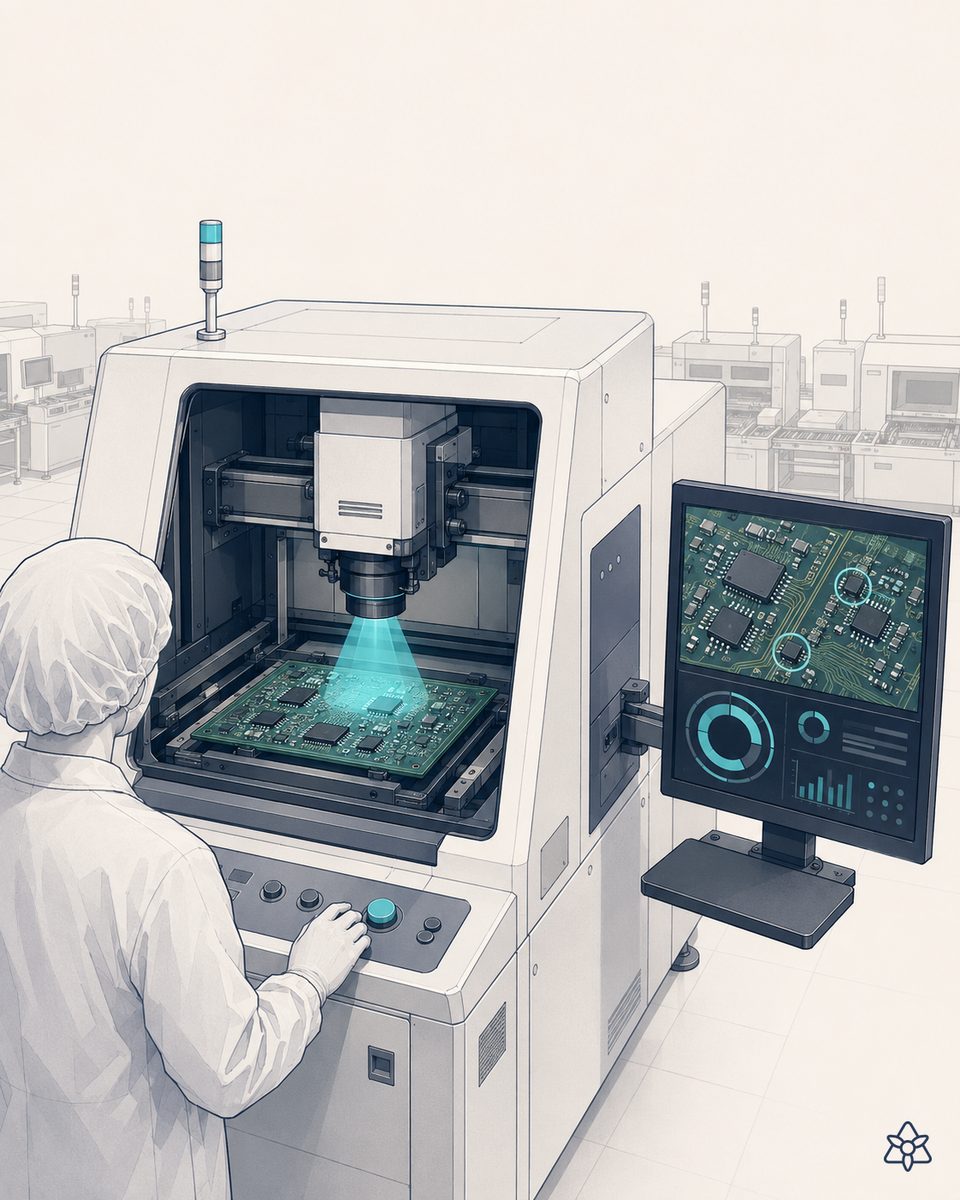
The oven does not make PCBs — it makes profiles. And every PCB asks for its own.
In an SMT reflow oven, the “golden” recipe the process engineer validated with the profiling card is the recipe of the reference panel. But production puts a different panel in every minute: different SKU, different thermal mass, different copper, different BGAs. And the oven reacts to the real loading — a large panel behind a gap cools the zones down and the next one comes out with a short soak. The IPC window is met for most of them and broken for the panel that happened to be in the odd spot — and the symptom shows up at AOI or, worse, as a field failure.
- What goes into the oven — the panel: SKU, thermal mass, list of sensitive components (large BGAs, 0201s, connectors). Data from the MES.
- What happens inside the oven — zone temperatures, conveyor speed, real loading (gaps vs back-to-back panels). Data from the oven PLC, nearly all of it, nearly always.
- What comes out of the oven — the solder joint, the BGA, the fine-pitch component. And AOI verification catches defects, but it does not catch the thermal cause: only the effect.
The process engineer knows this — but one card profile per shift does not protect panel 47, the one that went in behind five gaps on a Friday at 6pm. What is critical is board-by-board drift, the kind you only see once AOI is already pulling boards with tombstoning.
iLEAN does not replace the card profiler — it seals the cracks between the reference and real production.
The reflow problem is not a lack of calibration: it is that the validated reference recipe, the real per-panel oven data, the SKU's list of sensitive components and the AOI result live on islands and nobody cross-checks the four of them board by board. iLEAN acts as the filler that closes those gaps, without asking you to change the oven or the way you calibrate with the profiling card.
Edge sees zone temperature every second. Connect reads panel thermal mass from the MES and the AOI findings. The agent infers the real thermal profile of every PCB and, if it falls outside the IPC window, holds the panel before the oven or routes it to conscious rework. The engineer signs off — never the other way round.
The three iLEAN pieces applied to the SMT reflow thermal profile:
- Edge — terminal integrating the zone thermocouples and a pass camera over the oven. It reads temperature, conveyor speed and real loading every second, and triggers a traffic light or a panel hold when the combination points outside the IPC window. It works with no network. If the MES goes down, Edge keeps reading and holding with the light on the panel.
- Connect — captures the panel's thermal mass and the SKU's list of sensitive components (from the MES, or from the ECAD if that is where it lives), the AOI findings per panel and, from outside, the paste supplier's notice when a new lot arrives. And it captures the process engineer's knowledge — the mental rule about which SKU is the first to drift when the oven cools after a gap.
- Agent — cross-checks zone temperature, thermal mass, oven loading and the IPC window of the most sensitive component. If the combination points outside the window, it holds the panel or routes it to conscious rework before AOI catches it as a defect. The engineer validates and signs off.
Profiler per shift vs. board-by-board profile with iLEAN
| Aspect | Card recipe + downstream AOI | With iLEAN Edge + Connect + Agent |
|---|---|---|
| Profile verification | One card per shift, on a reference panel | Inferred profile for every PCB |
| Reaction to drift | When AOI pulls a board with tombstoning | Hold or reroute before the oven |
| SKU changeover | “Golden” recipe adjustment, conveyor at fixed speed | Speed and zones suggested from the SKU's real mass |
| Oven loading | No compensation | Compensated for real loading (gaps vs back-to-back) |
| Per-panel traceability | Recipe + AOI result | Per-panel record with inferred thermal profile and IPC window |
| Operation with no network | n/a | Edge keeps reading and holding with the panel light |
Impact estimate for your plant — to be validated with your numbers.
The block below is an estimate to be validated with the specific data of your line. We put it forward so the committee has an order of magnitude; we refine it during the diagnostic.
- SMT line with a multi-zone reflow oven, multi-SKU EMS with large BGAs and 0201 components, AOI at the exit.
- Edge pilot on the oven (integration with zone thermocouples + loading camera + MES reading + hold actuator). First value expected within a few weeks.
- Reduction of rework from tombstoning and cold joints ≥ 30 % on the recurring recipe-changeover incident (the other failure modes remain a matter of design and paste).
- Indicative payback between 4 and 9 months, depending on the frequency of rework documented in recent lots and the average cost of BGA rework / a field failure found late.
- The hard lever: a single BGA panel recovered on the line pays for a good part of the pilot.
And the CAIO's reasonable doubt
“What if the AI decides to hold a panel that was going to come out fine?” — hallucination is a problem of free generation, not of anchored tasks. In tasks where the AI limits itself to inferring the real thermal profile of a panel from the oven thermocouples and comparing it with the IPC window of the most sensitive component, the best models brought the error below 1.5 % [1]. And even so, what is critical is not decided alone: iLEAN holds and the process engineer signs off. The three safety rings are there precisely for this.
[1] OpenAI paper “Why Language Models Hallucinate”, 2025 — on the reliability of AI in anchored tasks.
What people ask about the SMT reflow oven thermal profile
What is the IPC J-STD-020 process window and why does it matter board by board?
The IPC J-STD-020 window defines the ramp, soak, time above liquidus and peak temperature ranges a component can withstand without damage. Going over the top degrades components and opens cracks in BGAs; falling under the bottom leaves cold joints. And the window is not met for a production run: it has to be met for every PCB, because each panel puts a different thermal mass into the oven.
Why doesn't one single profile work for every PCB?
Because the panel's thermal mass changes with the SKU, with the PCB weight, with the amount of copper, with the size of the BGAs and with how loaded the oven is when the next panel goes in. A “golden” recipe that works for 10 panels in a row can leave panel 11 short on reflow if the oven cools down during a gap. The card profiler measures well, but it measures when you send it through — not on every PCB.
How does Edge anticipate tombstoning and BGA cracks?
Edge integrates the oven's fixed thermocouples zone by zone, captures every reading in seconds and cross-checks it against the panel's thermal mass (from the MES) and the oven's real loading (from the camera reading or the pass sensor). The agent compares the thermal profile inferred for that PCB with the IPC window of the most sensitive component. If the combination points outside the window, it holds the panel before the oven and alerts the process engineer.
Does Edge replace the card profiler?
No. The card profiler remains the reference for calibrating the oven and verifying the reference profile. What Edge adds is what the card cannot do: measure the profile of every PCB that goes through, not of one validation panel per shift. It is the difference between measuring the reference and measuring production.
What does an Edge on an SMT reflow oven cost?
An order of magnitude close to an Edge on an electronics line: an initial investment covering terminal + integration with the oven thermocouples and the MES + panel hold actuator, plus an annual licence. The reasonable payback to present to the committee is several months — the hard lever is the avoided rework on cold joints and BGAs and the reduction in field failures. We ask for your line's data and send you the estimated ROI in 48h.
More cases in ilean edge
- If the extractor bearing goes, the booth loses negative pressure — and the oven goes down with it.iLEAN Edge watches the PVD paint booth extractor bearing with a thermal camera: the curing oven stays up…
- Beverage end-of-line palletizer — the shift ends with no stop because the motor current warned days earlier.iLEAN Edge reads the motor current of the beverage end-of-line palletizer and warns before the late…
- Powder metallurgy compaction — parts in tolerance shift after shift, not just in the SPC sample.iLEAN Edge tracks hydraulic pressure on the powder metallurgy compaction press and keeps parts in…
- Operator presence in the risk zone of a stamping press — automatic cycle inhibit without losing rhythm.iLEAN Edge detects operator presence in the risk zone of a stamping press and blocks the cycle in…
- Edge ultrasound on the refinery steam network — traps and joints, kg/h, immediate saving.iLEAN Edge with ultrasound scans the refinery saturated steam network: it finds failed traps and leaking…
- Vortex steam flow on a plate heat exchanger — pasteurization stays in band instead of being corrected afterwards.iLEAN Edge reads the vortex steam flow of the plate heat exchanger and keeps food pasteurization in band…
Tell us about your case and within 48h we'll send you the estimated ROI of this AI project for your SMT line.
We work on your oven's real data, not on ours. Diagnostic with no commitment.
Request estimated ROI in 48h See iLEAN Edge