Powder metallurgy compaction — parts in tolerance shift after shift, not just in the SPC sample.
In powder metallurgy (PM/sintering), the green height and density of the part depend on a hydraulic pressure that drifts with powder moisture, the supplier batch and die temperature. iLEAN Edge closes the loop on that pressure every cycle, learns its normal signature per SKU and warns the shift supervisor before SPC confirms the scrap. The person signs — tolerance holds shift after shift.
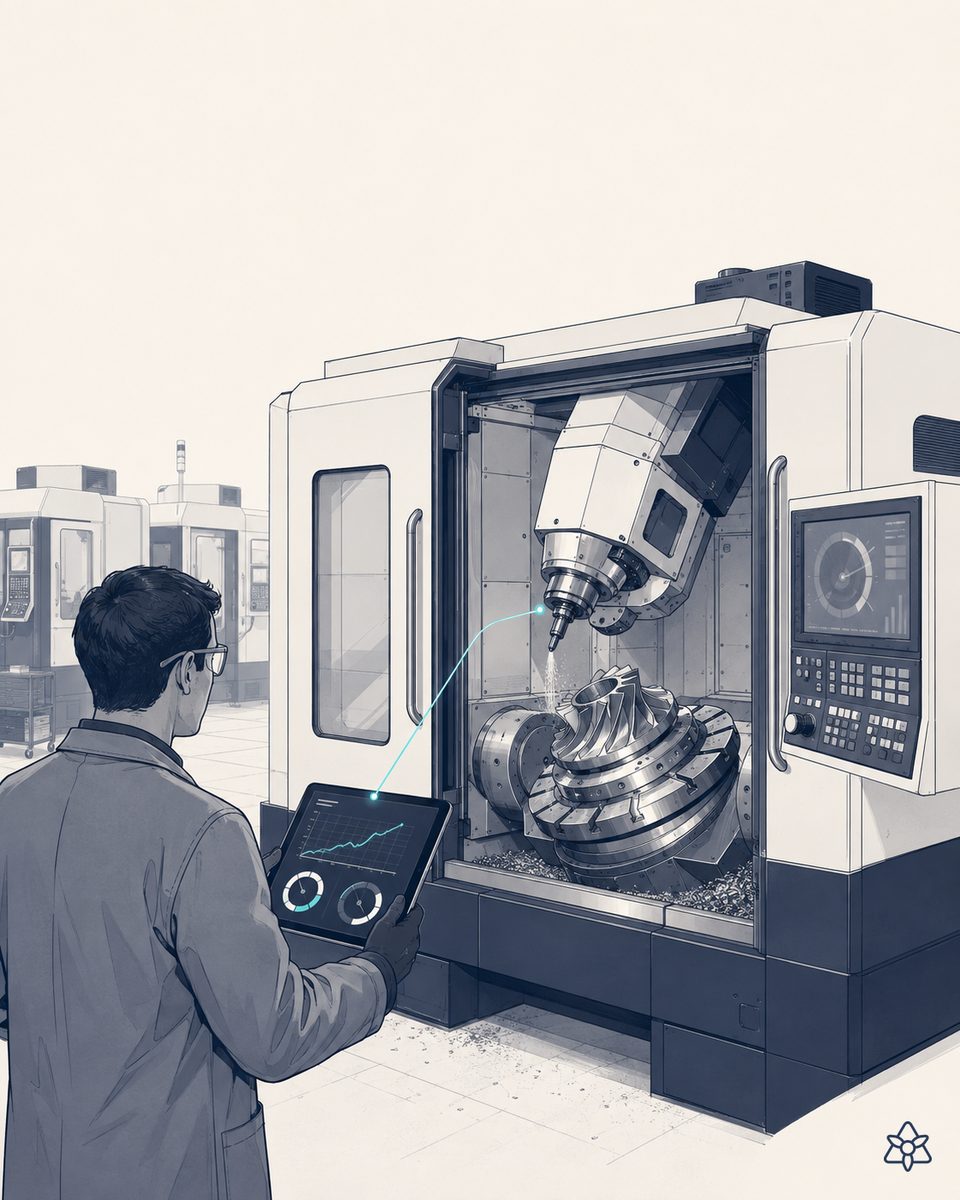
The green part falls out of tolerance by a few micrometres nobody looked at together.
In powder metallurgy compaction, the green height and final density of the part are the result of a fine balance between dosed powder weight, closing hydraulic pressure and tooling temperature. SPC looks at one sample every so many cycles. By the time that sample confirms a deviation, hundreds of parts have already been made with the same drift — some pass, some do not, and all of them go into the furnace. The problem is not SPC; it is what happens between one sample and the next:
- Powder moisture changes with the shift (hopper openings, warehouse conditions) and alters the real compressibility of the powder in the die.
- The supplier batch arrives with a compressibility slightly different from nominal and nobody retunes the closing pressure.
- The die heats up as the shift goes on, and that shifts green height by a few micrometres.
- The hydraulic oil filter starts to clog and the real pressure at the cylinder drops without the setpoint changing.
The classic system (fixed setpoint + sampling SPC + an experienced shift supervisor) works nearly always. When it does not, the bill is paid in post-sintering grinding, in scrapped critical parts (hydraulic pumps, synchros) or by an automotive customer that detects the dimensional deviation at goods-in. It is not a lack of process; it is information living in silos at the critical moment.
iLEAN Edge does not add another SPC — it seals the crack between pressure, powder weight, batch and die.
The piece that solves the pain is iLEAN Edge: a physical terminal on the shop floor, next to the press cabinet, that watches hydraulic pressure the way a veteran press supervisor would if the powder scale, the die thermocouple and the circuit filter were all on the same screen at the same time.
Edge sees the hydraulic pressure curve of every cycle. Connect reads the batch, the powder supplier ticket and the ambient humidity wherever they live. The agent cross-checks pressure + batch + die and proposes a setpoint adjustment or a service to the shift supervisor. The person signs — the part stays in tolerance.
The three iLEAN pieces applied to hydraulic pressure in PM compaction:
- Edge — a terminal next to the press cabinet, reading main cylinder pressure, cushion pressure, ram position and, where it exists, ejection force. The CNN learns the normal signature of the pressure curve per SKU and per tool — not the setpoint, but the shape of the cycle. It cross-checks against the powder weight dosed at fill and the tooling temperature. It works without a network: if connectivity to the MES drops, Edge keeps watching cycle by cycle, because what is critical cannot depend on the WiFi.
- Connect — captures the powder supplier batch (scale ticket, compressibility certificate, packing date), warehouse ambient humidity, the die plan and SKU changeovers. And it also captures what arrives from outside — a supplier email warning that the next batch comes with a different baseline, a lab observation about the powder grade — at second zero.
- Agent — cross-checks the pressure-density signature cycle by cycle against moisture, batch and die temperature. When the drift exceeds tolerance, it proposes to the shift supervisor: adjust the pressure setpoint by 2 bar, schedule hydraulic filter cleaning at the end of the shift, or hold the current batch for sampling. The supervisor signs. It does not recalibrate the press on its own — except where the management team configures autonomy.
PM compaction with classic SPC vs. compaction with iLEAN Edge on hydraulic pressure
| Aspect | Fixed setpoint + sampling SPC | With iLEAN Edge on pressure + batch + die |
|---|---|---|
| Control frequency | One sample every N cycles | Every cycle |
| Detection of inter-shift drift | By the time SPC confirms it, there is scrap | Before the next sample fails |
| Cross-check with moisture / batch / die | Each in its own system and its own person | Cross-checked by the agent on the shop floor |
| Hydraulic filter servicing | Fixed calendar | Proposed when the real drift justifies it |
| Operation without a network | Setpoint yes, context no | Edge keeps watching cycle by cycle on the cabinet light |
| Critical part dossier | Sampled curve, reconstructed | Per part — pressure curve, batch, human signature |
Impact estimate for your plant — to be validated with your numbers.
The block below is an estimate to be validated with the actual data of your plant. We put it forward so the committee has an order of magnitude; we refine it during the diagnostic.
- Powder metallurgy plant making automotive parts (synchros, hydraulic pumps, gears, structural parts) with a hydraulic compaction press and a sintering furnace, with documented dimensional scrap between shifts.
- Edge pilot on the press (pressure transducers + integration with the fill scale, MES and SPC). First expected value within a few weeks: detecting the drift cycle by cycle before SPC confirms it.
- Indicative payback between 4 and 9 months, depending on the frequency of documented incidents and the average cost of scrap + post-sintering grinding.
- Expected reduction of dimensional scrap of ≥ 30% in the first year on critical parts. A reminder of the automotive quality standard: in the order of 25 PPM [1] — inter-shift drift is hard to sustain at that level without Edge watching cycle by cycle.
And the fair doubt of the quality manager
«What if the AI changes the setpoint on its own and knocks my press out of calibration?» — the proposal does not execute itself. iLEAN works on an anchored task: it reads the pressure curve the transducer already provides and compares it with the learned signature. On anchored tasks, the best models brought error below 1.5% [2]. And even so, the shift supervisor sees the curve, sees the proposal, and signs. The setpoint does not change on its own — except where the management team configures autonomy.
[1] Automotive quality standard ~25 PPM — source Symestic.
[2] OpenAI paper «Why Language Models Hallucinate», 2025 — on the reliability of AI in anchored tasks.
What people ask about hydraulic pressure in powder metallurgy compaction
Why does the powder metallurgy part drift out of tolerance shift after shift?
Because the green density and the height of the compacted part depend on the closing hydraulic pressure — and that pressure drifts for reasons the panel never shows: powder moisture changes with the shift, the supplier batch arrives with slightly different compressibility, the die heats up over the shift, the oil filter starts to clog and the real pressure at the cylinder drops. Each cause on its own moves green height by a few microns. Added together, the part falls out of tolerance and ends up as scrap or as the extra cost of grinding after sintering.
Which signals does iLEAN Edge read on the compaction press?
Hydraulic pressure of the main compaction cylinder (analogue transducer), auxiliary upper and lower cushion pressure, ram position through the cycle and, where it exists, ejection force. Edge cross-checks that signal with the dosed powder weight (fill scale or LVDT) and the tooling temperature. The signature of the problem is very clear: same recipe, same powder weight, yet the pressure curve rises and green height shifts a few micrometres between the first and the last shift of the day. Edge sees it and counts it — it is not left to the veteran operator's memory.
Why Edge on the shop floor and not the quality MES?
Because the quality MES looks at one sample every N parts, late and through traditional SPC. iLEAN Edge looks at every cycle on the shop floor and learns the pressure-density signature per SKU and per tool. It catches the drift between shifts before the next SPC sample confirms it — and by the time it confirms it, the scrap has already piled up. And it works locally: if the OT network loses its connection to the MES cloud, Edge keeps watching the press, because what is critical cannot depend on the WiFi.
Does the AI recalibrate the press on its own when it sees drift?
No. iLEAN proposes — the person signs. Edge detects the drift in the pressure-density curve, the agent cross-checks it with powder moisture, batch, die temperature and hydraulic filter servicing, and proposes a concrete correction to the shift supervisor: adjust the pressure setpoint by 2 bar, schedule hydraulic filter cleaning at the end of the shift, hold the current batch for sampling. The supervisor validates and signs. In PM with parts critical for automotive or hydraulics, that is the default safety ring.
How much does the pilot cost and when does it pay back?
The order of magnitude of an Edge pilot on a PM press is close to that of any Edge pilot in a processing plant: terminal + pressure transducers + integration with MES and SPC, plus an annual licence. The reasonable payback to present to the committee is several months — the hard lever is scrap avoided + post-sintering grinding avoided, once parts stop falling out of tolerance between shifts. Send us your press data and we will send back the estimated ROI within 48h.
More cases in ilean edge
- Edge ultrasound on wine bottling inertisation — catch the leak before the batch oxidises.iLEAN Edge with ultrasound detects the nitrogen leak in wine bottling inertisation before oxygen reaches…
- If the extractor bearing goes, the booth loses negative pressure — and the oven goes down with it.iLEAN Edge watches the PVD paint booth extractor bearing with a thermal camera: the curing oven stays up…
- Beverage end-of-line palletizer — the shift ends with no stop because the motor current warned days earlier.iLEAN Edge reads the motor current of the beverage end-of-line palletizer and warns before the late…
- SMT reflow oven thermal profile — every PCB has its own window, not the one of the last board in.iLEAN Edge tracks the SMT reflow oven thermal profile board by board to keep every PCB inside the IPC…
- Operator presence in the risk zone of a stamping press — automatic cycle inhibit without losing rhythm.iLEAN Edge detects operator presence in the risk zone of a stamping press and blocks the cycle in…
- Edge ultrasound on the refinery steam network — traps and joints, kg/h, immediate saving.iLEAN Edge with ultrasound scans the refinery saturated steam network: it finds failed traps and leaking…
Tell us your case and within 48h we will send the estimated ROI of this AI project for your PM press.
We work on the real data of your plant, not on ours. Diagnostic with no commitment.
Request estimated ROI in 48h See iLEAN Edge