Operator presence in the risk zone of a stamping press — automatic cycle inhibit without losing rhythm.
On a stamping press, the lost-time injury almost never arrives during production with the curtain armed: it arrives during a die change, during a strip jam, in setup mode where the curtain is muted and somebody starts a cycle at the wrong moment. iLEAN Edge sees human presence inside the press enclosure with a 3D camera, inhibits cycle start in milliseconds and leaves the per-event dossier for EHS and for the insurer. The certified functional safety layer stays intact — the safety manager gets the traceability back.
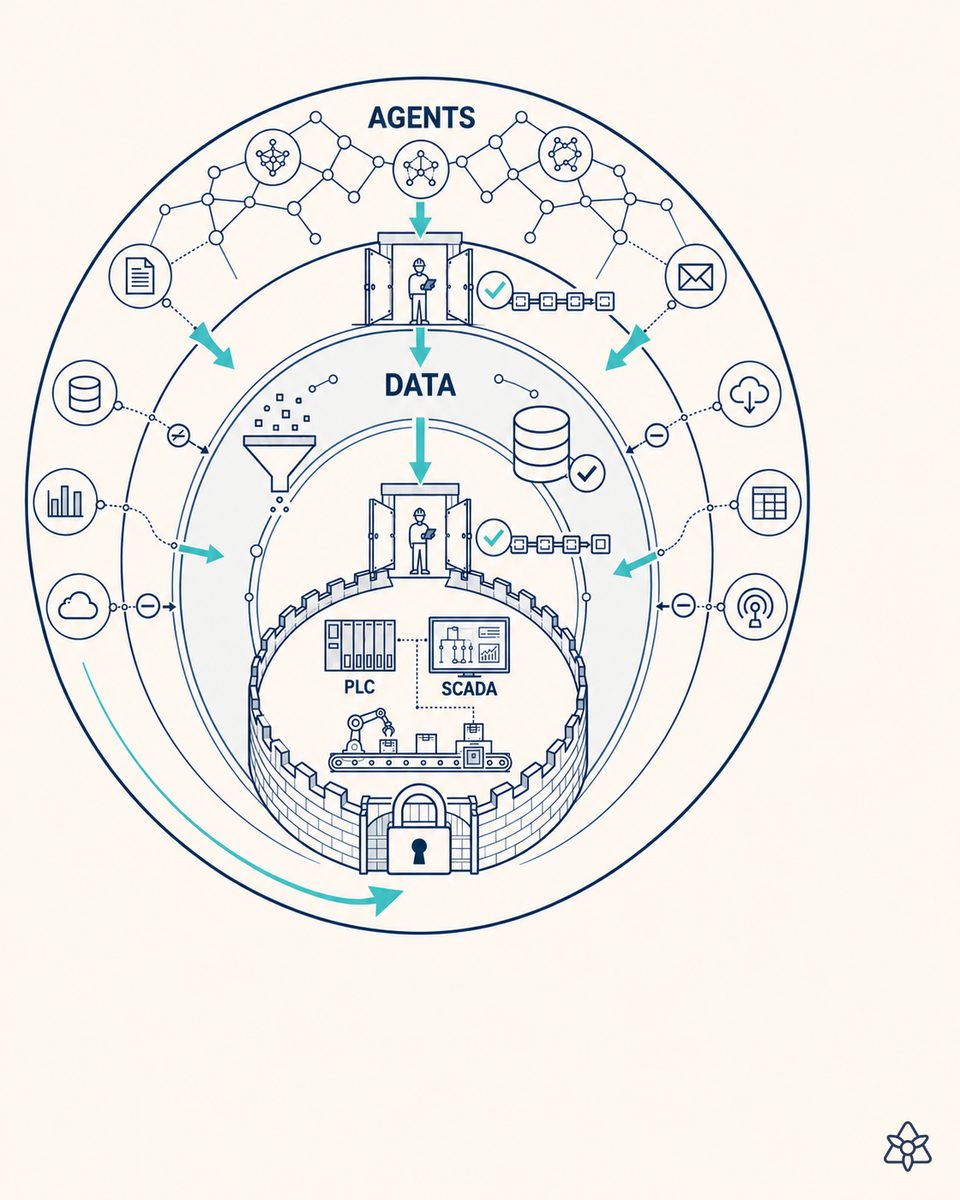
The press accident almost never arrives with the curtain armed.
Modern stamping has the functional safety layer properly built — light curtain, two-hand control, emergency stop, EN ISO 13849 certification. And even so, when somebody reviews the lost-time incident reports in a stamping shop, nearly all of them share the same script:
- Die change. The die setter steps into the enclosure with the curtain muted in setup mode — because there is no other way to do the job. When he finishes and steps out, somebody starts the cycle believing nobody is inside any more. The operator does not always get to tell the story, because he does not always get to tell it.
- Strip or coil jam. The feeder jams, the operator leans into the enclosure to clear it. The curtain reads "all clear" the instant the hand leaves the beam, but the hand comes back before the reset closes. Milliseconds for the cycle to catch what it never should.
- A colleague walking behind. The hazardous envelope of a press is not only the front enclosure. Large presses have a pit, a coil-feed side and a rear area where people pass through for non-production reasons.
Each of those scripts is a gap the approved light curtain cannot see. Each one is defensible before an inspection if it is documented — and a human and financial disaster if it happens undocumented. The EHS manager knows this; what he did not have until now was a way to see human presence inside the enclosure continuously without wearing the team down with a hundred extra procedures.
iLEAN does not replace the curtain — it adds the human presence layer that was missing inside the enclosure.
The problem of presence in the risk zone is not a lack of functional safety: it is a lack of continuous vision of the inside of the enclosure. The certified functional safety layer (light curtain, two-hand control, emergency stop, certified bus) is in place and is not touched. iLEAN Edge sits on top of it, as the filler that closes the gap the certification itself left exposed.
Edge sees human presence in 3D inside the enclosure, in setup mode too. The agent inhibits cycle start when there is presence and leaves the per-event dossier. The EHS manager gets the traceability back.
The three iLEAN pieces applied to the stamping press:
- Edge — terminal with a 3D camera over the enclosure (front + coil-feed side + rear if the press requires it). The CNN detects human presence through pose estimation, with no facial recognition. It fires an output to the press PLC as a cycle inhibit whenever there is presence in the risk zone. It works with no network.
- Connect — captures the press operating mode (production / setup / maintenance), the scheduled die change from the MES and the work order. And it absorbs what arrives from outside: a new part from the customer, a die modified by the external toolmaker.
- Agent — cross-checks presence, operating mode, cycle and die change plan. It consolidates the dossier per press, per shift and per event, useful for occupational safety compliance, for the insurer, for the safety committee and for training. The policy is defined by a person; the agent applies it with 24/7 consistency.
Press with an approved curtain vs. press with iLEAN intelligent presence
| Aspect | Curtain + two-hand + e-stop only | With iLEAN Edge + Connect + Agent |
|---|---|---|
| Vision of the enclosure | Perimeter (whatever crosses the curtain) | Continuous 3D interior, in setup mode too |
| Setup mode / die change | Curtain muted, procedure + eyesight | Edge sees presence and inhibits the cycle |
| Facial recognition | n/a | No — analysis by workstation, not by person |
| Per-event traceability | Verbal report + EHS logbook | Automatic dossier per press and shift |
| Conversation with insurer / auditor | What the operator remembers | Workstation data, counted and classified |
| Certified functional safety | Curtain + two-hand + e-stop | Intact — Edge sits on top of it |
Impact estimate for your plant — to be validated with your numbers.
The block below is an estimate to be validated with the actual data from your shop. We put it forward so the committee has an order of magnitude; we refine it during the diagnostic.
- Stamping shop with 2-6 mechanical or hydraulic presses, frequent die changes, setup mode active several times per shift, historical near-miss reports that can be documented.
- Edge pilot on the Pareto press (3D camera + integration with the press PLC + dossier). First value expected within a few weeks.
- Expected reduction in cycle initiations with presence in the zone of ≥ 30% against the baseline — and the rest, recorded instead of invisible.
- Indicative payback between 4 and 9 months, considering the lever of a single lost-time injury avoided and the cadence recovered in setup mode.
- Hard lever: a single serious accident avoided pays for the system in one go, before cadence even enters the conversation.
And the safety manager's reasonable doubt
"What if the AI mistakes a shadow for a person and stops the press when it shouldn't? And the other way round?" — hallucination is a problem of free generation, not of anchored tasks. In tasks where the AI merely classifies what it sees inside a known enclosure (human presence yes/no per zone), the best models brought the error below 1.5% [1]. And even so, nothing critical is decided alone: the certified light curtain and the two-hand control remain active and trigger the stop by themselves if Edge fails. And the other way round: Edge adds a second layer where the first one was muted out of necessity — that is a net safety gain, not a replacement of a certified layer. The three rings are there for exactly this.
[1] OpenAI paper "Why Language Models Hallucinate", 2025 — on the reliability of AI in anchored tasks.
What people ask about operator presence in the risk zone of a stamping press
Why does the risk zone of a stamping press still cause scares despite the light curtains?
Because the classic functional safety layer — light curtain (EN ISO 13849, EN 692/693), two-hand control, emergency stop — protects the perimeter but leaves practical gaps: the die change where the operator has to step inside, the strip or coil jam that forces a hand in, the moment a colleague walks behind just as someone else is initiating a cycle. The curtain trips when somebody crosses it; what is missing is seeing who is inside, where they are and what posture they are in within the press enclosure, continuously, so the cycle cannot start if there is human presence in the risk zone even when the curtain is muted in setup mode.
How does Edge inhibit the press cycle on presence and keep cadence when there is none?
With an Edge terminal and a 3D camera over the press enclosure. The neural network detects human presence in defined zones (die entry, strip side, pit) through pose estimation — with no facial recognition. If there is presence in the risk zone, Edge fires an output — dry contact, safety bus — that the press PLC reads as a cycle inhibit. Once the zone is clear, Edge releases the condition and the press can cycle again. The certified functional safety layer stays active underneath: if Edge fails, the curtain and the two-hand control do their job. If Edge works, cadence holds because unnecessary stoppages caused by muting in setup mode stop piling up.
Does this replace the light curtain or the two-hand control?
No. iLEAN Edge complements the certified functional safety layer, it does not replace it. The approved light curtain, the two-hand control and the emergency stop remain the ultimate guarantors of compliance with EN ISO 13849, EN 692/693 and the machinery directive. What Edge adds is an intelligent presence layer inside the enclosure — above all in setup / die change mode, where the curtain is muted and the press has historically been at its most dangerous. Edge sees human presence even with the curtain overridden, and inhibits the cycle in milliseconds.
What per-event traceability does it leave for EHS, the insurer and an occupational safety audit?
Every presence event in the risk zone is recorded — which zone, how long, what speed the press was running at, what the system decided, which mode it was in (production or setup). The agent consolidates the history into a dossier per press and per shift: how many times someone stepped in for a die change, how long they stayed inside, how many cycle initiations were inhibited by presence. The conversation with the insurer and with the EHS manager stops being about what the operator remembers; it runs on the data from the workstation. And training gets sharpened around the points where people step in most.
What payback is reasonable for an Edge presence pilot on a stamping press?
The order of magnitude is that of an Edge pilot on a critical workstation: terminal + 3D camera + integration with the press PLC + dossier, plus the annual licence. The hard lever is threefold: the lost-time injury avoided (whose average cost in stamping is far higher than the entire pilot), the cadence recovered in setup mode (where time is lost today to muting and to well-founded fear), and the traceability that closes discussions with the insurer. Indicative payback sits at several months. We send you the estimated ROI in 48h using the real data from your press, not ours.
More cases in ilean edge
- Beverage end-of-line palletizer — the shift ends with no stop because the motor current warned days earlier.iLEAN Edge reads the motor current of the beverage end-of-line palletizer and warns before the late…
- Powder metallurgy compaction — parts in tolerance shift after shift, not just in the SPC sample.iLEAN Edge tracks hydraulic pressure on the powder metallurgy compaction press and keeps parts in…
- SMT reflow oven thermal profile — every PCB has its own window, not the one of the last board in.iLEAN Edge tracks the SMT reflow oven thermal profile board by board to keep every PCB inside the IPC…
- Edge ultrasound on the refinery steam network — traps and joints, kg/h, immediate saving.iLEAN Edge with ultrasound scans the refinery saturated steam network: it finds failed traps and leaking…
- Vortex steam flow on a plate heat exchanger — pasteurization stays in band instead of being corrected afterwards.iLEAN Edge reads the vortex steam flow of the plate heat exchanger and keeps food pasteurization in band…
- Viscous chemical reactor — the agitator motor current tells the batch's story before any alarm does.iLEAN Edge reads agitator motor current in a viscous chemical reactor, anticipates blade seizure and…
Tell us about your case and in 48h we'll send you the estimated ROI of this AI project for your stamping shop.
We work on the real data from your press, not ours. Diagnostic with no commitment.
Request estimated ROI in 48h See iLEAN Edge