Edge ultrasound on the refinery steam network — traps and joints, kg/h, immediate saving.
The saturated steam network of a refinery is kilometres of line, hundreds of traps and thousands of joints. Traps failed open and leaking joints let expensive steam through 24 hours a day, and classic prioritisation follows the trap that hisses loudest, not the one that costs most. iLEAN Edge with ultrasound scans the network, quantifies the kg/h lost at each point and the agent proposes a route prioritised by €/h. The energy efficiency manager signs the plan.
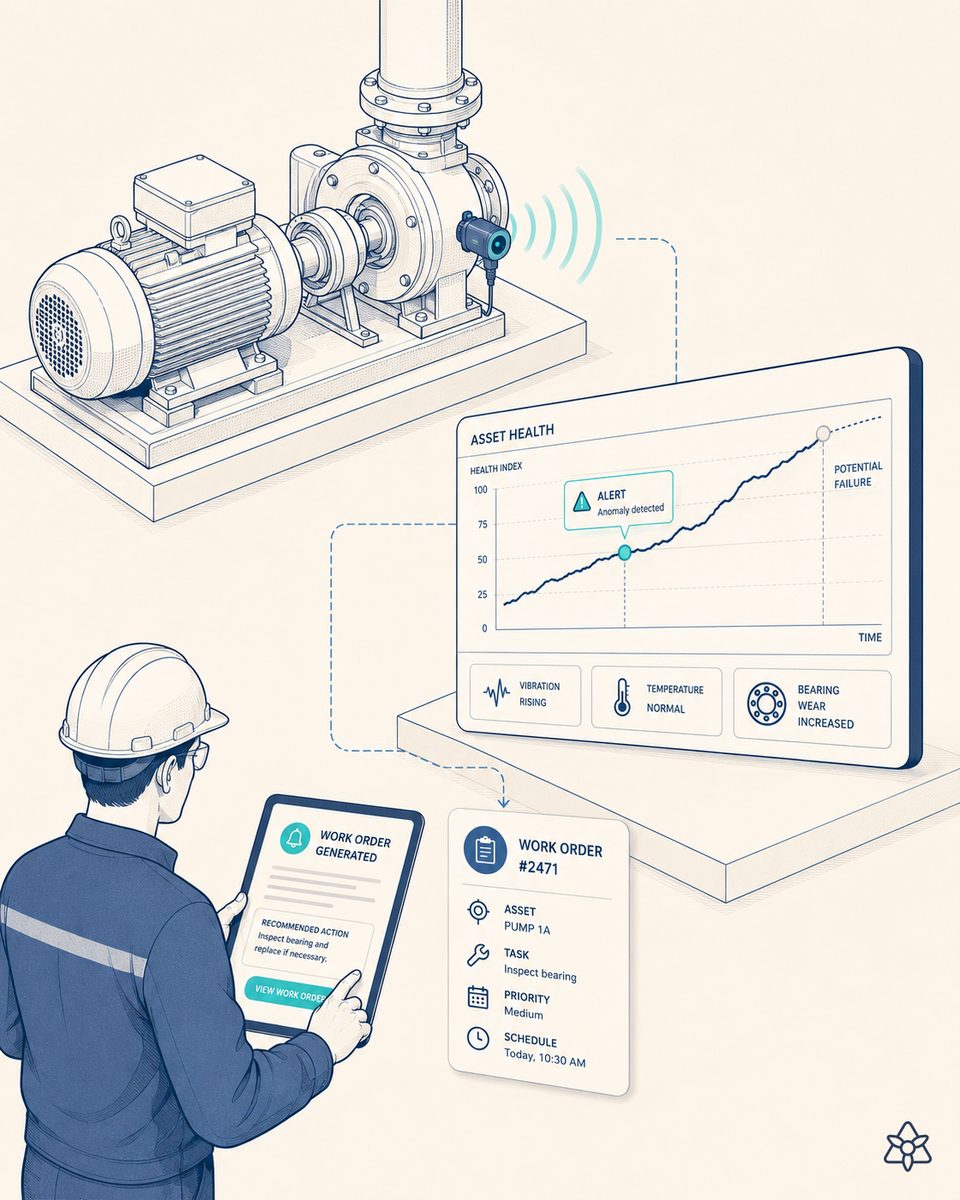
Hundreds of traps, thousands of joints, and prioritisation done by ear.
Saturated steam in a refinery is expensive energy: every kg/h lost is fuel burned in the boiler for nothing, plus the associated carbon footprint. A steam leak always follows the same script:
- The refinery has a steam network that is practically a map of the plant — pipe-racks between units, traps at every low point, joints at every flange.
- The trap survey comes round once a year (when it comes at all). It spots the ones failed open and notes them in a spreadsheet.
- The repair plan is prioritised by the trap that hisses loudest or the one that is easiest to reach, not by the one losing the most kg/h.
- Between one survey and the next, a joint can start leaking from thermal cycling and nobody finds out until the following year — months of steam venting to atmosphere.
The energy efficiency manager knows it. His people know it. What he does not have is continuous mapping that quantifies every point in kg/h and €/h and proposes a prioritised route the crew can execute between shutdowns. The veteran who could hear the traps like nobody else retires this year.
iLEAN Edge does not reinvent the trap survey — it makes it continuous and prioritises it by cost.
Ultrasonic trap surveying has existed for decades. What is missing is a layer that turns every inspected point into a quantified figure, cross-references it with the real steam generation cost of the refinery and proposes a repair route the manager can sign that same week. iLEAN is the filler that covers what the boiler SCADA, the maintenance CMMS and the inspector's spreadsheet left exposed.
Edge hears the leak and quantifies it. Connect captures the real cost of steam. The agent cross-references and proposes the route. The person signs — the steam network is never touched on its own.
The three iLEAN pieces applied to saturated steam leaks in a refinery:
- Edge — terminal with an ATEX (intrinsically safe) ultrasonic sensor, on the operator's own device or on a fixed station in safe areas. A CNN trained to tell a working trap from one failed open, estimate the steam flow lost in kg/h and translate it into €/h using the enthalpy of the steam and the generation cost. It works with no network: it records points with the light of the panel and syncs when connectivity returns.
- Connect — captures from inside the fuel consumption and steam production of the boiler house SCADA, the shutdown plans in the CMMS, the trap survey history, the hot work permits. And it captures from outside the email from the trap supplier (lead time of the spare model), the WhatsApp from the shift leader ("the trap on unit 7 is hissing louder").
- Agent — cross-references the Edge map with the real steam generation cost, how accessible each point is and the window of the next scheduled shutdown. It proposes a repair route prioritised by € lost per hour that fits the crew you already have. The efficiency manager signs the plan; every repaired trap is checked against the real saving in boiler fuel.
Annual trap survey vs. continuous iLEAN mapping
| Aspect | Classic annual survey | With iLEAN Edge ultrasound |
|---|---|---|
| Frequency | Annual, external | Continuous, with the operations team |
| Quantification | Yes/no, sometimes estimated | kg/h and €/h per point, with real enthalpy |
| Prioritisation | The loudest one or the easiest to reach | The one that costs most every hour |
| Detection between surveys | n/a — found at the next one | Continuous, a joint that starts leaking is detected |
| Crew route | Spreadsheet from the external report | Weekly plan prioritised by € lost |
| Saving verification | Estimated, no cross-check | Checked against boiler fuel from the SCADA |
Impact estimate for your plant — to be validated with your numbers.
The block below is an estimate to be validated with the specific data of your refinery. We set it out so the committee has an order of magnitude; we refine it during the diagnostic.
- Mid-sized refinery with a saturated steam network from 6 to 16 bar, several hundred traps, a boiler house with 3-5 units, a dedicated energy efficiency team.
- Edge pilot on one process unit + integration with the boiler SCADA and the CMMS. First value expected within a few weeks: the first kg/h map and the first repair plan prioritised by €/h.
- Indicative payback between 4 and 9 months — steam is one of the most expensive utilities in the refinery and the accumulated leak is usually enormous.
- Expected reduction in the fuel consumption associated with leaks ≥ 30% against baseline in the first half-year.
- Hard lever: less fuel burned per kg/h of steam produced, verifiable month by month against the boiler house SCADA. The annual external survey becomes a complement, no longer the only snapshot of the year.
And the reasonable doubt of the CAIO
"What if the AI gets the flow wrong and I end up repairing the wrong traps?" — hallucination is a problem of free generation, not of anchored tasks. In tasks where AI is limited to reading an ultrasonic sensor, classifying the trap by its acoustic signature and estimating flow with an anchored physical model, the best models brought the error below 1.5% [1]. And even so, nothing critical is decided alone: iLEAN proposes the route, the person signs, and the saving is checked against boiler fuel. If the estimate errs on the high side, the SCADA proves it wrong within a month.
[1] OpenAI paper "Why Language Models Hallucinate", 2025 — on the reliability of AI in anchored tasks.
What people ask about Edge ultrasound on a refinery steam network
Why does the saturated steam network of a refinery have so many undetected leaks?
The saturated steam network of a refinery has kilometres of line, hundreds of traps and thousands of joints at high temperature and pressure. Steam traps degrade in service (they fail open and let live steam through) and many joints lose tightness through thermal cycling. Routine inspection covers them all once a year, but the kg/h lost at each point gets diluted into a spreadsheet and priority goes to the trap that hisses loudest, not to the one that costs most.
What exactly does the ultrasonic sensor see on a steam trap?
Ultrasound (20-100 kHz) picks up the turbulent flow of steam escaping through a trap failed open or through a leaking joint. The CNN trained into iLEAN Edge tells a working trap (discrete condensate discharge) from a trap failed open (continuous steam discharge) and estimates the steam flow lost in kg/h. With the enthalpy of the steam and the generation cost of the refinery, it translates every point into euros per hour.
How does iLEAN decide what to repair first in a network with hundreds of points?
The agent cross-references the Edge leak map with the real cost of steam generation (captured by Connect from the boiler house SCADA), how accessible each point is for the crew (some require a hot work permit) and the window of the next scheduled shutdown. And it proposes a repair route prioritised by € lost per hour. The person — the energy efficiency manager — signs the plan and the crew executes it.
Is it safe to approach a saturated steam network with an Edge terminal?
The ultrasonic sensor is operated at a reasonable distance and requires no contact. iLEAN Edge runs on the operator's own device or on a fixed station in areas without specific ATEX risk. In ATEX areas an intrinsically safe variant of the sensor is used. The terminal complies with the ATEX and work permit procedures of the refinery — no line is altered, no point is worked on without the signature of the operations manager.
How much does an Edge ultrasound pilot cost in a refinery?
The order of magnitude of an Edge pilot in a refinery is comparable to any Edge pilot in a plant: an initial investment covering the terminal with ATEX ultrasonic sensor + integration with the boiler house SCADA and the CMMS + an annual licence. Payback is among the fastest in the industrial catalogue because steam is expensive energy and the accumulated leak is enormous. We send you the ROI with the kg/h and the € of your refinery in 48h.
More cases in ilean edge
- Powder metallurgy compaction — parts in tolerance shift after shift, not just in the SPC sample.iLEAN Edge tracks hydraulic pressure on the powder metallurgy compaction press and keeps parts in…
- SMT reflow oven thermal profile — every PCB has its own window, not the one of the last board in.iLEAN Edge tracks the SMT reflow oven thermal profile board by board to keep every PCB inside the IPC…
- Operator presence in the risk zone of a stamping press — automatic cycle inhibit without losing rhythm.iLEAN Edge detects operator presence in the risk zone of a stamping press and blocks the cycle in…
- Vortex steam flow on a plate heat exchanger — pasteurization stays in band instead of being corrected afterwards.iLEAN Edge reads the vortex steam flow of the plate heat exchanger and keeps food pasteurization in band…
- Viscous chemical reactor — the agitator motor current tells the batch's story before any alarm does.iLEAN Edge reads agitator motor current in a viscous chemical reactor, anticipates blade seizure and…
- AGV proximity at regulated warehouse intersections — zero near-miss and ISO 3691-4 traceability.iLEAN Edge anticipates AGV crossings at regulated warehouse intersections: zero near-miss and ISO 3691-4…
Tell us your case and within 48h we will send you the estimated ROI of this AI project for your steam network.
We work with the real kg/h of your refinery, not ours. Diagnostic with no commitment.
Request estimated ROI in 48h See iLEAN Edge