Vortex steam flow on a plate heat exchanger — pasteurization stays in band instead of being corrected afterwards.
A food plate heat exchanger depends on saturated steam flow to hold the pasteurization temperature inside its band. Below it, microbiological risk; above it, scorched flavour and caramelization on the plate. iLEAN Edge reads the vortex flowmeter and anticipates drift before the product leaves the band. The person signs off — the setting never moves on its own.
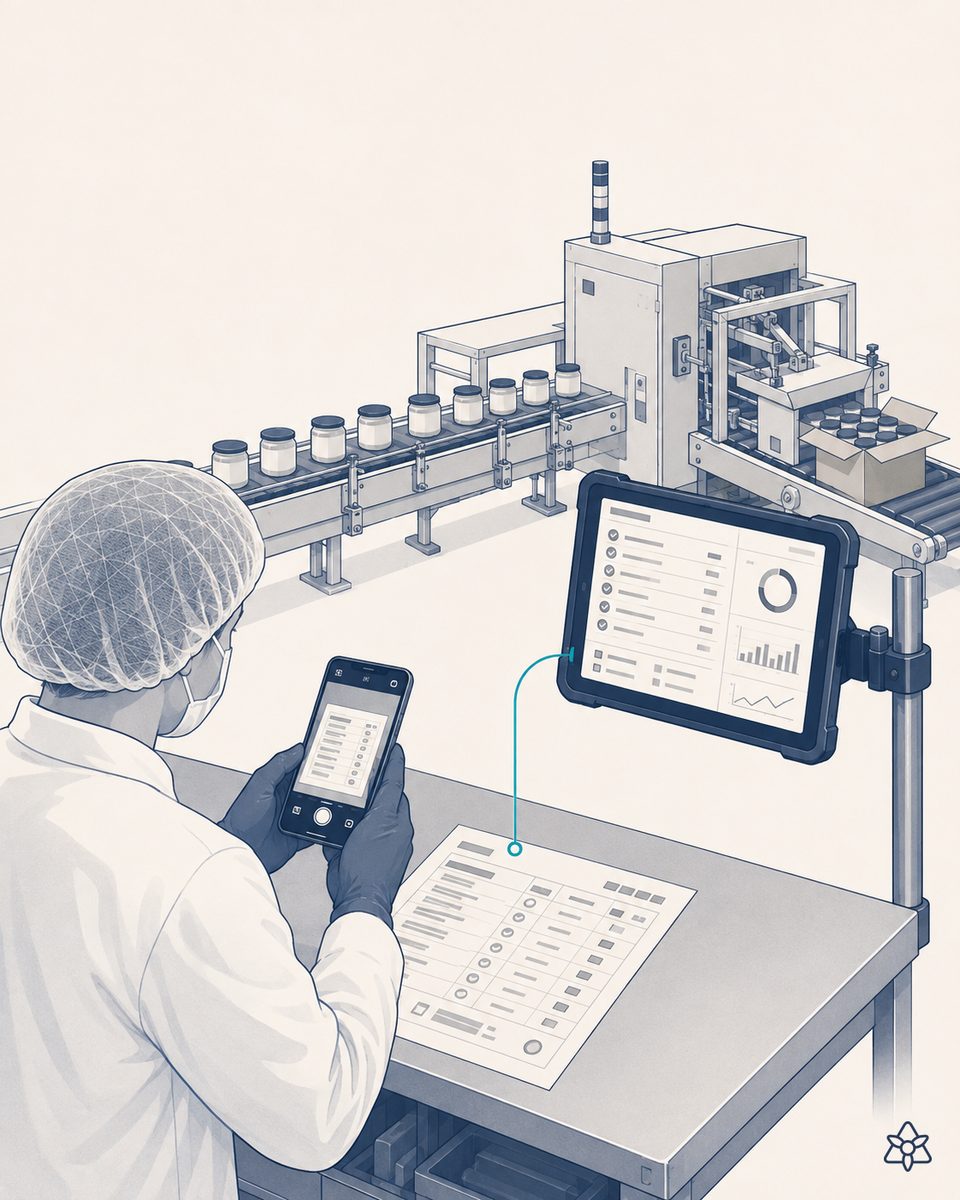
Pasteurization is won or lost at the cause, not at the effect.
Correct pasteurization in a plate heat exchanger demands five cross-checked readings that are almost never in the same place:
- Saturated steam flow — read by the vortex flowmeter on the hot-side line. It is the cause: the energy entering the product.
- Plant steam pressure — from the main header, fluctuating with every other consumer (autoclave, CIP on another line).
- Product temperature at inlet and outlet — the cold-side thermocouples. They are the effect: by the time the holding-tube sensor raises an alarm, the batch is already out of band.
- Product flow — the pace demanded by the filler downstream. It changes with every start and stop.
- Accumulated plate fouling — the drift of the exchanger between CIPs, which almost nobody measures and everybody suffers.
The operator reads the outlet thermostat and reacts once it is already out. The classical system works 99% of the time — and that 1% is the under-processed batch that goes unnoticed until the lab, or the scorched batch that reaches filling with a cooked flavour. Pasteurization is decided before the outlet, not after it.
iLEAN does not replace the pasteurizer SCADA — it seals the cracks between the five readings you already have.
The pasteurization problem is not a shortage of sensors: it is information living in islands that, at the critical moment (plate fouling rising, a product changeover, a steam peak from another line), is not cross-checked in time. iLEAN acts as the filler that closes those gaps, without asking you to change the exchanger, the thermocouples or the vortex meter.
Edge reads the vortex meter and the thermocouples. Connect captures the batch recipe. The agent cross-checks against the historical curve of the exchanger and anticipates drift — before the thermostat shouts. The person signs off — never the other way around.
The three iLEAN pieces applied to vortex steam flow in food pasteurization:
- Edge — a neural-network terminal on the vortex flowmeter signal (steam flow) and on the cold-side thermocouples of the exchanger. It cross-checks steam + pressure + temperature + product flow in milliseconds and anticipates drift before the batch leaves the band. It works without a network. As long as the cabinet has power, the reading and the holding record continue.
- Connect — captures the batch recipe (family, expected viscosity, pasteurization band required by regulation or by the retailer) whether it comes from the ERP, from the MES or from the R&D spreadsheet. And it captures what arrives from outside (a raw-material supplier change sent by messaging app, a new importer specification by email) at second zero.
- Agent — cross-checks the five readings against the historical curve of the exchanger (accumulated plate fouling, how much steam it demands to hold temperature) and the batch recipe. If the kinetics indicate that temperature will fall out of band before the next cycle, it proposes a corrective action (raise steam, lower product flow, schedule a CIP) and the operator decides. The line never restarts by itself.
Reactive pasteurization vs. cross-checked pasteurization with iLEAN
| Aspect | Reactive control + thermostat | With iLEAN Edge + Connect + Agent |
|---|---|---|
| Control variable | Product temperature at the outlet (effect) | Steam flow + pressure + thermocouples (cause + effect) |
| Fouling detection | CIP by calendar or by rising pressure | Steam/temperature trend cross-checked with the historical curve |
| Product changeover | A single curve for every family | A curve learned per family/recipe |
| Steam header peak | Temperature drop detected late | The agent anticipates it from header pressure |
| Operation without a network | n/a | Edge keeps running on cabinet power |
| File for the IFS/BRC auditor | Rebuilt by hand, weeks | Pasteurization dossier per batch, automatic |
Impact estimate for your plant — to be validated against your numbers.
The block below is an estimate to be validated with the specific data of your plant. We set it out so the committee has an order of magnitude; we refine it during the diagnostic.
- Food plant with one plate pasteurizer, multi-product (milk/juice/soup or similar), CIP by calendar, occasional cooked flavour in delicate families.
- Edge pilot on the pasteurizer (neural-network terminal on the vortex meter + thermocouples + integration with the ERP/MES recipe). First value expected within a few weeks.
- Indicative payback between 4 and 9 months, depending on the frequency of scrap from under- or over-processing, the cost of plant steam and the demands of the IFS/BRC auditor.
- Hard levers: ≥30% reduction in scrap from under-processing/scorching, steam savings from finer operation and an automatic pasteurization dossier for audits.
And the quality manager's fair objection
«What if the AI gets it wrong and lets an under-processed batch through?» — hallucination is a problem of free generation, not of anchored tasks. In tasks where the AI only cross-checks a signal against a curve (vortex against thermocouples and recipe), the best models brought the error below 1.5% [1]. And even so, nothing critical is decided alone: iLEAN proposes the corrective action and the person signs off. The three safety rings exist precisely for this.
[1] OpenAI paper "Why Language Models Hallucinate", 2025 — on the reliability of AI in anchored tasks.
What people ask about vortex steam flow in food pasteurization
Why a vortex flowmeter on the saturated steam of a plate heat exchanger?
The vortex meter measures the volumetric flow of gases and vapours with a bluff body (von Kármán effect), with no moving parts that stick with condensate, and it withstands the pressure and temperature of plant saturated steam. In food pasteurization with a plate heat exchanger it is used to know the mass flow of steam entering the hot side, cross-checked with pressure: that cross-check gives you the real heat transferred to the product, not the heat the thermostat set-point claims.
Why does steam flow matter if there is already a thermostat?
The thermostat reads product temperature at the heat exchanger outlet: it detects that you are out of band once you already are. Vortex flow reads the energy entering on the steam side in real time — it is the cause, not the effect. By cross-checking vortex + pressure + product temperature, iLEAN anticipates drift (plate fouling that demands more steam to hold temperature, header fluctuation, poorly trapped condensate) before the thermostat raises an alarm. That is the difference between correcting and preventing.
How does iLEAN anticipate falling out of the pasteurization band?
Edge reads the vortex flowmeter, plant steam pressure, product temperature at the inlet and outlet of the heat exchanger, and product flow. The agent cross-checks those five curves against the historical curve of the exchanger (how much steam it demands to hold temperature as a function of accumulated plate fouling). If the trend indicates that temperature will fall out of band before the next cycle, it proposes a corrective action: raise steam, lower product flow or, if fouling is high, schedule a CIP. The operator decides and signs off.
Does it work for different product families on the same heat exchanger?
Yes. The transfer curve of a plate heat exchanger changes with the viscosity and thermal conductivity of the product — whole milk is not the same as concentrated juice, nor as soup. iLEAN Connect captures the batch recipe (family, expected viscosity, blend ratio) from the ERP, from the MES or from the R&D spreadsheet, and the agent learns the curve specific to each family. That avoids over-processing the easy product and under-processing the difficult one, a frequent outcome when the same curve is used for everything.
What payback is reasonable in a food pasteurization line?
The order of magnitude of an Edge pilot on a food plate heat exchanger covers the neural-network terminal + integration with the vortex meter and the thermocouples + access to the batch recipe. A reasonable payback ranges from several months to a year, and there are three hard levers: a ≥30% reduction in scrap from under-processed or scorched batches (cooked flavour, caramelization on the plate), steam savings from finer operation (not «high just in case») and a pasteurization dossier valid for an IFS/BRC auditor, generated automatically. We ask for your plant data and send you the estimated ROI within 48h.
More cases in ilean edge
- SMT reflow oven thermal profile — every PCB has its own window, not the one of the last board in.iLEAN Edge tracks the SMT reflow oven thermal profile board by board to keep every PCB inside the IPC…
- Operator presence in the risk zone of a stamping press — automatic cycle inhibit without losing rhythm.iLEAN Edge detects operator presence in the risk zone of a stamping press and blocks the cycle in…
- Edge ultrasound on the refinery steam network — traps and joints, kg/h, immediate saving.iLEAN Edge with ultrasound scans the refinery saturated steam network: it finds failed traps and leaking…
- Viscous chemical reactor — the agitator motor current tells the batch's story before any alarm does.iLEAN Edge reads agitator motor current in a viscous chemical reactor, anticipates blade seizure and…
- AGV proximity at regulated warehouse intersections — zero near-miss and ISO 3691-4 traceability.iLEAN Edge anticipates AGV crossings at regulated warehouse intersections: zero near-miss and ISO 3691-4…
- Final rinse conductivity in cataphoresis on anodized aluminum — one haze and the part is cosmetic scrap.iLEAN Edge tracks final rinse conductivity in cataphoresis on anodized aluminum and keeps cosmetic…
Tell us about your case and within 48h we'll send you the estimated ROI of this AI project for your pasteurization line.
We work on the real data of your plant, not on ours. Diagnostic with no strings attached.
Request estimated ROI within 48h See iLEAN Edge