Final rinse conductivity in cataphoresis on anodized aluminum — one haze and the part is cosmetic scrap.
Paint drag-out in the final rinse of the cataphoresis process on anodized aluminum is what decides whether the profile ships to the customer or goes in the bin. iLEAN Edge tracks rinse conductivity in line, cross-checks it against immersion times and flow rate, and warns before cosmetic rejects pile up. The person signs off.
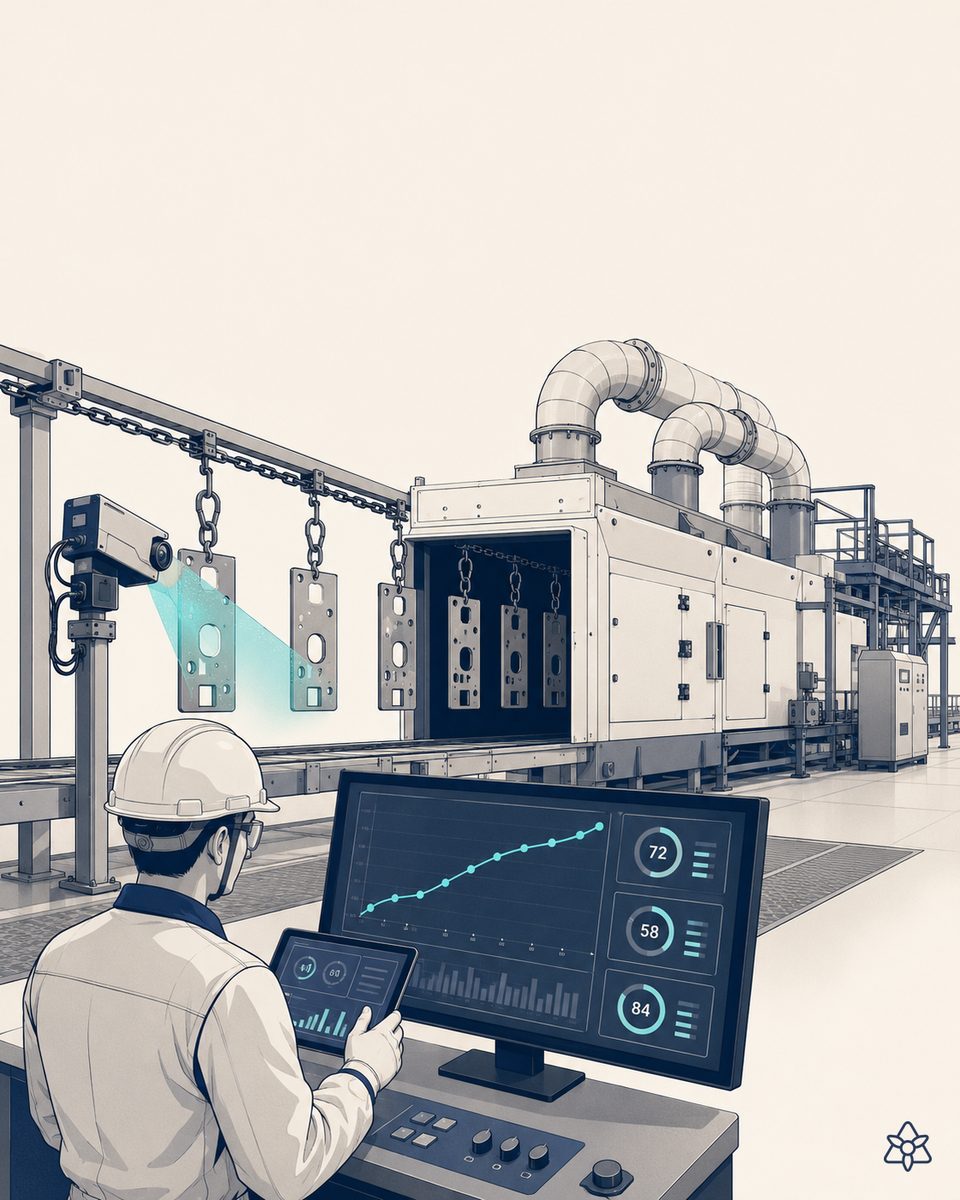
The rinse that decides the cosmetics of the profile.
On a cataphoresis line running anodized aluminum, the final rinse is not a formality: it is the cut-off between what goes into the oven clean and what carries dissolved paint with it. Rinse conductivity is the direct indicator of that drag-out. It rises when too much product comes in and the demineralised water make-up does not compensate. And the symptom does not show up at the rinse: it shows up after the oven, as haze, staining or uneven gloss on profiles that already cost time and energy.
- What comes into the rinse — the previous rack, the paint drag-out from the cataphoresis bath, the thermal mass of the profile. Data that lives between the tunnel PLC and the shift leader's head.
- What happens in the rinse — conductivity, DI flow rate, temperature. Usually on the chemical supplier's panel, sometimes never leaving it.
- What comes out of the rinse — the curing oven and cosmetic quality control, which pick up the cost of everything above. And architectural glazing does not forgive hazes.
The paint shop manager knows this — but manual sampling once a shift does not cover long profiles with frequent SKU changes. What is critical is the slow drift of the rinse, the one you notice when five racks have already been cured with haze.
iLEAN does not add another panel — it seals the cracks between chemical control, the line and the customer.
The cataphoresis rinse problem is not a lack of instrumentation: it is that the rinse data, the paint bath data and the cosmetics measured by quality control live on islands, and the technician finds out too late. iLEAN acts as the filler that closes those gaps, without asking you to change the tunnel or the chemical supplier.
Edge sees rinse conductivity every second. Connect reads the flow rate and the times wherever they sit. The agent cross-checks against the production order and, if the drift points to cosmetic haze, holds the rack before the oven. The person signs off — never the other way round.
The three iLEAN pieces applied to the final rinse of cataphoresis on anodized aluminum:
- Edge — terminal with vision + probe integration in the final rinse tank. It reads conductivity in seconds, cross-checks it against the PLC reading and, if the drift crosses the threshold, triggers a traffic light or a rack hold before the oven. It works with no network.
- Connect — captures the DI flow rate and the immersion times from the tunnel control, even if they live on an old panel belonging to the chemical supplier. And it captures from outside: a customer email with a change of shade or a tighter finish requirement, a message from the anodizing lead about a change in the prior sealing step.
- Agent — cross-checks conductivity, flow rate, the thermal mass of the rack and the cosmetic history of the SKU. If the drift points to haze, it proposes increasing the DI make-up, purging the tank or diverting the rack before the oven. The technician validates and signs off; the oven does not resume on its own.
Manual rinse sampling vs. in-line tracking with iLEAN
| Aspect | Manual sampling + final quality control | With iLEAN Edge + Connect + Agent |
|---|---|---|
| Rinse reading | Per shift or by exception | Continuous, second by second, in line |
| Reaction to drift | When the haze appears after curing | Traffic light and rack hold before the oven |
| DI make-up | Fixed recipe per SKU | Adjustment suggested to the technician from real drift |
| Tank purge | Planned by time or by appearance | Planned by real accumulated load |
| Traceability per rack | Whatever the MES plus the shift report holds | Per-rack file with conductivity curve and make-up |
| Operation with no network | n/a | Edge keeps reading and holding on the cabinet's power |
Impact estimate for your plant — to be validated with your numbers.
The block below is an estimate to be validated with the specific data of your line. We lay it out so the committee has an order of magnitude; we refine it during the diagnostic.
- Cataphoresis line on anodized aluminum profiles for architectural glazing, multi-SKU with frequent colour changes.
- Edge pilot on the final rinse tank (conductivity probe + integration with the tunnel PLC + rack hold actuator). First value expected within a few weeks.
- Reduction of cosmetic rejects from haze / staining of 30% or more on the recurring rinse incident (the other failure modes remain a matter for the process).
- Indicative payback between 4 and 9 months, depending on the frequency of cosmetic rejects and the average cost of rework (stripping + repainting) or scrap.
- The hard lever: a single rack avoided pays for a good part of the pilot.
And the CAIO's reasonable doubt
"What if the AI decides to hold a rack that was fine?" — hallucination is a problem of free generation, not of anchored tasks. In tasks where the AI merely compares a physical reading against a threshold trained on the line's own history, the best models pushed the error below 1.5% [1]. And even so, nothing critical is decided alone: iLEAN holds and the person signs off. The three safety rings exist for exactly this.
[1] OpenAI paper "Why Language Models Hallucinate", 2025 — on the reliability of AI in anchored tasks.
What people ask about the final rinse of cataphoresis on anodized aluminum
Why does final rinse conductivity govern cosmetic rejects?
Because that rinse is the last thing to touch the profile before the curing oven. Any dissolved paint residue or dragged-in salts stays on the surface as a film, a stain or a haze that becomes visible once cured. If rinse conductivity rises, the rinse stops rinsing — and cosmetic rejects show up on parts that already cost you cataphoresis time.
Why does anodized aluminum complicate cataphoresis compared with galvanized steel?
Because the anodic layer on aluminum changes the electrochemical response versus steel: surface conductivity is not the same, drag-out behaves differently and the margin for error in the final rinse gets narrower. Small drifts that go unnoticed on steel leave hazes or uneven gloss on anodized profiles — and the architectural glazing customer rejects on cosmetics.
How does iLEAN Edge read the rinse without stopping the line?
Edge integrates the existing conductivity probe (or fits a new one in the tank) and captures every reading in seconds. Connect reads the flow rate and the immersion time from the tunnel control, even if they live on an old panel. The agent cross-checks the three data points against the production order and, if the drift points to cosmetic haze, holds the rack before the curing oven.
What does Edge do when rinse conductivity drifts?
It triggers a traffic light and proposes three actions to the process technician: increase the DI make-up flow to the rinse, purge the tank or divert the rack before the oven. The person chooses and signs off. It works with no network: if the line loses WiFi, Edge keeps reading and holding, because anything critical cannot depend on connectivity.
How long does an Edge pilot take in cataphoresis on anodized aluminum?
First value within a few weeks, with Edge on the final rinse, integration with the tunnel control and a hold actuator. A reasonable payback to present to the committee runs to several months, with the hard lever being cosmetic rejects avoided per rack. We ask for your line data and send you the estimated ROI within 48h, with your numbers.
More cases in ilean edge
- Vortex steam flow on a plate heat exchanger — pasteurization stays in band instead of being corrected afterwards.iLEAN Edge reads the vortex steam flow of the plate heat exchanger and keeps food pasteurization in band…
- Viscous chemical reactor — the agitator motor current tells the batch's story before any alarm does.iLEAN Edge reads agitator motor current in a viscous chemical reactor, anticipates blade seizure and…
- AGV proximity at regulated warehouse intersections — zero near-miss and ISO 3691-4 traceability.iLEAN Edge anticipates AGV crossings at regulated warehouse intersections: zero near-miss and ISO 3691-4…
- Tunnel kiln temperature in glazed ceramic firing — stable shade and flatness between loads.iLEAN Edge measures the real zone-by-zone curve of the glaze tunnel kiln and keeps shade and flatness…
- AI thermography on the aerospace CNC spindle — the bearing is changed on schedule, not on breakdown.iLEAN Edge watches the CNC spindle bearing with continuous thermography: the bearing is changed on…
- Cobot proximity to the operator in small appliance assembly — human cadence without stopping the cobot.iLEAN Edge grades cobot speed by operator proximity in small appliance assembly cells: human cadence…
Tell us your case and within 48h we'll send you the estimated ROI of this AI project for your cataphoresis line.
We work on your plant's real data, not on ours. Diagnostic with no commitment.
Request estimated ROI within 48h See iLEAN Edge