AI thermography on the aerospace CNC spindle — the bearing is changed on schedule, not on breakdown.
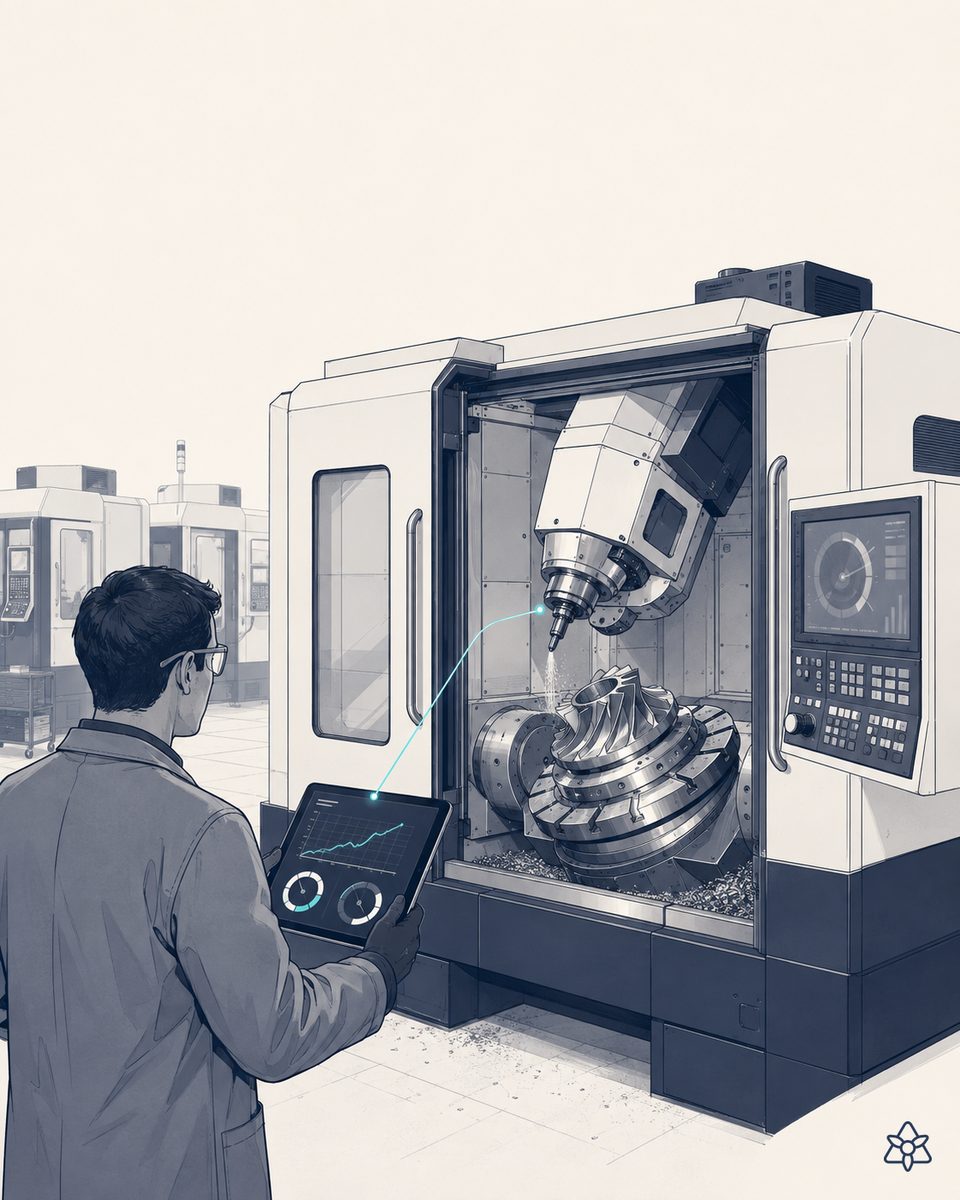
A spindle failure in an aerospace aluminum machining cell is not a stoppage — it is a structural wing rib out of tolerance and a delay to your tier 1 customer. iLEAN Edge watches the spindle bearing with continuous thermography, learns its normal heating pattern per recipe and raises the alert before the spindle shows its first thermal jump. The maintenance manager signs the change window.
By the time the spindle warns you, the structural part is already lost.
The spindle of an aerospace aluminum CNC is the most expensive item in the cell and the one you can least afford to change at the wrong moment. The failure always follows the same script:
- The spindle bearing goes into fatigue — micro-seizures, coolant contamination, a peak axial load during a finishing pass.
- It starts running hotter than normal, long before it moves a single micron of vibration.
- The PLC control fires the pre-alarm when the thermal pattern is already off, too late to get the structural part in progress out safely.
- The spindle is changed on breakdown, not on schedule. The cell stops for days. The aerospace part in the queue —a wing rib, a structural bed— is rescheduled or reworked, depending on what was left inside.
The maintenance manager knows what is happening. His people know what is happening. What he does not have is a learned thermal pattern of a healthy spindle running its normal recipe to compare against what the operator is seeing on the screen. That pattern is built —if it is built at all— in a spreadsheet only known to the person who retires next year.
iLEAN Edge does not add another sensor — it learns the thermal pattern of the healthy spindle and watches the drift.
The spindle problem is not a shortage of data: the CNC's PLC already has spindle temperature, vibration and headstock power draw. What is missing is a layer that learns the normal heating pattern per recipe and per tool, compares it in real time against what the thermal camera is seeing, and cross-checks the drift with the MES production plan and the real spindle hours. That layer is iLEAN — the filler that covers what ERP, MES, SCADA and CMMS left exposed.
Edge sees the bearing's thermal pattern. Connect captures the real spindle hours and the batch recipe. The agent cross-checks against the aerospace plan and proposes the change window. The person signs — the spindle does not change itself.
The three iLEAN pieces applied to aerospace CNC spindle thermography:
- Edge — a physical terminal in the cell with a fixed thermal camera aimed at the spindle housing. A CNN trained on the normal heating pattern per machining recipe (roughing vs. finishing, tool used, speed). It detects the drift against the pattern, not a fixed threshold. It raises the alert in the CMMS and a status light in the cell. It works without the network: if the plant loses WiFi, Edge keeps watching and recording the pattern.
- Connect — captures the real spindle hours from SCADA, the recipe from MES, the change history from the CMMS, and the maintenance manager's spreadsheet where he tracks the bearings replaced over the last few years. And it captures from outside the delivery note of the spare bearing, the supplier's lead-time notice, the aerospace customer's message about urgent parts.
- Agent — cross-checks the thermal drift from Edge with the aerospace production plan, the real hours and the bearing stock. It proposes a change window that does not cut any structural part in half. If the drift accelerates, it raises the priority of the alert. The maintenance manager signs the work order and the change goes into the schedule.
Spindle by ear vs. spindle with a learned thermal pattern
| Aspect | Classic maintenance | With iLEAN Edge thermography |
|---|---|---|
| Normal spindle pattern | In the maintenance manager's head | Learned per recipe and tool, checked in real time |
| Drift detection | When the PLC fires the pre-alarm | Much earlier — at the subtle change in thermal pattern |
| Bearing change | On breakdown, cell stopped | On schedule, without cutting an aerospace part in progress |
| Structural part in the queue | Rework or scrap whatever was left inside | Cleared before the change, no rework |
| Operation without network | n/a | Edge keeps watching on cabinet power |
| The veteran's knowledge | Retires with him | Captured as a learned pattern in Central |
Impact estimate for your plant — to be validated with your numbers.
The block below is an estimate to be validated with the specific data of your plant. We put it forward so the committee has an order of magnitude; we refine it during the diagnostic.
- Tier 2 aerospace plant with 6 to 12 aluminum CNC cells, structural parts with demanding tolerances, roughing + finishing recipes on the same machine.
- Edge pilot on one critical cell (thermal camera + integration with MES and CMMS). First expected value within a few weeks: learned thermal pattern and first drift detected.
- Indicative payback between 4 and 9 months, depending on the historical frequency of spindle failures and the average cost of an unscheduled change.
- Expected reduction of unscheduled spindle failures ≥ 30% over the baseline, and practically zero structural parts left half-machined by a sudden failure.
- Hard lever: a single spindle failure avoided + zero aerospace parts scrapped mid-cycle. One avoided failure pays for the pilot.
And the IT director's reasonable doubt
«What if the AI gets it wrong and stops my spindle when it was fine?» — hallucination is a problem of free generation, not of anchored tasks. In tasks where the AI does nothing but compare a thermal pattern against a learned pattern, the best models brought the error below 1.5% [1]. And even so, critical decisions are not made alone: iLEAN proposes the change window and the person signs. The three safety rings are there precisely for this.
[1] OpenAI paper «Why Language Models Hallucinate», 2025 — on the reliability of AI in anchored tasks.
What people ask about Edge thermography on aerospace CNC spindles
Why does the spindle bearing fail on an aerospace aluminum CNC?
In aerospace aluminum machining the spindle runs at high revolutions, with abundant coolant flood and variable axial loads (roughing and finishing on the same part). The spindle bearing suffers contact fatigue, coolant contamination and small micro-seizures that raise local temperature before any vibration appears. By the time the failure shows up on the spindle, the part —sometimes a wing rib or a structural bed— is already out of tolerance and rework means days.
What exactly does the iLEAN Edge thermal camera see on the spindle?
iLEAN Edge integrates a fixed thermal camera aimed at the spindle housing in the area next to the front bearing. The trained CNN compares the thermal pattern against the spindle's normal heating curve for that machining recipe, that tool and that speed. It does not watch a fixed threshold —it watches the pattern— and it detects the drift long before the spindle reaches the PLC pre-alarm.
How does iLEAN decide when to schedule the bearing change?
The agent cross-checks the thermal drift from Edge against the MES production plan, the real spindle hours, the change history and the aerospace batches still in the queue. It proposes a change window that does not cut any structural part in half. The person —the maintenance manager— signs the work order and the change goes into the schedule. Nobody learns from the failure at three in the morning.
Does Edge thermography still work if the plant loses the network?
Yes. The non-negotiable design of iLEAN Edge is that the basic cycle —see, compare against the learned pattern, trigger the actuator or the alert— keeps running on cabinet power alone. In an aerospace machining plant, what is critical cannot depend on WiFi being up. When the network returns, Edge syncs with Central and the agent recalculates the change window.
How much does it cost to put Edge thermography on an aerospace CNC cell?
The order of magnitude of an Edge pilot on an aerospace machining cell is comparable to any Edge pilot on the shop floor: an initial investment covering terminal + thermal camera + integration with MES/CMMS, plus an annual licence. A reasonable payback is measured in a few months, because the hard lever is the spindle failure avoided (unscheduled change, withdrawal of the structural part in progress, delay to a tier 1 aerospace customer). We run the ROI with your plant's numbers in 48h.
More cases in ilean edge
- AGV proximity at regulated warehouse intersections — zero near-miss and ISO 3691-4 traceability.iLEAN Edge anticipates AGV crossings at regulated warehouse intersections: zero near-miss and ISO 3691-4…
- Final rinse conductivity in cataphoresis on anodized aluminum — one haze and the part is cosmetic scrap.iLEAN Edge tracks final rinse conductivity in cataphoresis on anodized aluminum and keeps cosmetic…
- Tunnel kiln temperature in glazed ceramic firing — stable shade and flatness between loads.iLEAN Edge measures the real zone-by-zone curve of the glaze tunnel kiln and keeps shade and flatness…
- Cobot proximity to the operator in small appliance assembly — human cadence without stopping the cobot.iLEAN Edge grades cobot speed by operator proximity in small appliance assembly cells: human cadence…
- Edge ultrasound for compressed air leaks in automotive — the ones that bleed most, first.iLEAN Edge with ultrasound maps compressed air leaks across multi-plant automotive workshops and ranks…
- A seized conveyor bearing at 250 °C is not a spare part — it is eight hours of oven downtime.iLEAN Edge runs thermography on the conveyor bearings of the biscuit tunnel oven: it warns days before…
Tell us about your case and in 48h we'll send you the estimated ROI of this AI project for your aerospace CNC cells.
We work on your plant's real data, not on ours. Free diagnostic, no commitment.
Request estimated ROI in 48h See iLEAN Edge