Cobot proximity to the operator in small appliance assembly — human cadence without stopping the cobot.
In a collaborative assembly cell, a cobot that only knows how to stop when the operator steps in is safe and expensive: it loses cadence every time a hand comes close. iLEAN Edge measures the operator-to-cobot distance in real time and grades the speed — far: cadence; mid-range: reduced; close: stop — without touching the certified laser scanner. The health and safety manager stays in command of the risk; the production team gets the rhythm back.
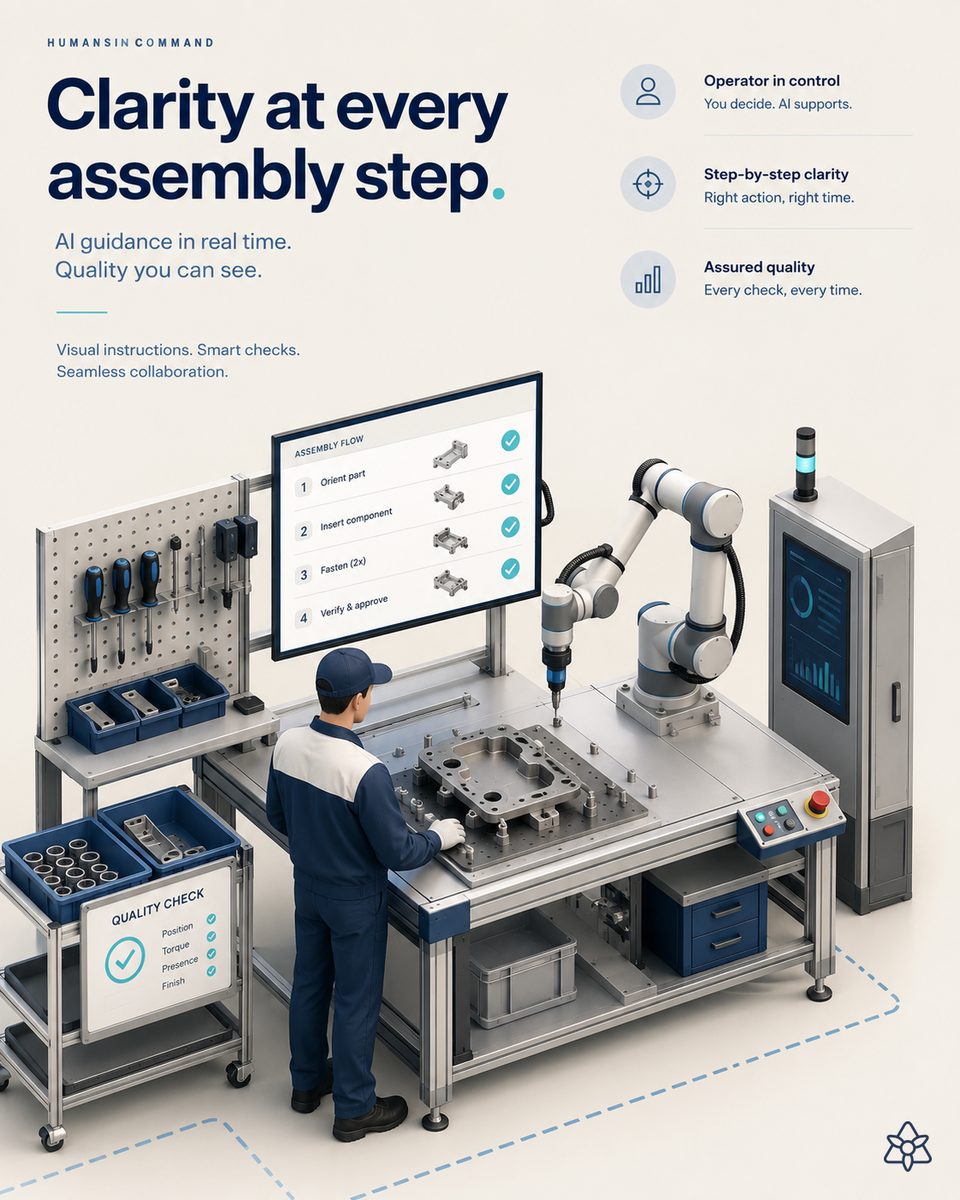
Safe does not mean stopped. And stopped costs money.
The collaborative assembly cell for small appliances — coffee machine, iron, blender, vacuum cleaner — lives with the same trap as almost every cobot installation on the market:
- Safety is well solved and badly exploited. The certified laser scanner triggers the cobot stop when the operator enters the zone; that complies with EN ISO 10218 and ISO/TS 15066. But between “safe zone at normal cadence” and “danger zone with a stop”, there is a whole middle band where the cobot should slow down, not halt. Almost nobody modulates that band properly.
- Operator and cobot dance all shift long. Every time the operator’s hand comes closer to place the next part or clear a bit of debris, the cobot stops — because the scanner only knows stop or don’t stop. Human cadence is discontinuous; so is the cobot’s, but for the wrong reason.
- The missing knowledge is continuous distance, not yes/no. The operator-to-cobot distance is there, physically, all the time. What is missing is a system that measures it continuously, cross-references it with the cycle and turns it into a graded speed command.
The production manager knows this and can do little with classic resources: the scanner is what it is. The health and safety manager does not want to lower their guard. And the cell ends up an expensive machine performing below its potential because the whole system is designed in black and white.
iLEAN does not replace the scanner — it adds the layer missing between safe and stopped.
The cobot cadence problem is not a lack of safety: it is a lack of an intermediate layer. The functional safety layer (laser scanner, emergency stop, certified bus) is the one already there, and it is not touched. iLEAN Edge sits on top of it, like the filler between cobot and operator, and contributes a continuous distance the classic system cannot see.
Edge sees the operator in 3D and measures the distance to the cobot continuously. The agent cross-references it with the cobot cycle and triggers the reduced-speed output — before the scanner has to stop anything. The health and safety manager stays in command.
The three iLEAN pieces applied to the collaborative cell:
- Edge — a terminal with a 3D camera and a pose-estimation neural network above the cell. It computes the minimum body-to-cobot distance in milliseconds and translates it into three regimes — normal, reduced, stop — via dry contact or OPC UA to the controller. No facial recognition. The data is per workstation, not per person. Works with no network.
- Connect — captures the SKU in production and the cobot cycle recipe from the PLC or the MES, and absorbs order changes (a new SKU from the importer, a BOM modification) without anyone having to re-send anything.
- Agent — cross-references distance, time, cycle and SKU, proposes adjustments to the shift supervisor (rotating the operator if the workstation goes into reduced regime too often) and generates the per-workstation, per-shift dossier for the risk assessment review. The person validates; the cobot does not reconfigure itself.
Binary cobot vs. cobot with iLEAN graded proximity
| Aspect | Cobot + laser scanner + binary stop | With iLEAN Edge + Connect + Agent |
|---|---|---|
| Operator-to-cobot distance | Yes/no (safe zone or critical zone) | Continuous, in milliseconds, skeleton vs envelope |
| Cobot response | Normal cadence or stop | Three regimes: normal · reduced · stop |
| Stops per shift | One for every operator entry | Only the ones that genuinely require it |
| Facial recognition | n/a | No — analysis per workstation, not per person |
| Dossier for the risk assessment | Manual reconstruction | Proximity history per workstation and shift |
| Certified functional safety | Scanner + certified bus | Untouched — Edge sits on top of it |
Impact estimate for your plant — to be validated with your numbers.
The block below is an estimate to be validated with the specific data from your cell. We put it forward so the committee has an order of magnitude; we refine it during the diagnostic.
- Collaborative small appliance assembly cell — coffee machine, iron, blender or similar — with a UR, Doosan, ABB or Fanuc CR type cobot, already in production with a certified laser scanner.
- Edge pilot on one Pareto workstation (3D camera + integration with the cobot controller + dossier). First value expected within a few weeks.
- Expected reduction of unnecessary cobot stops of ≥ 30% against the baseline, with functional safety untouched.
- Indicative payback between 4 and 9 months, depending on the cadence currently lost and the SKU mix.
- Hard lever: cadence recovered hour by hour + a proximity dossier useful for the risk assessment review and for the insurer.
And the health and safety manager’s reasonable doubt
“What if the AI grades the speed wrong and leaves the operator exposed?” — hallucination is a problem of free generation, not of anchored tasks. In tasks where the AI does nothing but measure a continuous distance and translate it into three levels, the best models brought the error below 1.5% [1]. And even so, nothing critical is decided alone: the certified functional safety layer (laser scanner, safety bus, emergency stop) stays in place and triggers the stop by itself if Edge fails. The three rings exist for precisely this.
[1] OpenAI paper “Why Language Models Hallucinate”, 2025 — on the reliability of AI in anchored tasks.
What people ask about cobot proximity in collaborative assembly
Why does a cobot in a collaborative assembly cell end up stopped so often?
Because most collaborative cells still run on a single binary safety threshold: if the operator enters the zone, the cobot stops. It is safe, yes — but it is also why the line loses cadence. When the operator’s hand is close, the cobot should slow down, not stop. When it is a metre away, it should run at normal speed. ISO/TS 15066 foresees exactly this as Speed and Separation Monitoring; most installations still do not implement it seriously because they lack reliable 3D vision and an agent that cross-references distance with the cycle. iLEAN Edge does both.
How does Edge grade cobot speed according to the distance to the operator?
With an Edge terminal and a 3D camera/sensor above the cell. The neural network extracts the operator’s skeleton through pose estimation (key points: shoulder, elbow, wrist) — no facial recognition — and measures the minimum distance between any point of the body and any point of the cobot envelope. From that distance, Edge triggers an output — dry contact, OPC UA or a signal over the certified safety bus — that the cobot controller reads as a speed limit: far, normal cadence; mid-range, reduced speed; close, controlled stop. The cobot invents nothing — it still takes its orders from the cell PLC.
Does this remove the need for a certified safety laser scanner?
No. In this case iLEAN Edge complements the functional safety layer, it does not replace it. The emergency stop and the last-resort safety perimeter required by the risk assessment (EN ISO 10218, ISO/TS 15066) stay in the laser scanner and in the certified safety bus. What Edge adds is an anticipatory productivity layer: grading speed long before the operator enters the scanner’s critical zone. The cell works at human cadence without the scanner having to trigger a stop every five minutes.
What about traceability and the dossier for the cobot risk assessment?
Edge records every proximity event, its minimum distance, the speed the cobot was running at and the system response. The iLEAN agent consolidates that history into a dossier per workstation and per shift, useful for the periodic review of the risk assessment and for the health and safety manager’s audit. If an insurer or the customer asks how many times the workstation was in reduced-speed regime over the last month, the answer comes out in seconds — with the cobot’s actual speed at each event, not the theoretical setpoint.
How much does an Edge pilot cost in a collaborative small appliance cell?
The order of magnitude is that of any Edge pilot on a bounded workstation: terminal + 3D camera + integration with the cobot controller + annual licence. The hard lever is not only avoiding the incident — it is recovering the cadence the cell was losing every time the cobot stopped. Indicative payback runs to several months on the Pareto of the SKU that moves the most money through the cell. We send you the estimated ROI in 48h with your cell’s real data, not ours.
More cases in ilean edge
- Final rinse conductivity in cataphoresis on anodized aluminum — one haze and the part is cosmetic scrap.iLEAN Edge tracks final rinse conductivity in cataphoresis on anodized aluminum and keeps cosmetic…
- Tunnel kiln temperature in glazed ceramic firing — stable shade and flatness between loads.iLEAN Edge measures the real zone-by-zone curve of the glaze tunnel kiln and keeps shade and flatness…
- AI thermography on the aerospace CNC spindle — the bearing is changed on schedule, not on breakdown.iLEAN Edge watches the CNC spindle bearing with continuous thermography: the bearing is changed on…
- Edge ultrasound for compressed air leaks in automotive — the ones that bleed most, first.iLEAN Edge with ultrasound maps compressed air leaks across multi-plant automotive workshops and ranks…
- A seized conveyor bearing at 250 °C is not a spare part — it is eight hours of oven downtime.iLEAN Edge runs thermography on the conveyor bearings of the biscuit tunnel oven: it warns days before…
- Coriolis flow in aseptic UHT filling — dosing is measured in grams per unit, not at end of shift.iLEAN Edge cross-checks Coriolis mass flow with the batch recipe to guarantee dosing in aseptic UHT…
Tell us about your case and within 48h we will send you the estimated ROI of this AI project for your collaborative cell.
We work on your cell's real data, not ours. Diagnostic with no commitment.
Request estimated ROI in 48h See iLEAN Edge