Coriolis flow in aseptic UHT filling — dosing is measured in grams per unit, not at end of shift.
Aseptic UHT dairy filling demands exact dosing, unit by unit: one under-filled carton is a customer claim; many are a regulatory one. iLEAN Edge reads the Coriolis flow meter at second zero, cross-checks it against the batch recipe and holds the pack when dosing drifts. The person signs — the filler does not restart on its own.
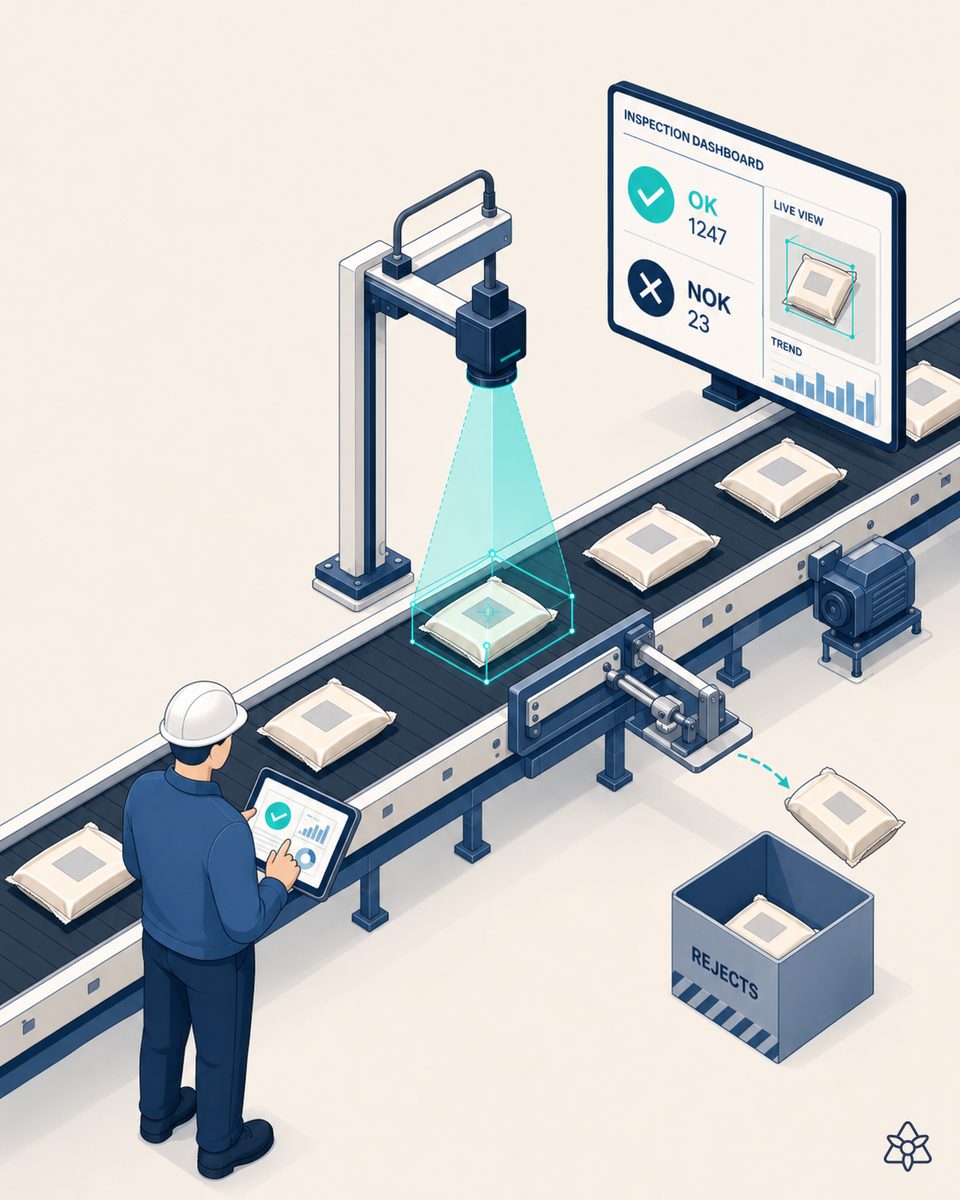
UHT dosing is decided between three realities that are almost never in the same place.
A correct carton of UHT milk is the intersection of three pieces of data that, in most plants, each live on their own island:
- Real mass flow — read by the Coriolis meter installed on the filler pipework. It sits in the transmitter signal, almost never cross-checked against anything else.
- The batch recipe — grammage per SKU, expected density, tolerance. It lives in the ERP, in a MES, or in a spreadsheet that R&D updates in the morning and nobody forwards to packaging.
- Process state — SIP/CIP phase, first pack after a recipe change, product temperature leaving the plate heat exchanger. Often only in the shift leader's head.
The packaging operator has three screens, two checklists, and the SKU changeover is the most vulnerable moment. Quality control weighs a sample every so many units and reconstructs what happened. The classic system works 99% of the time. That 1% is the claim that lands — and, if it shows a pattern, it is a penalty.
iLEAN does not replace your Coriolis meter or your filler — it seals the cracks between the systems you already have.
The UHT dosing problem is not a lack of information: it is information living on islands that, at the critical moment (the SKU changeover, carryover after SIP, density drift from temperature), does not reach the decision maker in time. iLEAN acts as the filler compound that closes those gaps, without asking you to change the filling machine, the ERP or the flow meter.
Edge reads the Coriolis meter at second zero. Connect captures the recipe wherever it lives — ERP, MES, a forgotten spreadsheet. The agent cross-checks it against the set point and, if something does not add up, holds the pack. The person signs — never the other way around.
The three iLEAN pieces applied to Coriolis flow in aseptic UHT filling:
- Edge — a terminal running a neural network over the Coriolis signal (mass flow, density, temperature) and vision over the filler itself. It cross-checks data and view in milliseconds and fires the pack hold (stack light, rejector) when dosing goes out of tolerance. It works without a network. If the plant loses WiFi, Edge keeps reading and keeps holding.
- Connect — captures the batch recipe whether it comes from a modern ERP, a vertical MES or the spreadsheet that R&D updates every morning in a shared folder. It also captures what arrives from outside (a lab email with the newly validated grammage, a supplier message about a packaging change) at second zero, with nobody having to forward anything.
- Agent — cross-checks the Coriolis signal, the batch recipe, the SIP/CIP phase and the SKU changeover history. If there is a deviation, it does not send an email at 10pm: it holds the pack and alerts the packaging supervisor on whatever channel they use. The person validates and signs; the filler does not restart on its own.
UHT dosing by sampling vs. dosing cross-checked with iLEAN
| Aspect | Sampling + manual control | With iLEAN Edge + Connect + Agent |
|---|---|---|
| Flow source | Coriolis reads, filler executes — never cross-checked | Coriolis cross-checked with recipe and process phase |
| Control frequency | Weighed every N units | Every filling cycle, in milliseconds |
| SKU change / carryover after SIP | Assumption: "if we purged, it is fine" | First pack at steady state identified by the agent |
| Temperature drift | Detected in later analytics | Coriolis density compensated in line |
| Operation without network | n/a | Edge keeps running as long as the cabinet has power |
| Dossier for the IFS/BRC auditor | Rebuilt by hand, weeks | Per-batch dossier, automatic, with Coriolis history |
Impact estimate for your plant — to be validated with your numbers.
The block below is an estimate to be validated with the specific data of your plant. We put it forward so the committee has an order of magnitude; we refine it during the diagnostic.
- UHT dairy plant with 2 aseptic fillers, multi-SKU carton + bottle, recipe varying by density and grammage (whole, semi-skimmed, fortified, plant-based).
- Edge pilot on one filler (terminal running a neural network over the Coriolis signal + vision over the pack + integration with the ERP/MES recipe). First value expected within a few weeks.
- Indicative payback between 4 and 9 months, depending on how often weight non-conformities are recorded and the average cost of a claim or rework in your chain.
- The hard lever: a reduction of ≥30% in dosing scrap, elimination of out-of-tolerance weight claims (EU regulation on nominal quantities) and operator hours freed from manual checking.
And the packaging supervisor's fair objection
"What if the AI gets it wrong and lets an under-filled pack through?" — hallucination is a problem of free generation, not of anchored tasks. In tasks where the AI is limited to cross-checking a signal against a piece of system data (reading the Coriolis meter and comparing it to the recipe set point), the best models brought error below 1.5% [1]. And even so, what is critical is never decided alone: iLEAN holds the pack and the person signs. The three safety rings exist precisely for this.
[1] OpenAI paper "Why Language Models Hallucinate", 2025 — on the reliability of AI in anchored tasks.
What people ask about Coriolis flow in aseptic UHT filling
Why a Coriolis flow meter on an aseptic UHT filler?
Coriolis measures real mass flow (not inferred volumetric flow) and, in the same signal, density and temperature. In UHT dairy that is gold: dosing is specified in grams per carton or per bottle, and density changes with temperature after the tubular or plate heat exchanger. Other flow meters read volume and let the recipe assume the density — Coriolis closes that door. That is why it is the default sensor on serious aseptic fillers.
How does iLEAN Edge cross-check flow against the batch recipe?
iLEAN Edge sits between the Coriolis meter and the aseptic filler as a terminal running a neural network over the flow meter signal and over the image of the filler itself. Connect captures the batch recipe from the ERP, the MES or the engineering spreadsheet, and the agent cross-checks it against real mass flow on every filling cycle. If dosing drifts from the set point, it holds the pack before sealing and alerts the packaging supervisor. The person validates and signs — the filler does not restart on its own.
What happens if the network goes down during aseptic filling?
An aseptic UHT filler cannot wait for the WiFi to come back: if the network drops, it keeps filling. iLEAN Edge is built for that — as long as the cabinet has power, the basic loop of reading the Coriolis meter, comparing it against the set point and firing the actuator (pack hold, stack light) keeps working. When the network returns, it uploads the captured history to the central system. What is critical does not depend on connectivity.
Does it also detect carryover from the previous batch after SIP?
Yes. A recipe change after a SIP (Sterilization In Place) leaves a transient in which product density and temperature are not yet at steady state. iLEAN Edge cross-checks the Coriolis signal with the SIP curve, the recipe-change history and the ERP/MES integration to identify the first pack at steady state and hold everything before it. That is real traceability, not assumed traceability. The operator gets the decision on screen in milliseconds.
What payback is reasonable on a UHT dairy line?
The order of magnitude of an Edge pilot on an aseptic UHT filler covers the vision terminal plus integration with the Coriolis signal plus access to the batch recipe and to the pack hold system. The payback you can reasonably present to the committee ranges from several months to a year, and the hard lever is the combination of avoided scrap, avoided customer claims and operator hours freed from manual checking. Send us your plant data and we send back the estimated ROI in 48h, with your numbers, not ours.
More cases in ilean edge
- Cobot proximity to the operator in small appliance assembly — human cadence without stopping the cobot.iLEAN Edge grades cobot speed by operator proximity in small appliance assembly cells: human cadence…
- Edge ultrasound for compressed air leaks in automotive — the ones that bleed most, first.iLEAN Edge with ultrasound maps compressed air leaks across multi-plant automotive workshops and ranks…
- A seized conveyor bearing at 250 °C is not a spare part — it is eight hours of oven downtime.iLEAN Edge runs thermography on the conveyor bearings of the biscuit tunnel oven: it warns days before…
- If the cryogenic pump fails, the cold chain breaks — and the shipping window goes down with it.iLEAN Edge reads cryogenic LNG pump vibration to predict bearing failure without breaking the cold…
- The CIP dosing pump is cavitating and nobody hears it — until the next batch comes out with detergent residue.iLEAN Edge reads the CIP dosing pump vibration in a cheese plant and anticipates cavitation before it…
- PE/PP extruder motor current with AI — anticipate the jam without stopping the line.iLEAN Edge analyses the PE/PP extruder motor current and anticipates screw jamming without stopping the…
Tell us about your case and within 48h we send you the estimated ROI of this AI project for your UHT line.
We work on your plant's real data, not on ours. Diagnostic with no commitment.
Request estimated ROI in 48h See iLEAN Edge