The CIP dosing pump is cavitating and nobody hears it — until the next batch comes out with detergent residue.
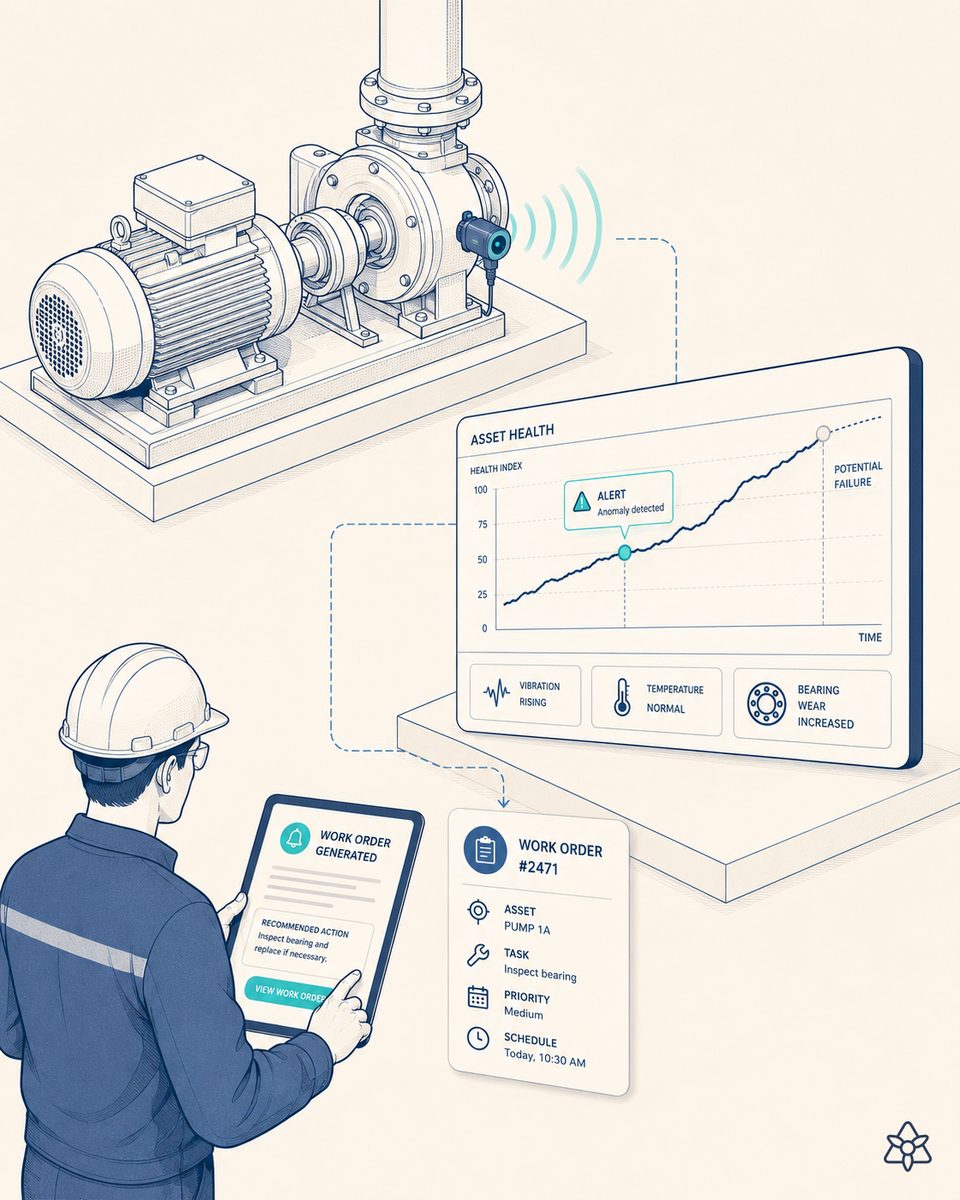
A cheese plant's CIP bets the whole batch on one cheap part: the dosing pump. If it cavitates, the caustic or acid concentration drifts, the rinse comes out poor, and the first cheese of the day carries residue. iLEAN Edge reads the pump's vibration in real time, recognises the signature of incipient cavitation before it reaches product, and alerts the shift supervisor. The person signs off — the line does not restart on its own.
A €4,000 pump can ruin a €40,000 batch.
The CIP (Clean-In-Place) system of a cheese plant is the silent guardian of the batch. It cleans tanks, heat exchangers and pipework without dismantling anything — and the whole cycle rests on one small, cheap part: the dosing pump that injects caustic, nitric acid or peracetic into the water line. When that pump cavitates, three things happen at once, and none of them shows up on the panel:
- The vibration signature changes — a broadband peak appears, rising above the vane-pass harmonic. Audible to a trained ear at 30 cm; inaudible at 2 m over plant noise.
- The real concentration drifts — the pump draws intermittent air, actual flow drops, and the conductivity of the cleaning solution never reaches range.
- The rinse comes out poor — the cycle finishes apparently fine (pressures OK, times OK), but detergent residue stays in the line. The first pack of the following day carries it out.
The quality manager finds out two days later through a complaint, or through an odd pH in a routine sample, or never finds out at all and the end customer perceives a soapy taste. The classic system — an operator who hears it, maintenance replacing the seal every X hours — works 99% of the time. That 1% is the one that reaches RASFF or the retailer's contact centre.
iLEAN Edge does not replace your maintenance team — it gives them the ear they cannot have.
The problem with incipient cavitation is not a lack of data: it is information living on an island (the pump housing) that, at the critical moment (the 5 minutes before the rinse turns poor), never reaches the person who decides. iLEAN acts as the filler that closes that gap, without asking you to change the pump, the CIP panel or the ERP.
Edge hears what the operator cannot hear. Connect takes the alert to the channel people already use. The agent crosses the signature with the CIP recipe and the maintenance calendar. The person signs off — never the other way round.
The three iLEAN pieces applied to the CIP dosing pump:
- Edge — a terminal with a MEMS or piezoelectric sensor bolted to the pump housing. It runs a CNN trained to recognise the spectral signature of incipient cavitation, seal blowout and air in the line. It fires a dry contact to the CIP PLC in milliseconds. It works without network: if the plant loses WiFi during the night cleaning cycle, Edge keeps reading and keeps alerting.
- Connect — captures the context the vibration signature alone cannot resolve: the detergent batch received from the supplier (what arrives by email or messaging app at hour zero), the CIP recipe from the MES, the date of the last mechanical seal change noted in a forgotten spreadsheet owned by the maintenance manager. And it takes the alert to the shift supervisor's earpiece or tablet through whichever channel they use.
- Agent — crosses the vibration signature, the CIP recipe, the maintenance calendar and the next scheduled packaging batch. If cavitation shows up 30 minutes before the end of the cycle, it does not send an email at 03:00: it holds the cycle, proposes an extra rinse and alerts the quality manager. The person validates and signs off; the line does not restart on its own.
Calendar-based maintenance vs. anticipation through the vibration signature
| Aspect | Classic CIP maintenance | With iLEAN Edge on the pump |
|---|---|---|
| Cavitation detection | An operator who hears it walking past (if they walk past) | Spectral signature recognised by a CNN in seconds |
| Mechanical seal replacement | Every X calendar hours, failing or not | When the signature justifies it — no sooner, no later |
| Rinse validation | Final conductivity + faith in the cycle | Pump signature + conductivity + recipe cross-checked |
| Cross-contamination | Detected through a complaint or a sample | Anticipated before the first pack of the day |
| Operation without network | n/a | Edge keeps running on the panel's power |
| Traceability for the IFS/BRC auditor | Maintenance report rebuilt by hand | Automatic record per CIP batch, with the signature attached |
Impact estimate for your plant — to be validated with your numbers.
The block below is an estimate to be validated with the specific data of your plant. We put it forward so the committee has an order of magnitude; we refine it during the diagnostic.
- Mid-sized plant making cured or fresh cheese, automatic CIP per shift, caustic and acid dosing pump on the tank and pasteuriser branch.
- Edge pilot on the dosing pump (sensor + trained CNN + dry contact to the CIP PLC). First expected value in a few weeks: healthy signature recorded, first useful alert of incipient cavitation.
- Expected reduction of poor-rinse events of ≥ 30% against the baseline of the last few years.
- Indicative payback between 4 and 9 months, depending on the historical frequency of rinse incidents and the average cost of reworking or destroying the first batch of the day.
- The hard lever is a single cross-contamination avoided: first batch of the day recovered, no retailer complaint, no food-safety authority inspection. One single event pays for the pilot.
And the maintenance manager's reasonable doubt
«What if the CNN gets it wrong and stops the CIP over some odd vibration that was not cavitation?» — hallucination is a problem of free generation, not of anchored tasks. In tasks where the AI merely recognises a signature over the real sensor signal, the best models brought error below 1.5% [1]. And even so, the critical call is never made alone: Edge alerts, the person signs off. The three safety rings are there for precisely this.
[1] OpenAI paper «Why Language Models Hallucinate», 2025 — on the reliability of AI in anchored tasks.
What people ask about CIP dosing pump vibration
What is cavitation in a CIP dosing pump in a cheese plant?
Cavitation is the formation of vapour bubbles inside the pump body when suction pressure drops below the vapour pressure of the detergent. Those bubbles collapse against the impeller and generate irregular vibration, a dry rattling noise and aggressive wear. In cheese-plant CIP the risk is not only mechanical: a cavitating pump doses badly, leaves an irregular caustic or acid concentration, and a poor rinse can leave detergent residue in the line — in other words, it contaminates the next batch of cheese.
How does iLEAN Edge detect cavitation before it breaks the CIP?
Edge is a terminal with an accelerometer or MEMS sensor attached to the pump housing and a neural network trained to recognise the spectral pattern of incipient cavitation. It is not a simple overall-vibration threshold: it is signature recognition — the broadband peak rising above the vane-pass harmonic — several minutes before the operator can hear it. Edge fires an alert to the CIP panel and to the shift supervisor. The person decides whether to stop the cycle or run it at low pressure.
Does Edge work if the CIP loses network during the cycle?
Yes. Edge is designed so the critical cycle does not depend on WiFi. As long as the terminal has power, the neural network keeps running locally on the sensor signal and keeps firing the alert and the dry contact to the CIP PLC. When the connection returns, it uploads the records so the agents can cross them with the cleaning order, the detergent batch and the recipe for the next packaging run.
Do we have to replace the dosing pump or the CIP panel?
No. Edge is installed from the outside — a magnetic or bolted sensor on the housing, with no drilling and no draining of the pump — and it connects to the CIP PLC through a dry contact or through whatever legacy integration you already have. If your dosing pump is old and has no interface, Connect acts as the bridge: it reads what it can (motor current, suction pressure if there is a digital gauge) and fills in the context. We do not ask you to replace assets in order to start measuring.
How long does it take to get the first useful alert on the shop floor?
A few weeks. The typical pilot starts with the sensor installed, the pump's baseline pattern (healthy signature) recorded over the first CIP cycles, and the network tuned to the specific detergent you use (caustic, nitric acid, peracetic). From there, the useful alerts arrive without the operator having to watch a screen — they come through the channel they already use. The payback estimate for a small or mid-sized cheese plant with one CIP per shift is something we close with your own numbers in 48h.
More cases in ilean edge
- A seized conveyor bearing at 250 °C is not a spare part — it is eight hours of oven downtime.iLEAN Edge runs thermography on the conveyor bearings of the biscuit tunnel oven: it warns days before…
- Coriolis flow in aseptic UHT filling — dosing is measured in grams per unit, not at end of shift.iLEAN Edge cross-checks Coriolis mass flow with the batch recipe to guarantee dosing in aseptic UHT…
- If the cryogenic pump fails, the cold chain breaks — and the shipping window goes down with it.iLEAN Edge reads cryogenic LNG pump vibration to predict bearing failure without breaking the cold…
- PE/PP extruder motor current with AI — anticipate the jam without stopping the line.iLEAN Edge analyses the PE/PP extruder motor current and anticipates screw jamming without stopping the…
- Hot stamping press — the die does not break on a cold blank, because someone looked at the hydraulic pressure in time.iLEAN Edge tracks hot stamping press hydraulic pressure and prevents die breakage from cold blanks. The…
- Iberian ham curing chamber humidity — the right rind, or a Reserva batch off target.iLEAN Edge tracks the Iberian ham curing chamber's humidity to keep the rind right and weight loss…
Tell us about your case and in 48h we'll send you the estimated ROI of this AI project for your CIP.
We work on your plant's real data, not on ours. Diagnostic with no commitment.
Request estimated ROI in 48h See iLEAN Edge