PE/PP extruder motor current with AI — anticipate the jam without stopping the line.
A screw jam on a PE/PP extruder means hours of downtime, kilos of scrap on the next start-up and a delay to the downstream line. iLEAN Edge analyses the motor current signature, learns the normal pattern per recipe and warns the operator before the drive goes into overcurrent. The shift supervisor decides whether to reduce speed, change the filter or stop in time — and signs off. The line never stops on its own.
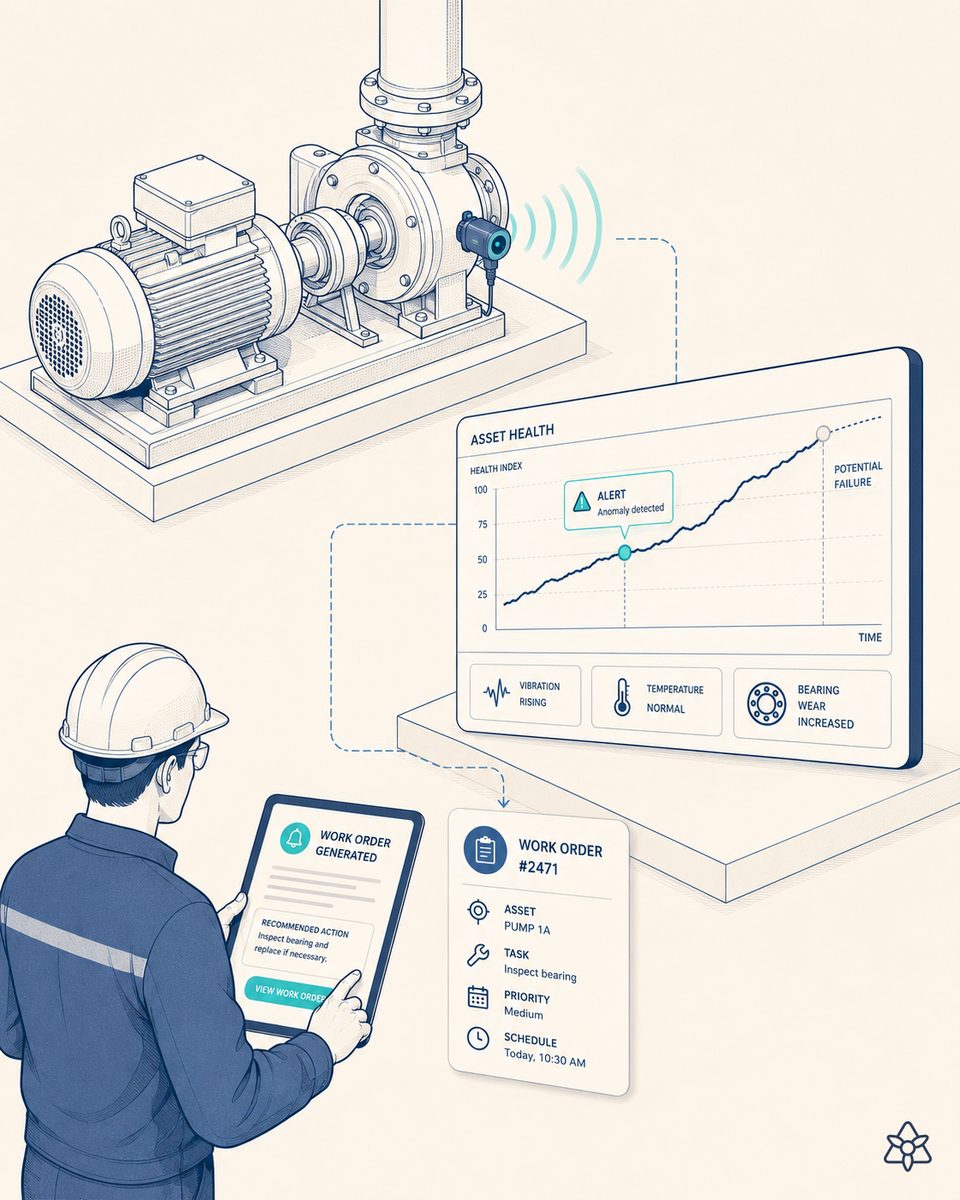
The screw does not warn you in words — it warns you in current, and nobody reads it in time.
A screw jam on a PE/PP extruder is one of those stoppages you can see coming, but only if you look in the right place:
- The pellet arrives with moisture slightly out of spec, or with a supplier batch change that the ERP never passed down to the shop floor.
- Melt viscosity rises. The motor current starts rising with it, but the operator is watching die temperature and film thickness, not the ammeter.
- The drive holds — until it doesn't. It goes into overcurrent and trips. The line stops, the die has to be opened, the barrel purged, everything cleaned.
- The next start-up means kilos of scrap, and the blowing or winding line downstream runs out of material for hours.
The shift supervisor knows it. The operator knows it. What is missing is a layer that learns the normal current pattern per recipe and per screw speed, cross-checks it with pellet moisture and temperatures, and tells the operator "drop to 80 rpm or change the filter" before the stoppage. The veteran's intuition — the one who could hear the jam coming in the sound of the extruder — retires next year.
iLEAN Edge does not add one more sensor — it learns the normal current signature and watches the drift.
The extruder's problem is not a lack of sensors: the motor drive already has current, the barrel has thermocouples, the die has pressure. What is missing is a layer that learns the normal current pattern per recipe and per screw speed, detects the drift before the drive trips and cross-checks it with everything else. iLEAN is the filler that closes the gap left open by the extruder SCADA, the plant MES and the shift supervisor's memory.
Edge sees the current signature as nobody had seen it before. Connect captures pellet moisture and recipe. The agent cross-checks and proposes. The operator acts before the stoppage.
The three iLEAN pieces applied to PE/PP extruder motor current:
- Edge — a terminal in the drive cabinet reading current (Modbus from a modern drive, or a clamp ammeter if the drive is old and you would rather not touch OT). A CNN trained on the normal pattern per recipe (PE 100, blown PE-HD, PP copolymer) and per screw speed. It detects drift against the pattern, not a fixed threshold. It works without a network: it keeps analysing on cabinet power alone and raises an alert through a dry contact to the local panel.
- Connect — captures from the inside the batch recipe from the MES, the barrel zone temperatures from the SCADA, the pellet moisture if there is a hygrometer (or the manual value the operator types into the extruder screen), the jam history from the CMMS. And from the outside, the pellet supplier's delivery note with the batch supplied, the warehouse messages about lot changes.
- Agent — cross-checks the current drift against recipe, moisture and temperatures, and proposes a proportionate corrective action: reduce screw speed, change the inlet filter, stop and clean before the forced stoppage. The shift supervisor signs off. The line never stops on its own during a critical reel change, and the veteran's knowledge about what to do in each situation is captured as an agent rule.
A jam heard by ear vs. a jam anticipated with Edge
| Aspect | Classic operation | With iLEAN Edge motor current |
|---|---|---|
| Reading the normal pattern | In the veteran's head | Learned per recipe and speed, checked in real time |
| Drift detection | When the drive trips | Much earlier — in the subtle change of signature |
| Corrective action | Reaction to overcurrent, forced stoppage | Reduce speed / change filter / stop in time |
| Start-up scrap | Unavoidable, several kilos | Reduced — many jams are avoided altogether |
| Intervention on OT | n/a | Zero — external clamp ammeter if needed |
| The veteran's knowledge | Retires with him | Captured as an agent rule |
Impact estimate for your plant — to be validated with your numbers.
The block below is an estimate to be validated with the specific data of your plant. We set it out so the committee has an order of magnitude; we refine it during the diagnostic.
- PE/PP extrusion plant with 3-8 lines (blown film, pipe, profile), a mix of modern and previous-generation drives, regular screw jams on some recipes.
- Edge pilot on one critical line + integration with MES/SCADA. External clamp ammeter if the drive is old, without touching OT. First value expected within a few weeks: normal pattern learned and first jam anticipated.
- Indicative payback between 4 and 9 months, depending on the historical jam frequency and the kilos of scrap per start-up.
- Expected reduction in screw jams of ≥ 30% against baseline in the first half-year.
- Hard lever: every jam avoided is OEE hours recovered + scrap kilos avoided + no delay to the downstream line. Three or four jams avoided in the half-year usually pay for the pilot.
And the CAIO's reasonable doubt
«What if the AI fakes the current signature and stops the line for nothing?» — hallucination is a problem of free generation, not of anchored tasks. On tasks where the AI does nothing more than compare a current time series against a pattern learned per recipe, the best models brought the error below 1.5% [1]. And even so, the critical call is never made alone: iLEAN proposes the corrective action, the person signs off. On non-critical batches it can operate with self-approval to reduce speed; on critical reel changes, human validation is mandatory. The three rings exist precisely for this.
[1] OpenAI paper «Why Language Models Hallucinate», 2025 — on the reliability of AI in anchored tasks.
What people ask about motor current analysis on a PE/PP extruder
Why does a PE/PP extruder screw jam, and what does each stoppage cost?
A PE/PP extruder screw jams because of fines agglomeration, viscosity shifts caused by pellet moisture or a batch change, contaminants (metal or ink from recycled material) or thermal degradation in the hot zones. Every jam means stopping the line, purging the barrel with the die open, cleaning and retightening — between 2 and 6 hours of downtime, plus the kilos of scrap from the next start-up. On a blown film or corrugated pipe line that is thousands of euros per incident.
What exactly does iLEAN Edge see in the extruder motor current?
iLEAN Edge reads the motor current (phases, RMS intensity, harmonics) at high frequency from the drive or from an external clamp ammeter, without touching the control system. The trained CNN learns the normal current pattern for each recipe (PE 100, blown PE-HD, PP copolymer) and each screw speed. When a deviation appears with the typical signature of agglomeration or of rising viscosity, the system raises an alert to the operator before the drive goes into overcurrent.
How does iLEAN decide whether to stop the line or hold the recipe?
The agent cross-checks the current deviation against the batch recipe, the pellet moisture (if there is a sensor, or if Connect captures the hygrometer reading), the barrel zone temperatures and the production plan. Then it proposes: reduce screw speed (moderate, avoidable jam), change the inlet filter (agglomeration), stop and clean (severe jam). The shift supervisor signs off. The line never stops on its own during a critical reel change.
Does Edge current analysis work without touching the motor drive?
Yes. iLEAN Edge can read the motor current in three ways depending on the integration: from a modern drive over Modbus/Ethernet, from the PLC that already receives the value, or from an external clamp ammeter fitted in the cabinet without touching the control bus. Option three is the usual one when the drive is old or the customer prefers zero intervention on OT. It works without a network: Edge keeps analysing the current on cabinet power alone and raises an alert through a dry contact if connectivity drops.
What does an Edge pilot on a PE/PP extruder cost?
The order of magnitude of an Edge pilot on an extruder is comparable to any Edge pilot in a plant: an initial investment covering terminal + clamp ammeter + integration with MES/SCADA + annual licence. A reasonable payback is measured in a few months, because the hard lever is every jam avoided (downtime, start-up scrap, delay to the downstream line). We run the ROI with your plant's kilos and downtime hours within 48h.
More cases in ilean edge
- Coriolis flow in aseptic UHT filling — dosing is measured in grams per unit, not at end of shift.iLEAN Edge cross-checks Coriolis mass flow with the batch recipe to guarantee dosing in aseptic UHT…
- If the cryogenic pump fails, the cold chain breaks — and the shipping window goes down with it.iLEAN Edge reads cryogenic LNG pump vibration to predict bearing failure without breaking the cold…
- The CIP dosing pump is cavitating and nobody hears it — until the next batch comes out with detergent residue.iLEAN Edge reads the CIP dosing pump vibration in a cheese plant and anticipates cavitation before it…
- Hot stamping press — the die does not break on a cold blank, because someone looked at the hydraulic pressure in time.iLEAN Edge tracks hot stamping press hydraulic pressure and prevents die breakage from cold blanks. The…
- Iberian ham curing chamber humidity — the right rind, or a Reserva batch off target.iLEAN Edge tracks the Iberian ham curing chamber's humidity to keep the rind right and weight loss…
- Inline pH in acid neutralization reactors — the set-point is not chased from the control room, it is held in the reactor.iLEAN Edge reads inline pH in the acid neutralization reactor and prevents overshoot — zero excess…
Tell us about your case and within 48h we'll send you the estimated ROI of this AI project for your PE/PP extruders.
We work on your plant's real data, not on ours. Diagnostic with no commitment.
Request estimated ROI within 48h See iLEAN Edge