If the cryogenic pump fails, the cold chain breaks — and the shipping window goes down with it.
An LNG cryogenic pump does not warn you with a beep — it warns you with a vibration signature that climbs slowly over days. By the time the classic protection system hears it, you already have a plant stoppage. iLEAN Edge recognises the pattern before: bearing wear, clearance loss, two-phase flow, misalignment. The plant keeps regasifying, the person signs off the intervention.
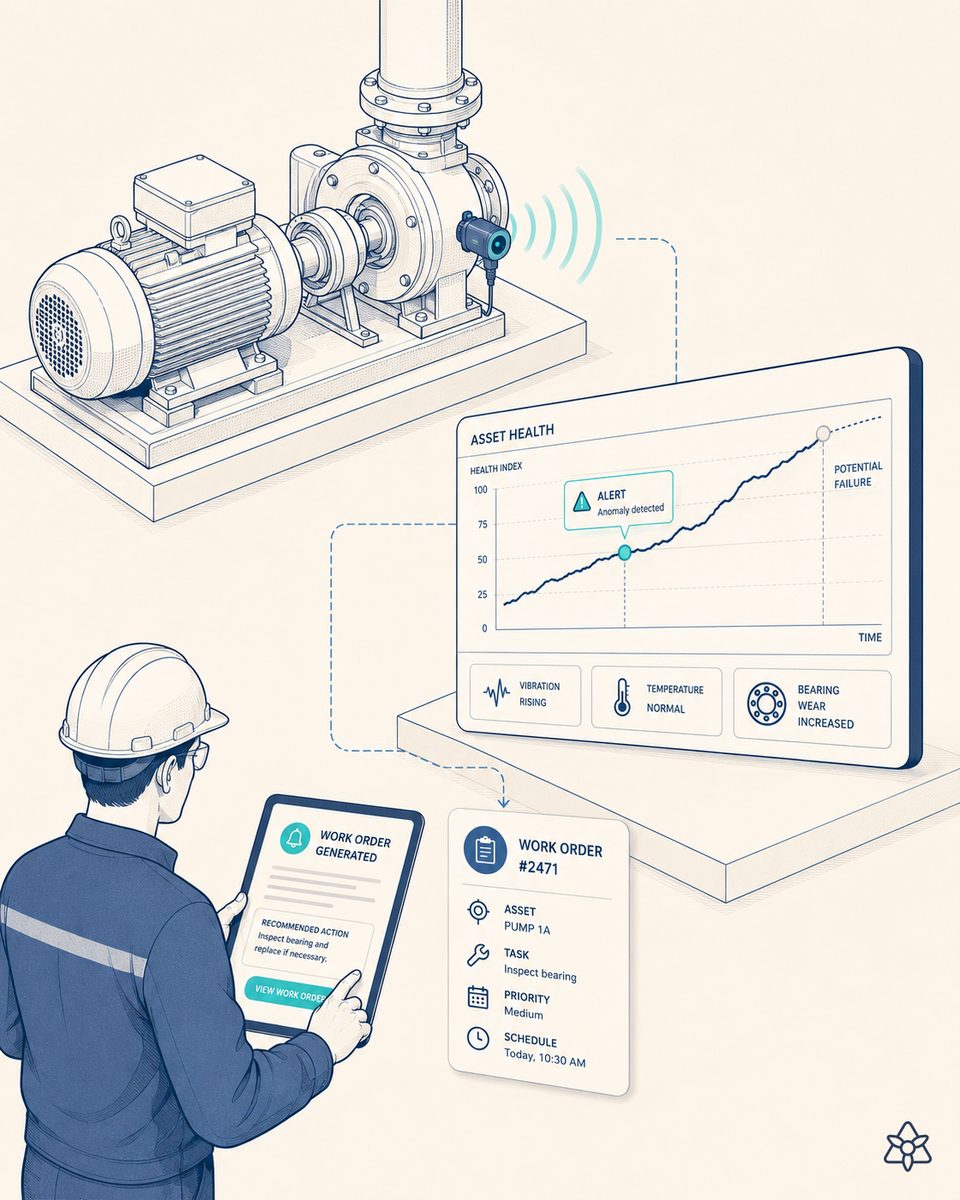
The bearing wears out slowly. The failure does not.
An LNG cryogenic pump — submerged or external — runs at −162 °C, lubricated by the fluid itself, with clearances in the order of hundredths of a millimetre. It is a brutally reliable component until it stops being one. And the path from "all OK" to "plant stoppage" is not abrupt: it is a vibration signature climbing over days or weeks, in bands the classic protection system does not look at until the overall threshold is crossed.
- Bearing wear — a harmonic of the rolling element pass frequency appears. Catch it at this point and you change the bearing at the next scheduled shutdown.
- Impeller clearance loss — the blade pass band rises. Catch it here and you plan the intervention without breaking the shipping window.
- Two-phase cavitation — gas enters the column; random broadband energy. Catch it here and you adjust NPSH before the impeller suffers.
- Terminal failure — protection trips, the pump stops, the regasifier loses flow, the shipping window collapses, and the cost is counted in hundreds of thousands.
The classic system — machine protection + maintenance rounds + a quarterly FFT analysis by an external expert — is designed for step 4. Steps 1, 2 and 3 happen silently between two rounds. The control room operator knows it; what they do not have is the permanent ear they need.
iLEAN Edge does not replace machine protection — it gives it the continuous ear between rounds.
The problem is not a missing transducer: in a serious LNG plant there are transducers on every pump. The problem is that the signal lives on an island — the protection rack, the FFT analysed every three months, the external expert's email that arrives late. iLEAN acts as the filler that closes that gap, without touching the SIL layer or the certified protection system.
Edge lives alongside machine protection and learns your pump's healthy signature. Connect crosses that signature with the demanded flow, the tank batch and the maintenance calendar. The agent prepares the file. The person decides and signs off.
The three iLEAN pieces applied to the LNG cryogenic pump:
- Edge — a terminal with a CNN trained to recognise the spectral signature of the four failure modes (bearing, clearance, two-phase flow, misalignment) over the signal from the proximity transducer or the external housing accelerometer. Local inference: if the plant loses the network, Edge keeps tracking how the anomalous pattern progresses and keeps raising alerts on the panel.
- Connect — captures the context: flow demanded by the regasifier, the tank batch being discharged, the pump's last maintenance noted on a maintenance manager's spreadsheet, the pump manufacturer's email with the technical note from the last incident in the fleet. All at second zero, without anyone forwarding anything.
- Agent — crosses the anomalous signature with the shipping window, the availability of redundant pumps and the estimated cost of diverting flow. It proposes the intervention that minimises stoppage risk: replacement at the next window, switch to pump B, NPSH adjustment. The person validates, signs off, and operations executes. And an evidence pack is left for the auditor.
Round-based maintenance vs. anticipation through a continuous signature
| Aspect | Classic cryogenic pump maintenance | With iLEAN Edge on the transducer |
|---|---|---|
| Vibration analysis | Quarterly FFT by external expert | Continuous signature recognition by local CNN |
| Bearing detection | When the overall threshold is crossed | At the first harmonic — days or weeks earlier |
| Response to an anomaly | Schedule a shutdown at the next window | Schedule the shutdown + divert flow with time to spare |
| Risk of unplanned stoppage | Accepted | Reduced — the signature warns before the trip |
| Operation without network | n/a | Edge keeps running as long as the cabinet has power |
| File for auditor / manufacturer | Rebuilt by hand | Per-event pack, automatic, with signature history |
Impact estimate for your plant — to be validated with your numbers.
The block below is an estimate to be validated with the specific data from your plant. We put it forward so the committee has an order of magnitude; we refine it during the diagnostic.
- Regasification or liquefaction plant with 3-6 cryogenic pumps at the head, 2-out-of-3 or 3-out-of-4 redundancy, shipping windows scheduled with the customer.
- Edge pilot on one critical pump (sensor + CNN trained on the healthy signature + alert to the control room). First value expected within a few weeks: baseline signature recorded, first useful alert of an anomalous pattern in a specific band.
- Expected reduction in unplanned stoppages per pump of ≥ 30% against the baseline of recent years.
- Indicative payback between 4 and 9 months, depending on the historical frequency of unplanned events and the average cost of a regasification stoppage over one window.
- The hard lever is a single unplanned stoppage avoided: shipping window saved, flow sustained, contractual clause not triggered. One alone pays for the pilot.
And the maintenance manager's reasonable doubt
"What if the CNN gets it wrong and tells us to stop a pump that was healthy?" — hallucination is a problem of free generation, not of anchored tasks. In tasks where the AI limits itself to recognising a signature over the sensor's real signal, the best models brought error below 1.5% [1]. And even so, what is critical is never decided alone: Edge proposes, the control room technician signs off, SIL protection stays where it has to be. The three safety rings are there for exactly this.
[1] OpenAI paper "Why Language Models Hallucinate", 2025 — on the reliability of AI in anchored tasks.
What people ask about LNG cryogenic pump vibration
Why is vibration so critical in an LNG cryogenic pump?
The cryogenic pump runs at −162 °C, with very tight clearances and bearings lubricated by the LNG itself. Any deviation in the vibration signature — bearing wear, clearance loss, impeller-to-diffuser contact, gas forming inside the column — brings the pump failure forward. And a failure is not just the cost of a part: it means breaking the cold chain, stopping regasification, losing the shipping window and, in the worst case, triggering a safety event over the basin or the tank.
How does Edge read the vibration of a pump submerged in LNG?
Edge connects to the proximity transducer or to the accelerometer mounted on the pump's external housing — there is no need to intervene on the cryogenic side. A CNN trained on your pump's healthy signature recognises progressive deviations (unbalance, misalignment, incipient bearing failure, two-phase cavitation) across the signal spectrum. Edge raises an alert on the control room panel with the inferred root cause and the estimated severity — not a generic "high vibration" code.
Does Edge replace a classic machine protection monitoring system?
No. Edge lives alongside your classic machine protection system. Protection stays where it has to be — in the certified functional safety system. iLEAN adds what that system does not do: early pattern recognition, cross-referencing with the operating recipe (flow demanded by the regasifier, tank batch being discharged, last maintenance), and an automatic evidence pack for audit. We do not touch the SIL layer; we fill the gap above it.
What happens if the plant loses connectivity during a critical event?
Edge keeps working. It is designed so that local inference does not depend on WiFi, on MPLS or on the cloud. As long as the terminal has power, the CNN keeps running over the signal and keeps tracking how the anomalous pattern progresses. When the connection returns, Edge uploads the records so the Central agents can cross the event with the other sources and prepare the file. Anything critical cannot depend on the network being up — that is an OT axiom, not an option.
How does Edge fit with the AI Act and OT security in an LNG plant?
It fits by design. Machine protection stays in the certified OT ring (ring 1). Edge capture and the inference CNN live in ring 3, where the AI has autonomy to detect and propose. Human validation — stopping the pump, diverting the flow — stays in the hands of the person, who signs off. It is the architecture the AI Act asks for in high-risk systems: powerful AI, human oversight on the critical decision, an auditable evidence pack.
More cases in ilean edge
- Edge ultrasound for compressed air leaks in automotive — the ones that bleed most, first.iLEAN Edge with ultrasound maps compressed air leaks across multi-plant automotive workshops and ranks…
- A seized conveyor bearing at 250 °C is not a spare part — it is eight hours of oven downtime.iLEAN Edge runs thermography on the conveyor bearings of the biscuit tunnel oven: it warns days before…
- Coriolis flow in aseptic UHT filling — dosing is measured in grams per unit, not at end of shift.iLEAN Edge cross-checks Coriolis mass flow with the batch recipe to guarantee dosing in aseptic UHT…
- The CIP dosing pump is cavitating and nobody hears it — until the next batch comes out with detergent residue.iLEAN Edge reads the CIP dosing pump vibration in a cheese plant and anticipates cavitation before it…
- PE/PP extruder motor current with AI — anticipate the jam without stopping the line.iLEAN Edge analyses the PE/PP extruder motor current and anticipates screw jamming without stopping the…
- Hot stamping press — the die does not break on a cold blank, because someone looked at the hydraulic pressure in time.iLEAN Edge tracks hot stamping press hydraulic pressure and prevents die breakage from cold blanks. The…
Tell us about your case and within 48h we'll send you the estimated ROI of this AI project for your LNG plant.
We work on your plant's real data, not on ours. Diagnostic with no commitment.
Request estimated ROI in 48h See iLEAN Edge