Iberian ham curing chamber humidity — the right rind, or a Reserva batch off target.
The humidity of the Iberian ham curing chamber decides whether the rind turns out the way the DO demands or the weight loss runs away. iLEAN Edge tracks humidity piece by piece, cross-references it with temperature, ventilation and entry weight, and anticipates the drift before it shows on the piece. The master ham curer signs the adjustment.
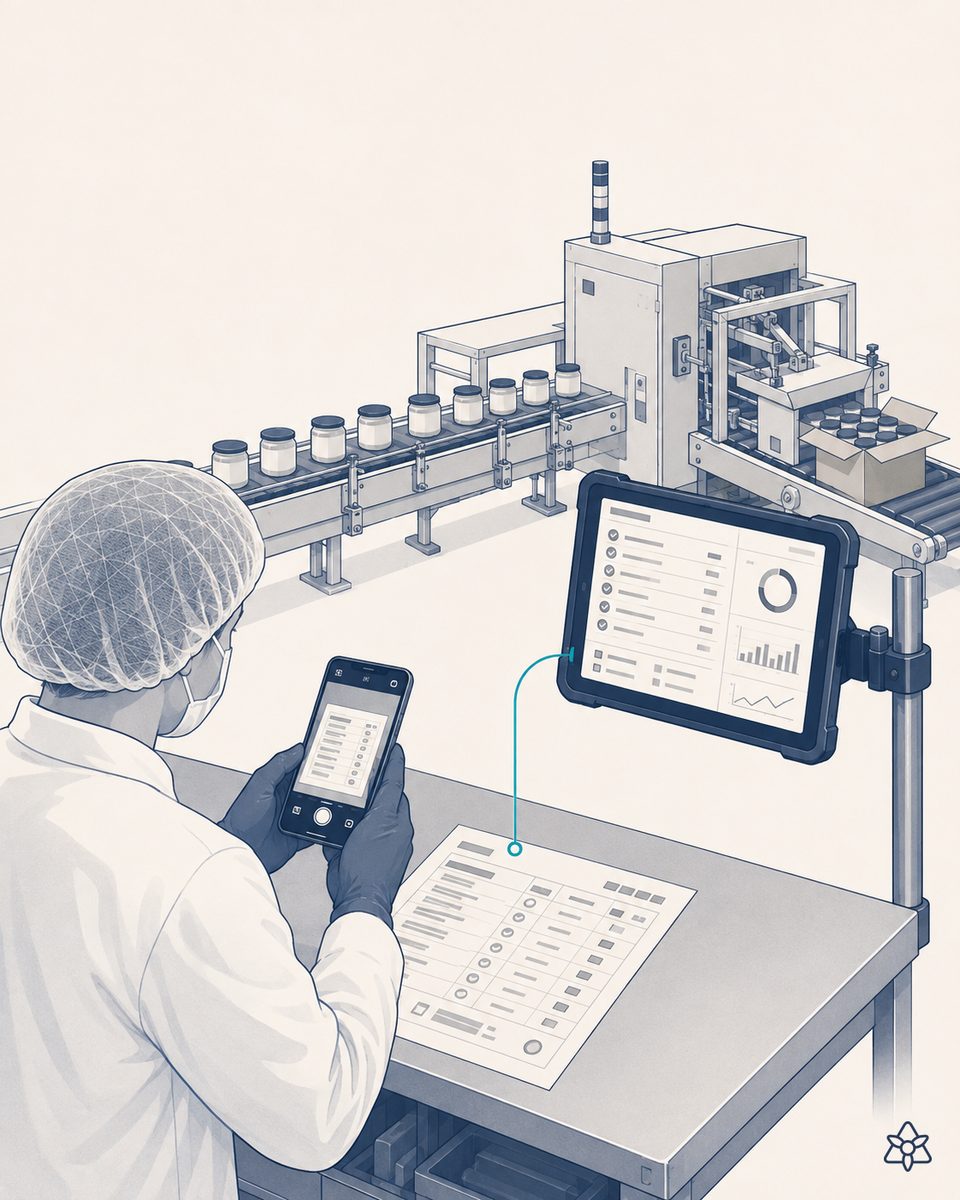
The chamber is not the batch: each piece has its own equilibrium humidity.
In an Iberian ham curing chamber, relative humidity is not a parameter of the air — it is the outcome of a balance between all the hanging pieces, the ventilation, the temperature and the curing phase. And that balance changes with every batch: entry weight, marbled fat, breed, feeding, season of slaughter. What is really happening only becomes visible much later, in the weight loss and in the rind at packing.
- What enters the chamber — the batch: piece-by-piece weight, bellota/cebo grading, salting batch. It usually lives in the MES, in the master's spreadsheet or on a drying-house sheet.
- What happens in the chamber — humidity, temperature, ventilation, natural warming. The hygrometers exist, but reading them every 3h and cross-referencing them with the batch is manual work.
- What leaves the chamber — the final weight loss, the rind, the Reserva-or-lower grading, the aw curve the DO requires. The cost of each deviation shows when it can no longer be corrected.
The master ham curer knows this. That is why they walk the chambers every day and adjust. But nobody can live inside a chamber, and the humidity drift of one early morning with three different batches hanging shows up once the rind has already closed. The classic system (fixed curve + daily visit + nose) works most of the time. The rest shows up in the final grading.
iLEAN does not decide the curing — it seals the cracks between the chamber, the batch and the craft.
The curing chamber's problem is not a lack of sensors: it is that the hygrometer's data, the batch's entry weight, the master's recipe and the DO's curve live in islands and nobody cross-references them in real time. iLEAN acts as the filler that seals those gaps, without asking you to change the chamber control or how the master works.
Edge sees the humidity every second, per cell. Connect reads the entry weight wherever it lives — MES, spreadsheet, the master's sheet. The agent cross-references against the expected curve for that piece profile and, if the drift points to a closing rind, proposes the adjustment. The master signs — never the other way round.
The three iLEAN pieces applied to the Iberian ham curing chamber:
- Edge — a terminal integrating the hygrometers and temperature probes distributed across the chamber. It reads each cell in seconds and triggers an alert when the humidity or the vertical gradient goes out of band. It works without a network. If the drying house loses WiFi, Edge keeps reading and recording with its own light.
- Connect — captures the batch's entry weight from the MES or from the master ham curer's sheet, the daily walk-through notes, and from outside the acorn supplier's slaughter report, the mountain weather forecast, the changes in the Regulatory Council's target curve. And it captures the master's knowledge — the mental rule applied when a Tuesday brings three medium-large acorn-fed batches — so it does not leave with them.
- Agent — cross-references humidity, temperature, ventilation, batch weight and target curve. If the drift points to a closing rind or weight loss off target, it proposes to the master an adjustment to the chamber's humidity or a move of the batch. The master decides. The hand stays where it belongs.
Curing with a fixed curve vs. piece-by-piece curing with iLEAN
| Aspect | Fixed curve + daily walk-through | With iLEAN Edge + Connect + Agent |
|---|---|---|
| Humidity reading | Manual log each shift, single point | Continuous, per cell, with vertical gradient |
| Adaptation to the batch | Same curve for small and large pieces | Curve adapted to the batch's entry weight |
| Reaction to drift | When the master notices it by touch | Alert before the rind closes |
| Capture of the craft | In the master's head | The master's rules collected and learned by the system |
| Traceability per batch | Chamber sheet + MES | Actual curve of each batch + photo/data per hanging piece |
| Operation without a network | n/a | Edge keeps reading and recording with its own light |
Impact estimate for your plant — to be validated with your numbers.
The block below is an estimate to be validated with the specific data of your chambers. We put it forward so the committee has an order of magnitude; we refine it during the diagnostic.
- Drying house with several Iberian ham curing chambers, batches heterogeneous in entry weight and bellota/cebo grading.
- Edge pilot on one chamber (distributed hygrometers + integration with the chamber control + reading of the MES and the master's sheet). First value expected within a few weeks.
- Reduction in grade downgrades (Reserva → lower) due to a closed rind or an off-target curve ≥ 30% on the recurring incident (the other failure modes remain a matter of the craft).
- Indicative payback between 4 and 9 months, depending on the frequency of grade downgrades and the price differential between Reserva and the lower grade.
- The hard lever: a single Reserva batch that does not drop a grade pays for a good part of the pilot.
And the CEO's reasonable doubt
“What if the AI proposes a bad humidity?” — hallucination is a problem of free generation, not of anchored tasks. In tasks where the AI merely cross-references a physical reading with the expected curve for a piece profile, the best models brought error below 1.5% [1]. And even so, what is critical is never decided alone: iLEAN proposes and the master ham curer signs. The three safety rings exist precisely for this.
[1] OpenAI paper “Why Language Models Hallucinate”, 2025 — on the reliability of AI in anchored tasks.
What people ask about humidity in Iberian ham curing chambers
Why does the curing chamber's humidity drive weight loss and the rind?
Because curing Iberian ham is essentially a balance between the piece's water loss and the humidity of the air around it. If humidity drops too far, the rind closes and traps water inside — it looks right on the outside and turns out wrong on the inside. If it rises, weight loss falls short, maturation gets out of control and the ham loses the aw curve the DO requires. Humidity is not a chamber parameter: it is the fine adjustment of each batch.
Why isn't a fixed humidity curve enough for DO Iberian ham?
Because the pieces are not equal: entry weight, marbled fat, breed, feeding, time of year at slaughter. A fixed humidity curve works for the average batch and mistreats the extremes — the small acorn-fed ham over-dries, the large one stays soft. And in a DO product, that is the difference between Reserva and a lower grade. The curve has to adapt to the piece, not the other way round.
How does iLEAN cross-reference humidity with temperature, weight and ventilation?
Edge integrates the hygrometers and temperature probes already in the chamber, captures every reading in seconds and cross-references it with the batch's entry weight, the ventilation plan and the target curve. Connect reads the weights from the MES or from the master ham curer's sheet. The agent compares against the expected curve for that piece profile and, if the drift points to rind or weight loss off target, proposes the adjustment to the master ham curer — who signs.
Does Edge replace the master ham curer?
No. Edge captures what the master ham curer knows and has never had a chance to write down anywhere — the mental rule of how they react to a humidity deviation on a Tuesday with three batches of medium acorn-fed pieces. That becomes permanent knowledge of the plant. The decision about the chamber is still the master's; the system puts the data, the curve and the proposal in front of them. The hand stays where it belongs.
What does an Edge cost in an Iberian ham curing chamber?
An order of magnitude close to an Edge in a food plant: an initial investment covering the terminal + integration with hygrometers and the chamber control + connection to the MES, plus an annual license. The reasonable payback to present to the committee is several months — the hard lever is the weight loss avoided in Reserva batches and the reduction in grade downgrades. We ask for your chamber's data and send you the estimated ROI in 48h, with your numbers.
More cases in ilean edge
- The CIP dosing pump is cavitating and nobody hears it — until the next batch comes out with detergent residue.iLEAN Edge reads the CIP dosing pump vibration in a cheese plant and anticipates cavitation before it…
- PE/PP extruder motor current with AI — anticipate the jam without stopping the line.iLEAN Edge analyses the PE/PP extruder motor current and anticipates screw jamming without stopping the…
- Hot stamping press — the die does not break on a cold blank, because someone looked at the hydraulic pressure in time.iLEAN Edge tracks hot stamping press hydraulic pressure and prevents die breakage from cold blanks. The…
- Inline pH in acid neutralization reactors — the set-point is not chased from the control room, it is held in the reactor.iLEAN Edge reads inline pH in the acid neutralization reactor and prevents overshoot — zero excess…
- KTL degrease bath conductivity — one out-of-band reading, one batch of paint lost in e-coat.iLEAN Edge tracks the KTL alkaline degrease bath conductivity online in automotive and warns before…
- Tanning bath pH — a uniform leather batch should not depend on which shift walks in.iLEAN Edge measures tanning bath pH in the tannery drum and keeps the leather batch uniform across…
Tell us your case and in 48h we'll send you the estimated ROI of this AI project for your drying house.
We work on your chamber's real data, not ours. Diagnostic with no commitment.
Request estimated ROI in 48h See iLEAN Edge