KTL degrease bath conductivity — one out-of-band reading, one batch of paint lost in e-coat.
The conductivity of the KTL alkaline degrease bath decides whether pretreatment cleans the part or contaminates the e-coat. iLEAN Edge tracks it online, crosses it with dosing and the rinse ramp, and warns before the paint goes into the oven with the part. The person signs off the adjustment.
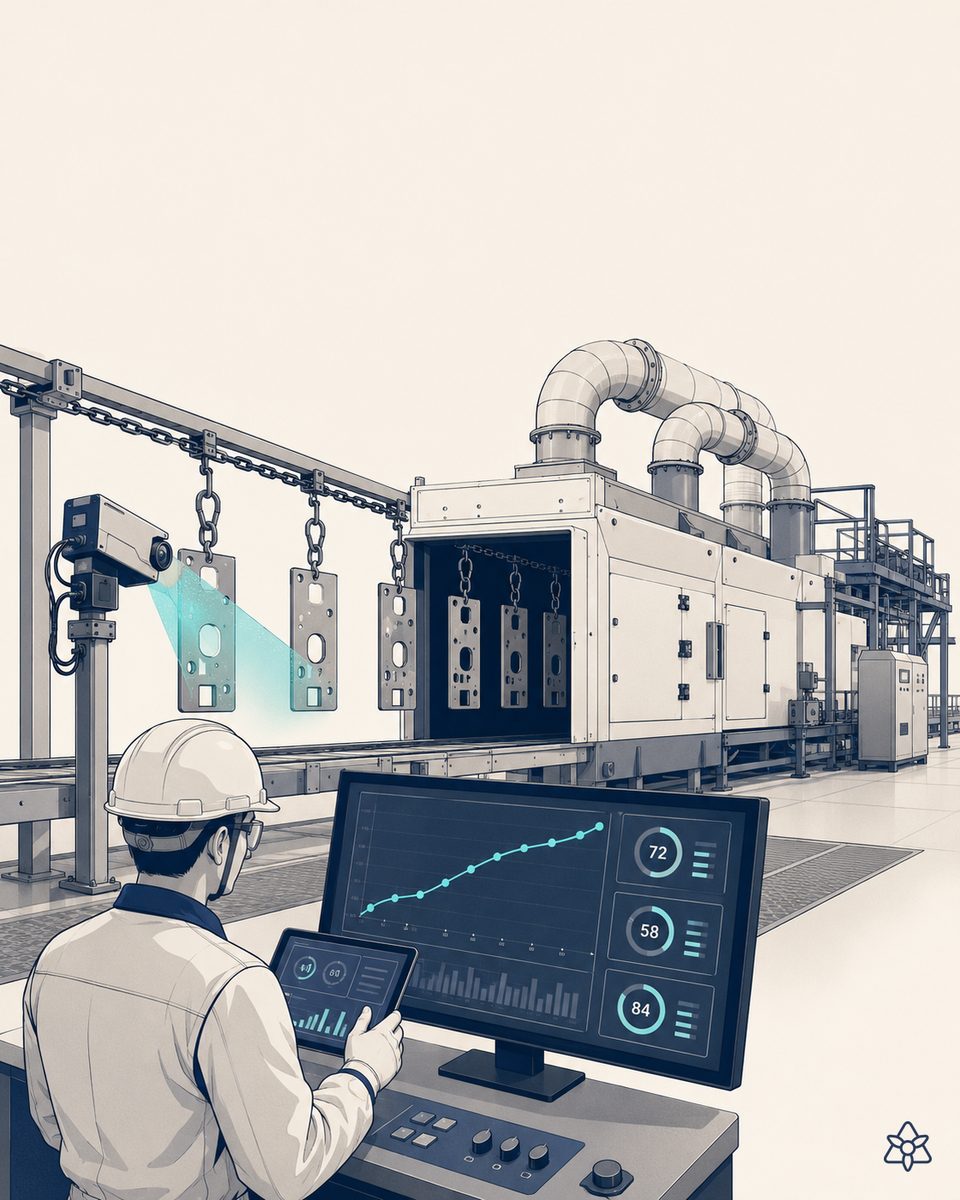
The bath that decides whether e-coat is scrap or quality.
In a KTL tunnel, alkaline degrease is the first barrier between a dirty part and an electrochemical process that only works on a clean surface. Bath conductivity is the chemical summary of that whole barrier: it rises when dragged-in salts and oils build up, it drops when dosing falls short. And in both cases the symptom is not visible in the bath: it is visible after the oven, on the painted part.
- What the bath carries — actual conductivity, alkaline dose, upstream and downstream rinses. It usually sits in the chemical supplier's control system or on an old isolated panel.
- What enters the bath — the previous rack, the accumulated load, where the parts come from (stamping, machining). Sometimes only on a shift report.
- What leaves the bath — the e-coat line and the final oven, which absorb the cost of everything above. And a cosmetic rejection is rework or scrap, not an incident note.
The paint shop manager knows this — but cannot be reading conductivity every 30 seconds. Manual measurement once per shift works most of the time. The exception is the one that sends a whole batch to rework. The critical part is slow drift, the kind you notice when it is already too late.
iLEAN does not replace your bath control — it seals the cracks between chemistry, line and planning.
The problem with the KTL degrease bath is not a lack of chemical control: it is that the bath data, the line data and the paint supplier data live on islands and reach the operator too late. iLEAN acts as the filler that closes those gaps, without asking you to change your dosing system or the tunnel panel.
Edge sees conductivity every second. Connect reads the dose wherever it lives — modern PLC, old panel, the chemical supplier's spreadsheet. The agent crosses it with the production order and, if something drifts, holds the rack before e-coat. The person signs off — never the other way round.
The three iLEAN pieces applied to KTL bath conductivity:
- Edge — terminal with vision + probe integration on the degrease tank itself. It reads conductivity in seconds, crosses it with the tunnel PLC reading and, if the drift exceeds the threshold, triggers a stack light or holds the rack before phosphating. It works with no network.
- Connect — captures the alkaline dose even when it lives on the chemical supplier's old isolated panel, or in a spreadsheet the process technician maintains. And it captures from outside: an email from the paint supplier with a formulation change, a message from the stamping supervisor about a drawing-oil change that soils more.
- Agent — crosses conductivity, dose, the bath's accumulated load and the rack's origin with the e-coat recipe. If the drift points to a coverage failure downstream, it proposes the dose or purge adjustment to the technician before the batch reaches the oven. The technician validates; nobody adjusts alone.
Manual bath readings vs. online tracking with iLEAN
| Aspect | Manual control + shift report | With iLEAN Edge + Connect + Agent |
|---|---|---|
| Bath reading | Manual log once per shift or by exception | Continuous, second by second, online |
| Reaction to drift | When the rejected batch comes back after the oven | Stack light and rack hold before phosphating |
| Dosing | Fixed dose from the chemical supplier's recipe | Adjustment suggested to the technician from real drift |
| Bath cleaning/purge | Scheduled by hours or by appearance | Scheduled by real accumulated load |
| Per-rack traceability | Whatever the MES holds + the shift notebook | Per-rack record with conductivity and dose curve |
| Operation with no network | n/a | Edge keeps reading and holding with the panel light |
Impact estimate for your plant — to be validated with your numbers.
The block below is an estimate to be validated with the actual data from your tunnel. We put it forward so the committee has an order of magnitude; we refine it during the diagnostic.
- Multi-stage KTL tunnel with alkaline degrease, phosphating and rinses, feeding an e-coat line with a final oven.
- Edge pilot on the degrease tank (conductivity probe + integration with the tunnel PLC + rack hold actuator). First value expected within a few weeks.
- Cosmetic e-coat rejection reduced by ≥ 30 % on the recurring bath incident (the other failure modes remain the operator's business).
- Indicative payback between 4 and 9 months, depending on how often coverage incidents occur and the average rework/scrap cost.
- The hard lever: a single avoided batch of badly deposited paint pays for a good part of the pilot.
And the IT manager's fair objection
"What if the AI gets it wrong and proposes a dose adjustment that ruins the bath?" — hallucination is a problem of free generation, not of anchored tasks. On tasks where the AI is limited to recontextualising a measured value (crossing conductivity with dose and load), the best models brought error below 1.5 % [1]. And even so, critical decisions are never taken alone: iLEAN proposes and the person signs off. The three safety rings exist precisely for this.
[1] OpenAI paper "Why Language Models Hallucinate", 2025 — on the reliability of AI in anchored tasks.
What people ask about KTL degrease bath conductivity
What happens when the KTL degrease bath conductivity drifts?
When it rises from dragged-in oils and salts, the part reaches phosphating dirty and the e-coat pays for it: craters, poor adhesion, coverage defects that only show up after the oven. When it drops, you underdose alkaline and the degrease does not clean. In both directions the symptom appears late and the cost is scrapped parts and scrapped paint.
Why is a poorly tracked degrease bath a time bomb in e-coat?
Because e-coat is an electrochemical process that assumes a clean surface. Dragged-in grease, salts or surfactants change how the KTL bath responds and break the uniform deposit. The defect leaves the oven, it can no longer be recovered, and per-rack traceability is the only way to know which batch was contaminated.
How does iLEAN Edge cross conductivity with dosing and cleaning?
Edge integrates the existing conductivity probe (or fits a new one if the probe does not communicate) and captures every reading in seconds. It crosses that with the alkaline dose from the PLC, the upstream spray flow and the cleaning schedule. Connect reads the bath control data even when it lives on an old isolated panel. The agent proposes the adjustment; the operator signs off.
Do you have to stop the KTL tunnel to install Edge?
No. Edge is installed in parallel, without touching the cycle. It reads from the PLC or from an added probe and triggers a stack light / supervisor alert without interfering with the line. It works with no network: if the tunnel loses WiFi, Edge keeps reading and holding batches with the panel light, because critical things cannot depend on connectivity.
How much does an Edge pilot cost on a KTL pretreatment tunnel?
The order of magnitude is close to an Edge on a paint line: an upfront investment covering terminal + integration with the bath control + probes if needed, plus an annual licence. A reasonable payback to present to the committee is several months — the hard lever is the avoided e-coat scrap. We ask for your tunnel data and send you the estimated ROI in 48h, with your numbers.
More cases in ilean edge
- Hot stamping press — the die does not break on a cold blank, because someone looked at the hydraulic pressure in time.iLEAN Edge tracks hot stamping press hydraulic pressure and prevents die breakage from cold blanks. The…
- Iberian ham curing chamber humidity — the right rind, or a Reserva batch off target.iLEAN Edge tracks the Iberian ham curing chamber's humidity to keep the rind right and weight loss…
- Inline pH in acid neutralization reactors — the set-point is not chased from the control room, it is held in the reactor.iLEAN Edge reads inline pH in the acid neutralization reactor and prevents overshoot — zero excess…
- Tanning bath pH — a uniform leather batch should not depend on which shift walks in.iLEAN Edge measures tanning bath pH in the tannery drum and keeps the leather batch uniform across…
- The transfer lobe pump jams halfway through the recipe — and the batch is left hanging on the stuffer.iLEAN Edge reads the vibration of the lobe pump transferring viscous meat batter in cured meat plants to…
- Magnetic flow meter in reagent dosing — discharge is adjusted in the reactor, not at the inspection.iLEAN Edge reads reagent magnetic flow in industrial wastewater plants and holds over-dosing before…
Tell us your case and within 48h we'll send you the estimated ROI of this AI project for your KTL tunnel.
We work on your plant's real data, not ours. Diagnostic with no commitment.
Request estimated ROI in 48h See iLEAN Edge